Your dream of an August peony wedding isn’t impossible, but it requires strategy, not just a bigger budget.
- The high cost is driven by a global supply chain gap in late summer, where available blooms are often poor-quality “dregs” from cold storage.
- Achieving the peony look hinges on choosing smart, high-petal-count alternatives or expertly managing the few expensive stems you do buy.
Recommendation: Focus on ‘visual value’ and floral mechanics. A few perfectly presented, durable blooms will always look more luxurious than a wilting, crowded centerpiece.
That image of a lush, romantic bouquet overflowing with soft, ruffled peonies is practically synonymous with the perfect wedding. For many brides, it’s a non-negotiable part of their vision. But when a wedding date falls in August or September, that dream collides with a harsh reality: jaw-dropping prices and warnings of wilting disasters. It’s a frustrating dilemma that leaves many feeling they must either abandon their floral vision or blow their budget entirely.
The common advice is often simplistic and unsatisfying. You’re told to “just choose another flower” or opt for artificial silks, which misses the point of your specific aesthetic desire. Others might suggest garden roses as a substitute, but rarely explain the nuanced differences in cost, petal count, and durability. The core of the problem isn’t just that peonies are “out of season”; it’s a complex interplay of global logistics, floral biology, and market economics that most people are never exposed to.
But what if the solution wasn’t about compromise, but about strategy? The key to achieving the peony look during the most challenging months isn’t about finding a cheap copy. It’s about understanding the professional playbook: the ‘why’ behind the cost, the science behind a bloom’s longevity, and the design principles that create a luxurious look with fewer, more impactful flowers. This guide demystifies the market, equipping you with the expert knowledge to navigate the challenges of an off-season wedding.
This article will break down the crucial factors you need to master. We will explore the supply chain that dictates price, compare high-value alternatives, reveal the secrets to conditioning and protecting delicate blooms, and redefine what it means to create a high-end floral aesthetic. Let’s delve into the strategic decisions that will make your floral dreams a reality, regardless of the calendar.
Summary: A Strategic Guide to Wedding Peonies Off-Season
- The May-June window: why importing peonies in December costs 3x more?
- Juliet Roses vs. Peonies: which offers the better petal count for the price?
- How to time the opening of tight peony buds for the exact ceremony hour?
- Do peonies smell too strong for a dinner table in a small room?
- Why peonies collapse faster than roses in 30°C heat and how to save them?
- Why choosing peonies in August is a recipe for a drooping disaster?
- Fewer expensive blooms vs. mass cheap greenery: which looks more luxe?
- How to Select Floral Arrangements That Won’t Wilt Before the Cake Cutting?
The May-June window: why importing peonies in December costs 3x more?
The dramatic price hike for peonies outside their natural spring season isn’t arbitrary; it’s a direct result of global supply chain economics. The primary peony season in the Northern Hemisphere, which supplies North America and Europe, is incredibly short, peaking from late April through June. During this window, supply is abundant and local, keeping costs relatively manageable. However, once July hits, the domestic season effectively ends.
To source peonies for a winter wedding, importers must turn to the Southern Hemisphere, primarily Chile and Argentina, where the seasons are reversed. This introduces massive logistical hurdles. The flowers endure long-haul flights, extensive cold chain management, and multiple layers of import duties and handling fees. These transportation overheads are the primary driver of the price increase. Market analysis confirms this trend, with costs soaring to $10-$15 per stem during the off-season compared to a peak-season average of around $7.
This global relay race of production isn’t seamless. There are critical supply gaps in early spring (March-April) as the Southern Hemisphere season ends before Europe’s begins, and again in late summer (July-September). An August or September wedding falls squarely in this latter gap. Any peonies available are likely the last, storage-fatigued “dregs” of the North American season, held in coolers for weeks, which severely compromises their quality and vase life. Understanding this calendar is crucial for setting realistic expectations about both cost and quality.
Juliet Roses vs. Peonies: which offers the better petal count for the price?
When the price or quality of off-season peonies becomes prohibitive, the conversation naturally turns to alternatives. The most frequently suggested substitute is the Garden Rose, and for good reason. However, a true expert analysis goes beyond simple substitution and looks at the aesthetic value proposition: what are you getting for your money in terms of visual impact?
The David Austin ‘Juliet’ rose is a prime contender. While it may not replicate the exact form of a peony, it delivers a similar romantic, multi-petaled look. The key difference lies in the petal count and cost stability. As floral expert Paul T. of Whole Blossoms notes, “Garden Roses have fewer petals (20-25) per stem, while Peonies have 40-50 per stem. Since Peonies are seasonal, and not as common as roses, they are far more expensive.” This higher petal count gives peonies their signature dense, lush appearance.
However, the crucial advantage of the Juliet Rose is its year-round availability and stable pricing. This allows for predictable budgeting, a luxury not afforded by the volatile peony market. The following table breaks down the trade-offs:
| Feature | Juliet Roses | Peonies |
|---|---|---|
| Cost per stem | $15 (year-round) | $7-20 (seasonal variance) |
| Petals per bloom | 20-25 petals | 40-50 petals |
| Visual volume | 3-4 inches diameter | 4-6 inches diameter |
| Availability | Year-round | Limited seasonal |
| Vase life | 7-10 days | 5-7 days |
While a peony offers more visual volume per stem, a Juliet rose provides reliability and a significantly longer vase life, making it a more robust choice for the pressures of a wedding day, especially in warmer months. The decision comes down to whether you prioritize the exact peony form or the guarantee of a beautiful, durable, and budget-friendly alternative.
How to time the opening of tight peony buds for the exact ceremony hour?
If you’ve committed to using peonies, especially if you’re managing them yourself, your biggest challenge is “bloom engineering”—forcing the tight buds to open perfectly on cue for the ceremony. Arriving as tight, golf-ball-sized buds, they require a precise conditioning schedule to reach their full, glorious state. This isn’t guesswork; it’s a controlled process that starts days before the wedding.
The first critical step is assessing the bud stage upon arrival. Florists use the “marshmallow test”: gently squeeze a bud between your thumb and forefinger. If it feels rock-hard, it will need more time and warmer conditions to open. If it has the soft, yielding feel of a marshmallow, it’s at the perfect stage to begin conditioning. This initial assessment dictates your entire timeline. A bud that is too soft may blow open too quickly, while one that is too hard may never open at all.
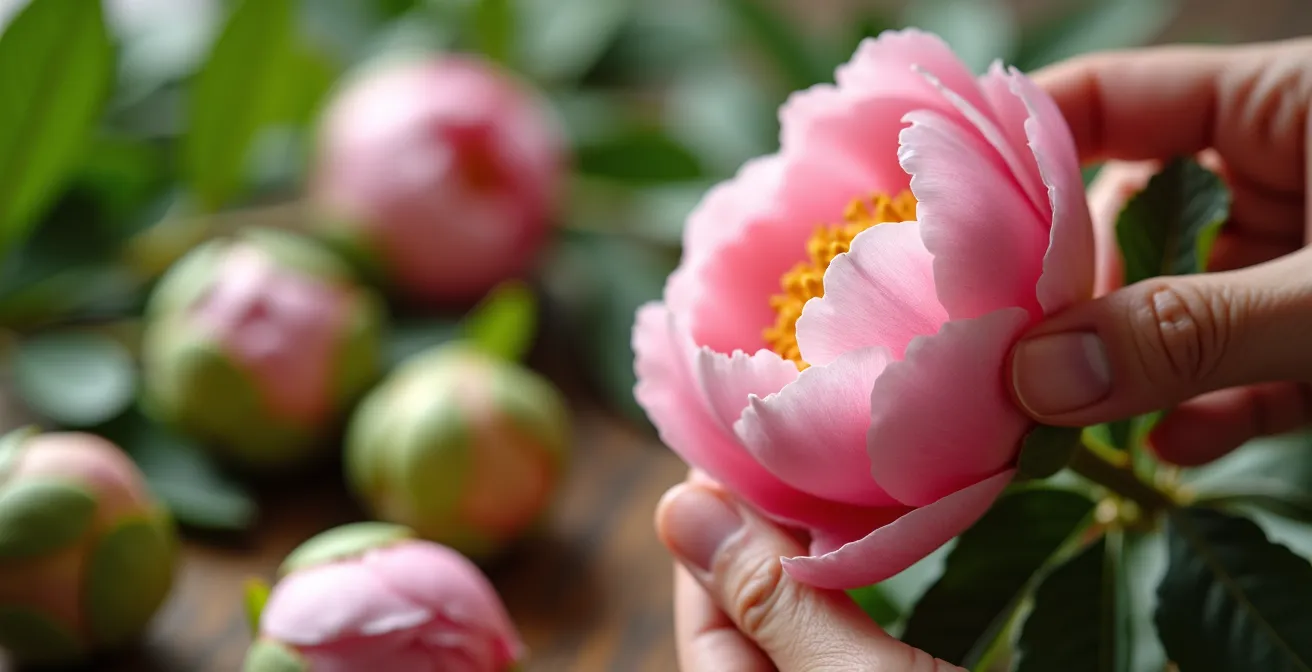
Once assessed, the conditioning begins. The process involves manipulating temperature and water to control the blooming speed. Warm water encourages faster opening, while refrigeration can act as a “pause button,” dramatically slowing the process down if the flowers are opening too quickly. This requires daily monitoring and adjustment to hit that perfect window of peak beauty for the ceremony itself.
Your 3-Day Peony Conditioning Plan
- Day -3 (Arrival): Assess bud stage using the “marshmallow test.” Remove lower foliage and give stems a fresh 45° cut. Place in a bucket with room-temperature water and flower food.
- Day -2 (Progress Check): Check opening progress. If they are opening too slowly, move them to a warmer room (but out of direct sun) and replace the water with slightly warmer water.
- Day -1 (Fine-Tuning): Buds should be showing significant color and starting to unfurl. If opening too fast, place the entire bucket in a refrigerator (away from fruit) for a few hours to slow them down.
- Wedding Morning (Final Prep): The peonies should be nearly or fully open. Re-cut the stems underwater to ensure maximum hydration before arranging them in your bouquet or centerpiece.
- Emergency Measures: For a stubborn bud on the wedding day, you can try placing it in warm water for 20-30 minutes. As a last resort, using a hairdryer on a cool, low setting from at least 12 inches away can sometimes encourage the outer petals to relax.
Do peonies smell too strong for a dinner table in a small room?
Beyond visual aesthetics and cost, a professional floral plan considers the full sensory experience, including fragrance. This is particularly important for centerpieces in an enclosed dining space, where floral scents can compete with the aromas of the food and even trigger sensitivities in guests. Not all peonies are created equal in this regard; their scent profiles vary dramatically by cultivar.
Some varieties, like the popular ‘Festiva Maxima’, are famous for their strong, spicy fragrance that can easily fill a room. While lovely in an entryway or a large, open-air ceremony space, this intensity can become overwhelming at an intimate dinner table. The scent can clash with the culinary experience and may be unpleasant for guests with allergies or fragrance sensitivities. In contrast, other cultivars such as the beloved ‘Sarah Bernhardt’ offer a much lighter, classic floral scent that is less likely to be intrusive.
As a general rule, white and blush double peonies tend to have stronger, more complex fragrances than the deeper pink or coral varieties. A strategic florist will practice sensory management, placing the most fragrant blooms in areas with high ventilation and opting for low-scent or unscented varieties for tabletop arrangements. This ensures the flowers enhance the ambiance without overpowering it. When discussing options with your florist, specifically asking about the fragrance intensity of the chosen cultivars is a mark of a well-considered plan.
Why peonies collapse faster than roses in 30°C heat and how to save them?
The single greatest enemy of a peony on a hot summer wedding day is dehydration. Their magnificent size is also their greatest vulnerability. A peony’s massive, multi-layered bloom has an enormous surface area, which leads to a rapid rate of water loss through transpiration. This is a simple matter of floral biology; studies show that peonies lose water 3x faster than roses at 30°C, causing them to wilt and “collapse” with alarming speed.
This makes them a high-risk choice for outdoor ceremonies or non-air-conditioned venues in August. A bouquet that looked perfect in the morning can look sad and droopy by the time you walk down the aisle. To combat this, florists employ specific heat-resistant mechanics and have emergency protocols on hand. For bouquets, this can involve wrapping the stems in wet paper towels hidden beneath the ribbon. For centerpieces, it means ensuring every single stem has a direct, individual water source.
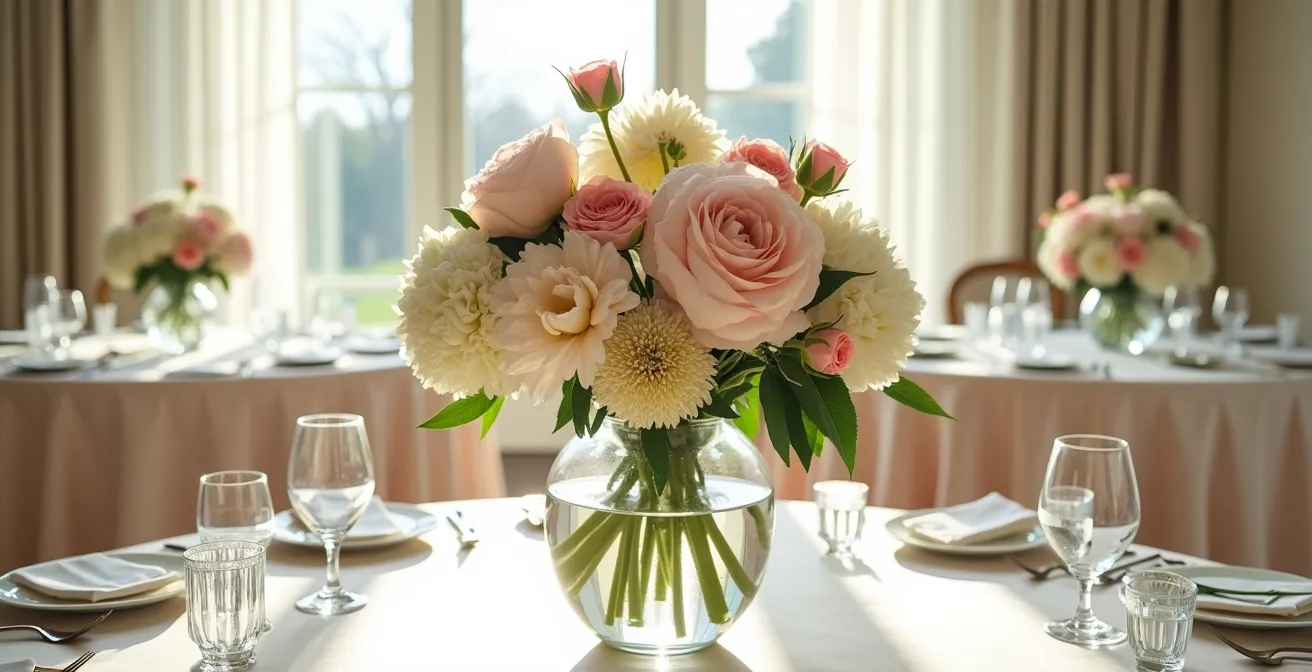
In arrangements, sturdier flowers like roses or carnations can be used to create a supportive structure around the more delicate peonies, helping them stay upright even as they soften. If a bloom does start to wilt, there is an emergency revival protocol. The first step is to re-cut the stem underwater to clear any air bubbles blocking water uptake. For a severely wilted bloom, the entire flower head can be submerged in a sink of cool water for 20-30 minutes to rehydrate the petals directly. A final spray with a professional anti-transpirant like Crowning Glory can help seal in moisture.
Why choosing peonies in August is a recipe for a drooping disaster?
We’ve established the supply chain challenges, but it’s vital for a bride planning an August wedding to understand the stark reality of the product quality itself during this specific month. Choosing peonies in August isn’t just a pricing issue; it’s a gamble on the flower’s fundamental viability. You are paying a premium for a biologically compromised product.
As one floral industry expert bluntly states, August is a “major transition period.” The robust Northern Hemisphere season is long over, and the Southern Hemisphere’s production has not yet ramped up to fill the void. The few peonies that are available are the absolute “dregs” of the previous season, having been held in cold storage for many weeks. This extended refrigeration depletes the flower’s energy reserves and weakens its cellular structure, a condition known as “cold storage fatigue.”
The consequences are severe and measurable. These flowers have a drastically reduced ability to absorb water and a much faster rate of decay. Industry data reveals that August peonies from cold storage have 60% shorter vase life and can cost up to $35 per stem. You are paying three to five times the peak-season price for a flower that is predisposed to fail. It might look acceptable upon delivery, but it lacks the resilience to withstand the stress and heat of a wedding day, making a drooping, wilting disaster highly probable. This is the unvarnished truth that every August bride needs to hear before committing to this high-risk floral choice.
Fewer expensive blooms vs. mass cheap greenery: which looks more luxe?
When faced with a tight floral budget, the intuitive response is often to maximize quantity—to get as many stems as possible for the money. However, in luxury floral design, the opposite is true. The secret to a high-end look is not volume, but curation and the strategic use of space. An arrangement packed with 20 stems of budget carnations will always look budget-conscious. An arrangement with three perfect, show-stopping peonies and premium greenery looks like a work of art.
This is the “negative space principle” in action. Expert florists use empty space to draw the eye and highlight the beauty of each individual expensive bloom. A crowded arrangement demotes a $20 peony to just another flower in a bunch; a spacious, airy design elevates it to a focal point. The key is distinguishing between cheap “filler greens” like leatherleaf fern, and “premium foliage” such as Silver Dollar Eucalyptus, Italian Ruscus, or Jasmine vine, which have their own architectural beauty and contribute to an expensive aesthetic.
Let’s consider a practical budget scenario. The table below illustrates how a $200 centerpiece budget can be allocated for wildly different results in perceived value.
| Approach | Components | Visual Impact | Professional Assessment |
|---|---|---|---|
| Quality over Quantity | 3-4 perfect peonies + premium eucalyptus | Elegant, spacious, artistic | Looks like $400+ arrangement |
| Quantity over Quality | 15-20 carnations + basic leatherleaf | Dense, crowded, generic | Looks budget-conscious |
| Hybrid Approach | 2 peonies + 5 spray roses + Italian ruscus | Balanced, lush, sophisticated | Best value perception |
For the August bride, the “Hybrid Approach” is often the most effective strategy. It allows you to have your coveted peonies, but in a smaller, manageable quantity, supplemented by other beautiful, more durable flowers and high-end greenery. This creates a lush, sophisticated look that feels expensive without relying solely on a mass of high-risk, high-cost blooms.
Key Takeaways
- Peony availability and price are dictated by a fragile global supply chain with a major quality gap in August/September.
- Success with off-season peonies depends on expert-level conditioning to manage bloom time and combat heat-related wilting.
- A “quality over quantity” design approach, using fewer premium blooms with high-end greenery, creates a more luxurious look than a mass of cheaper flowers.
How to Select Floral Arrangements That Won’t Wilt Before the Cake Cutting?
Ultimately, the longevity of your wedding flowers on the day comes down to two factors: the inherent durability of the flower species and the mechanical construction of the arrangement. No matter how beautiful a flower is, if it’s delicate and left without a water source, it will not survive a full day of photos, heat, and handling. As a bride, you need to think like a florist and prioritize mechanics.
Flowers can be ranked by their toughness. Tier 1 includes incredibly hardy blooms like orchids and carnations, which can survive for hours out of water. Tier 2 features reliable choices like roses, which hold up well with proper conditioning. Peonies, along with hydrangeas and dahlias, fall into Tier 3: the “handle with care” category. These flowers have a high water-demand and need a constant source of hydration to look their best.
This is where the mechanics become critical. A professional wedding florist’s quote from The Knot’s floral guide says it all: “It’s the mechanics, not just the flowers. Water-filled vases are best, high-quality floral foam second, and hand-tied bouquets need hidden water sources to last through the reception.” For your bouquet, this could mean tiny water vials attached to the stems of the most delicate flowers, hidden within the arrangement. For centerpieces, it means avoiding foam when possible and ensuring each stem reaches the water reservoir.
When finalizing your floral contract, ask specific questions about these mechanics. Will an anti-transpirant spray be used? What is the water source for the bouquets? It’s also wise to include a “Substitution Clause” that allows the florist to swap out any blooms that arrive in poor condition for a higher-quality, more durable alternative. This foresight is your best insurance policy against the disappointment of drooping flowers before the celebration is over.
Frequently Asked Questions About Wedding Peonies
Which peony varieties have the strongest scent?
Festiva Maxima and many white double peonies typically have the strongest, spiciest fragrance that can easily fill a room. If you are sensitive to smells or want to avoid overwhelming your dining area, it’s best to opt for lighter-scented pink or coral varieties.
Can strong floral scents trigger allergies at dinner tables?
Yes, absolutely. Concentrated floral fragrances in enclosed spaces like a dining room are a common trigger for allergies and sensitivities. For the comfort of all your guests, scent-conscious planning is essential, especially for tabletop arrangements.
What’s the best placement strategy for fragrant peonies?
The best strategy is to place highly fragrant peony varieties in open, well-ventilated areas where guests won’t be lingering for long periods. They are perfect for entryways, altar arrangements in a large church, or outdoor ceremony spaces. For dinner tables and near the wedding cake, always choose low-scent or unscented floral options.