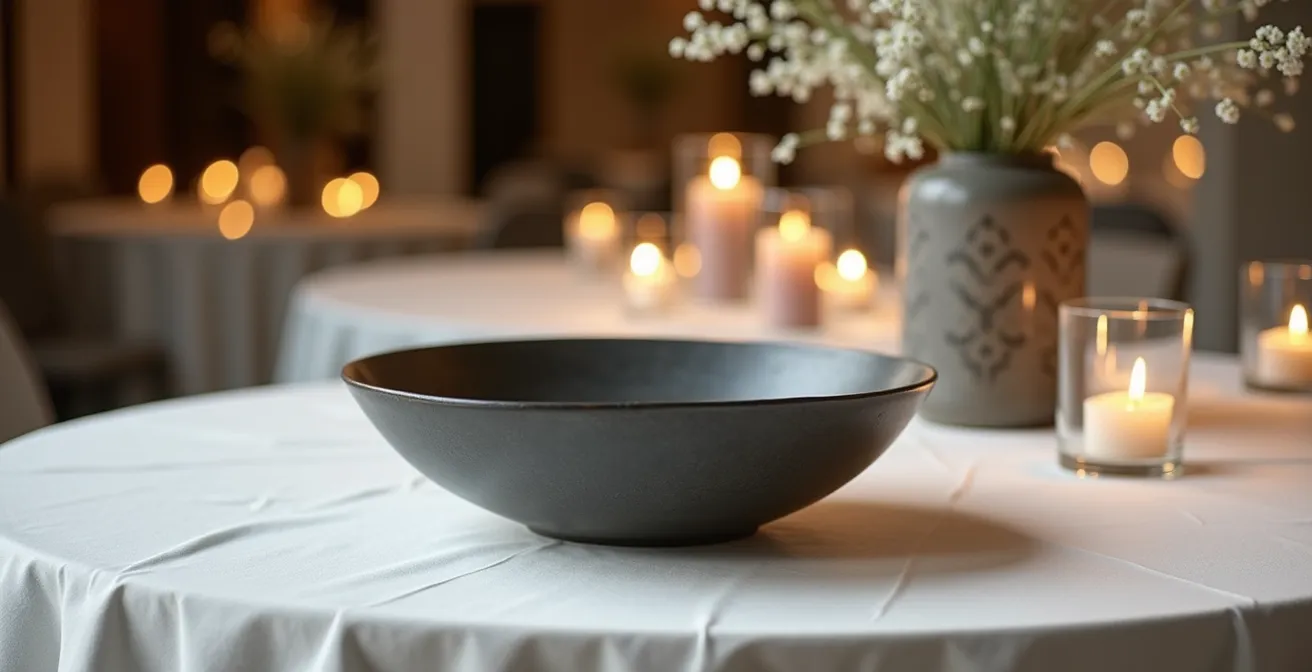
Many couples desire a minimalist wedding aesthetic but find their tables look sparse rather than sophisticated. The solution lies beyond simply using fewer flowers. True Ikebana is a rigorous artistic discipline where the unseen mechanics holding a single branch, the intentional use of empty space, and the clarity of the water are the true materials. This guide reveals the techniques to transform your tables from merely decorated into curated, living sculptures that create profound emotional impact.
You’ve pinned images of airy, elegant wedding tables. You’re drawn to a clean, modern aesthetic where every object has purpose. The conventional wisdom for achieving this look is to embrace minimalism, often interpreted as simply “using less.” Yet, this approach frequently leads to tables that feel not curated, but empty; not sophisticated, but unfinished. You see sparse arrangements that lack presence and tablescapes that miss the mark, failing to capture the intentional, artful atmosphere you envisioned for your celebration.
The common advice focuses on reducing elements—fewer flowers, simpler plates, no clutter. While well-intentioned, this advice misses the fundamental principle. The challenge isn’t about subtraction, but about elevation. It’s not about what you remove, but about how you give immense value to what remains. The overflow of traditional floristry is often a crutch, a way to create impact through volume. When you take that away, you need a new source of impact.
What if the secret wasn’t in minimalist styling, but in a centuries-old artistic discipline? The key to a truly sophisticated, minimalist table look lies in the principles of Ikebana, the Japanese art of flower arrangement. This is not about decoration; it’s a practice of sculpting with nature. It treats a single stem, the water it sits in, and the very air around it as equal components of a living sculpture. The perceived effortlessness of a branch cantilevered at an impossible angle is the result of hidden, rigorous technique.
This guide will not just show you the “look” of Ikebana; it will take you behind the curtain into the practitioner’s mindset. We will explore the unseen mechanics that create structural tension, the philosophy that makes empty space the most important element, and the practical logistics of bringing this ephemeral art to your wedding day. You will learn to see your tables not as surfaces to be covered, but as canvases for creating moments of focused, intentional beauty.
To fully grasp how to apply this art form to your wedding, this article is structured to build from the foundational mechanics to the overall atmospheric design. The following sections will guide you through each critical consideration, revealing the discipline behind the elegance.
Summary: The Art of Sculpting Space on Your Table with Ikebana
- Why you need heavy pin frogs to hold branches at impossible angles?
- Why the clarity of water matters more in Ikebana than traditional floristry?
- The 70/30 rule: why empty space is the most expensive part of the design?
- The logistical nightmare of moving wide, shallow bowls without spilling
- Odd numbers: how to cluster 3 small vases to replace one large centerpiece?
- The “less is more” rule: stripping back table settings for artistic impact
- The 3 decor items you should cut to improve the overall visual impact
- How to Style a Modern Art-Inspired Wedding That Feels Warm and Welcoming?
Why you need heavy pin frogs to hold branches at impossible angles?
The breathtaking magic of Ikebana often lies in its defiance of gravity. A single, dramatic branch reaching sideways, a delicate stem held in perfect isolation—these moments of structural tension are not accidents. They are feats of engineering made possible by a humble, hidden tool: the kenzan, or pin frog. Unlike floral foam, which merely holds stems upright, a heavy kenzan acts as a weighted anchor, creating a stable base that allows for the creation of dramatic, asymmetrical lines. The weight is not a secondary feature; it is the primary enabler of the art.
Choosing the right kenzan is a science. A lightweight frog will topple under the leverage of a long branch. The goal is to create a counterweight system within the vessel. A heavier kenzan provides the necessary ballast to hold branches at angles that would otherwise be impossible, allowing the artist to sculpt with lines and voids. This is the core of the unseen mechanics of Ikebana; the visible simplicity is directly enabled by the invisible, carefully calculated stability beneath the water’s surface. For added security, especially in shallow bowls, florists often apply museum wax or floral clay to the base of the kenzan to secure it firmly to the vessel.
Case Study: Bird Seed Florals’ Innovative Log Vase Ikebana
Pushing the boundaries of mechanics, Bird Seed Florals created innovative Ikebana arrangements using log vases as natural alternatives to traditional kenzans. In this approach, the log itself brings height and serves as a stable, organic base for the minimalist stems. This demonstrates how unconventional materials can replace traditional pin frogs, turning the mechanical anchor into a visible, sculptural part of the wedding centerpiece itself.
Your Action Plan: Selecting and Using the Right Kenzan
- Calculate the Ratio: Begin by assessing the weight of your heaviest floral element. As a rule, aim for a kenzan that weighs at least three times as much as your heaviest branch to ensure a stable foundation.
- Perform the ‘Table Bump Test’: Once your arrangement is complete, gently shake the table it rests on. This simulates the movement of service staff or guests and is a crucial test for stability. The arrangement should not wobble or shift.
- Secure the Base: Before placing it in a shallow bowl, apply a small amount of museum wax or floral clay to the bottom of the kenzan. This creates a stronger bond with the vessel.
- Position with Intent: Place the kenzan off-center in your vessel, often following the rule of thirds. Press down firmly for at least 10 seconds to create a secure seal with the wax or clay.
- Create Dynamic Tension: When inserting branches, do not place them all vertically. Use varying angles, such as 15°, 45°, and 75°, to create a sense of movement and dynamic balance, fully utilizing the stability of the heavy kenzan.
Why the clarity of water matters more in Ikebana than traditional floristry?
In most floral arrangements, water is purely functional—a life-support system hidden within an opaque vase. In Ikebana, especially when using wide, shallow vessels, water is transformed from a utility into a primary design element. It is not just a void to be filled but an active component of the composition. The surface of the water becomes a reflective plane, a water-as-a-lens that interacts with light, mirrors the lines of the stems, and adds a layer of depth and tranquility to the design. Therefore, its clarity is not a preference; it is a creative necessity.
Cloudy water, debris, or visible stems beneath the surface distract from the purity of the design. Pristine water creates a seamless transition between the vessel and the arrangement, reinforcing the sense of harmony. As Singapore’s Anelia Fleur specialists note, Ikebana principles emphasize the profound harmony between nature, space, and structure. The clarity of the water is a direct expression of this harmony. It represents purity and stillness, creating a meditative quality that invites the viewer to look closer. The way candlelight reflects on its undisturbed surface or how a single petal creates gentle ripples becomes part of the ephemeral artwork.
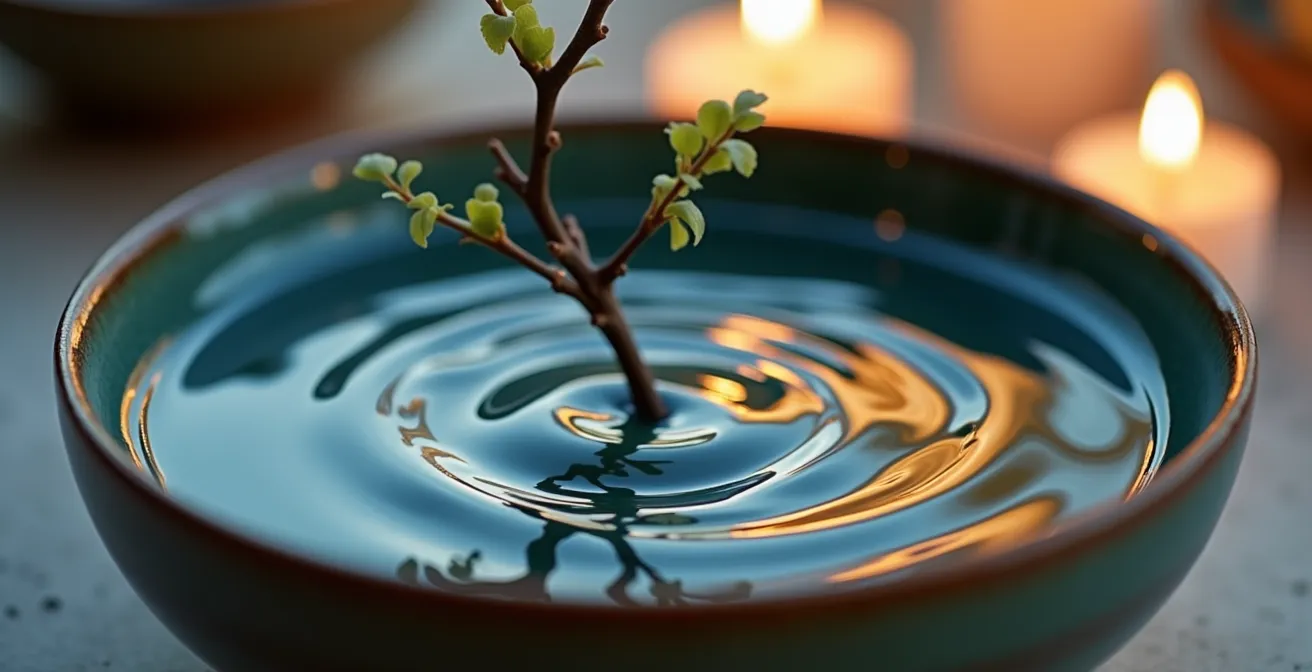
This image perfectly captures the role of water as a design element. The sharp reflection of the candlelight and the clean entry of the stem create a composition where the water is as important as the flower itself. This level of detail elevates the arrangement from a simple centerpiece to a multisensory experience, engaging the guest with the interplay of light, water, and form. It is a testament to the idea that in Ikebana, nothing is overlooked.
The 70/30 rule: why empty space is the most expensive part of the design?
In Western floral design, value is often equated with abundance—more blooms, more foliage, more impact. Ikebana completely inverts this logic. Here, the most valuable, impactful, and “expensive” component of the design is the empty space, or “Ma.” This is the intentional void. The 70/30 rule is a guiding principle: roughly 30% of the composition is the physical material (stems, vessel), while 70% is the negative space that defines and energizes it. This space isn’t a lack of something; it is a presence, an element that gives shape and meaning to the forms.
This approach has a tangible effect, as wedding designer Jessica Evans explains that Ikebana centerpieces can require up to 70% fewer blooms than dense, traditional arrangements. However, this reduction in materials does not equate to a reduction in cost or effort. The “expense” of the empty space comes from the artistic skill, time, and deliberation required to shape it perfectly. Anyone can fill a vase with flowers; it takes a trained eye to place three stems in a way that the space between them feels alive and full of energy. The void allows each element to be seen and appreciated in its entirety—its line, color, and texture.
Ikebana arrangements are all about simplicity with soul. Don’t expect overflowing centerpieces here; instead, imagine artful, architectural moments that leave room to breathe. Because sometimes, impact is created through thoughtfulness and negative space in contrast to opulence.
– Rocky Floral Designs, 2026 Top Trends in Wedding Flowers
This perspective shifts the conversation from “how many flowers can we get?” to “what is the most powerful statement we can make?” The empty space draws the guest’s eye, encourages contemplation, and creates a sense of calm sophistication that a dense arrangement cannot achieve. It is a quiet confidence, a declaration that beauty lies in balance and restraint, not in excess.
The logistical nightmare of moving wide, shallow bowls without spilling
The serene beauty of a finished Ikebana arrangement on a wedding table belies the intense logistical planning required to get it there. Wide, shallow bowls filled with water are inherently unstable and prone to spilling, making them a caterer’s and florist’s nightmare. A single misstep can ruin a pristine linen and disrupt the entire tablescape. Transporting pre-made arrangements of this style is often impossible, especially for more dramatic, cascading designs. The execution of this “effortless” look depends entirely on a rigorous, on-site professional workflow.
Florists specializing in Ikebana have developed precise methods to mitigate these risks. The most common solution is to assemble the arrangements directly on or near the reception tables. Stems and kenzans are transported separately, often in sealed bags with minimal water to keep them hydrated. The empty, fragile bowls are carefully wrapped and brought to the venue. An assembly station is set up, and the florist inserts the pre-soaked kenzan with its arranged stems into the bowl *before* adding water. Water is the last element to be introduced, poured carefully from a pitcher to just cover the kenzan’s pins. For any last-minute moves, a product like press-and-seal film can be used to temporarily cover the bowl.
This table from a Hunker tutorial highlights how the artistic style directly correlates with logistical difficulty, something crucial to discuss with your florist.
| Ikebana Style | Transport Difficulty | Stability Rating | Best For |
|---|---|---|---|
| Upright Moribana | Low | 9/10 | Long-distance venues |
| Slanting Style | Medium | 7/10 | On-site assembly |
| Cascading Style | High | 5/10 | Stationary displays only |
This behind-the-scenes reality underscores why Ikebana is a specialized service. You are not just paying for flowers, but for the expertise, precision, and problem-solving required to execute a fragile, water-based art form in a dynamic event environment. Understanding these logistics is crucial for a realistic and collaborative conversation with your floral designer.
Odd numbers: how to cluster 3 small vases to replace one large centerpiece?
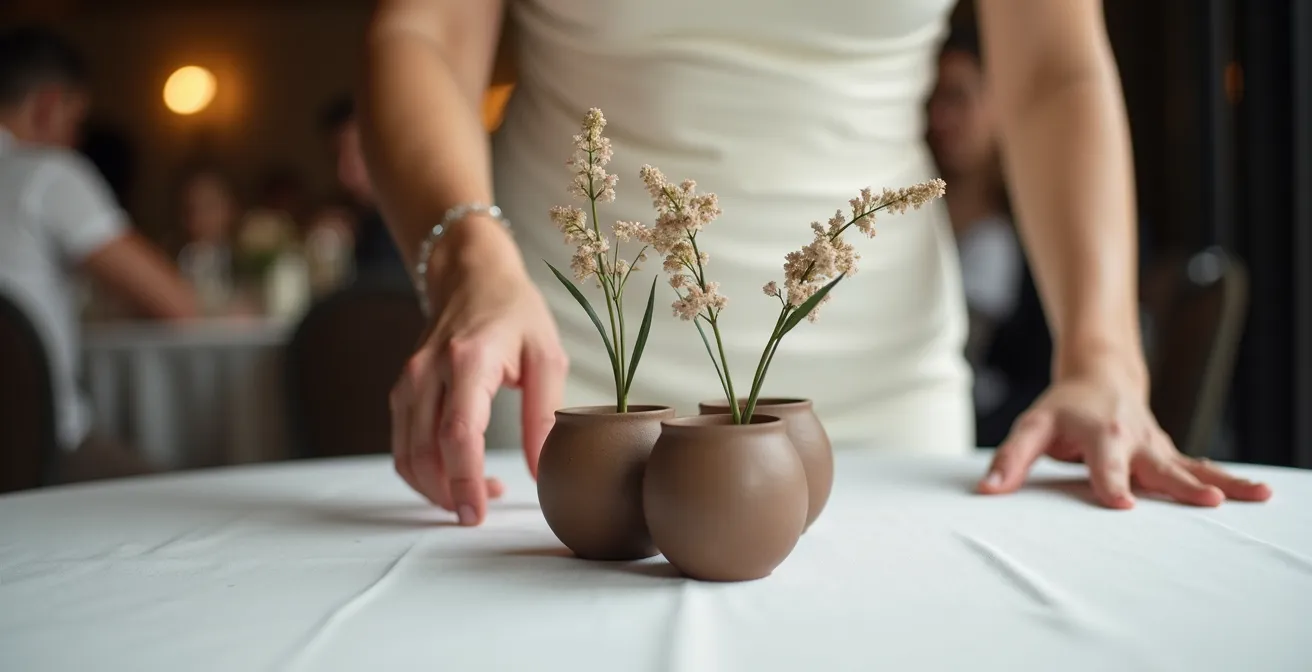
While a single, large Ikebana arrangement can be a stunning focal point, there is an equally powerful and often more dynamic approach: clustering. The principle of using odd numbers—typically three or five—is fundamental to Japanese aesthetics, as it creates a more natural, less rigid-feeling composition. Instead of one large centerpiece, consider a curated grouping of three small, individual bud vases or vessels. This approach allows you to create a “deconstructed” Ikebana arrangement that spans a larger area of the table with greater visual interest.
This technique allows for a play of height, texture, and form. Each of the three vessels can hold a single, significant element, embodying the core Ikebana tenets of Heaven (Shin), Man (Soe), and Earth (Hikae). One might be a tall, arching branch; another a full-faced bloom; and the third a low-lying piece of foliage. Arranged in a loose, asymmetrical triangle, they form a cohesive whole while allowing each element to retain its individual integrity. This creates a living sculpture that invites guests to engage with it from multiple angles, discovering new relationships between the elements as their perspective shifts.
Case Study: Maximizing Impact and Value with Clustered Arrangements
The value proposition of clustering can be surprising. As data from Designs by Hemingway shows, petite Ikebana centerpieces might cost $150 each, while a small standard arrangement is $200. By commissioning a cluster of three petite arrangements for a total of $450, a couple spends slightly more than for one large $400 centerpiece, but the result is a design with a much larger footprint and more dynamic visual interest. Furthermore, this approach offers a unique gifting opportunity: the individual arrangements can be given to special guests at the end of the night, extending the life and memory of the wedding’s beauty.
The “less is more” rule: stripping back table settings for artistic impact
An Ikebana arrangement cannot achieve its full artistic impact if it is placed in a cluttered environment. The “less is more” philosophy must extend beyond the vessel to the entire tablescape. Every item on the table—the plate, the flatware, the glassware, the napkin—becomes part of the overall composition. To allow the living sculpture of the centerpiece to breathe, you must ruthlessly edit its surroundings. This is not about creating a barren table, but about ensuring that every remaining object is beautiful, functional, and intentionally placed.
This means challenging the necessity of traditional table setting components. Does a decorative charger plate enhance the meal, or does it simply compete with a beautiful ceramic dinner plate? Does a complex napkin fold in a metal ring add value, or does a simple, elegant fold in high-quality linen feel more sophisticated? The goal is to remove visual noise so the eye is naturally drawn to the focal points: the artful arrangement, the quality of the materials, and the warm glow of candlelight. By stripping back the non-essentials, you amplify the importance of what is left.
To implement this, consider the following edits:
- Remove decorative charger plates. Let the quality of the dinnerware itself make a statement.
- Eliminate redundant flatware. Unless required by the menu, a setting of one fork, one knife, and one spoon is often sufficient and visually cleaner.
- Skip scattered table confetti or crystals. Instead, invest in a single, high-quality candle holder or a few votives with a sculptural quality.
- Consolidate menus. Rather than a printed menu at every setting, use a single, beautifully calligraphed menu card per table.
- Rethink salt and pepper shakers. One elegant, sculptural set per table is more impactful than individual shakers at each place.
Each removal is an act of curation. It creates negative space on the table itself, mirroring the intentional void within the Ikebana arrangement and creating a cohesive, art-gallery-like aesthetic that feels both modern and deeply considered.
The 3 decor items you should cut to improve the overall visual impact
Moving from philosophy to direct action, improving your tablescape is often a matter of strategic removal. Certain traditional decor items, while popular, actively detract from the sophisticated, minimalist aesthetic you are trying to achieve with Ikebana. By cutting them, you not only save on budget but, more importantly, you increase the visual impact of the elements that truly matter. These items create visual clutter and compete for attention with your carefully curated centerpieces.
The first and most common culprit is the symmetrical table runner. It rigidly bisects the table, forcing a predictable, centered arrangement. By removing it, you free the tablescape, allowing for more dynamic, asymmetrical placement of your Ikebana clusters. The second is scattered rose petals or table confetti. This practice adds a layer of visual noise that cheapens the look and distracts from the clean lines of the table setting and the purity of the arrangements. The final cut is multiple, individually printed place cards. These create a sea of small, distracting paper items.
This analysis shows how replacing these traditional items with minimalist alternatives not only saves money but creates a more dynamic and memorable visual experience.
| Traditional Item | Cost per Table | Minimalist Alternative | Cost Saved | Visual Impact |
|---|---|---|---|---|
| Symmetric Table Runner | $15-25 | Asymmetric Ikebana Placement | $20 | More Dynamic |
| Scattered Rose Petals | $10-15 | Clean Negative Space | $12 | More Sophisticated |
| Multiple Place Cards | $20-30 | Single Calligraphed Stone | $10 | More Memorable |
Replacing these with thoughtful alternatives—such as a single calligraphed stone or leaf as a place card, or simply letting the clean surface of the table provide the backdrop—strengthens the overall design. Each element is a decision. By making conscious choices to remove what is unnecessary, you create a powerful canvas for the art you are placing at its center.
Key Takeaways
- Ikebana’s impact comes from unseen mechanics, like heavy kenzans, that enable gravity-defying designs.
- Empty space (“Ma”) and water clarity are not background elements; they are active components of the composition.
- Executing this art form requires significant logistical planning, often involving on-site assembly.
How to Style a Modern Art-Inspired Wedding That Feels Warm and Welcoming?
A common fear associated with minimalism and modern art is that the resulting atmosphere will feel cold, sterile, or unwelcoming. This is a valid concern, but it stems from a misunderstanding of the aesthetic. A successful art-inspired wedding, particularly one using the principles of Ikebana, achieves warmth not through accumulation but through texture, light, and meaning. The goal is to create an environment that feels like a serene, intimate art gallery, not a stark, empty one.
The key is to balance the clean, sculptural lines of the Ikebana arrangements with elements that engage the senses and evoke a feeling of comfort. This is where material choice becomes paramount. Instead of polished, high-gloss surfaces, opt for natural, tactile textures. Think raw linen napkins, unglazed ceramic plates, and weathered wood tables. These materials have an inherent warmth and humanity that provides a beautiful counterpoint to the precise lines of the floral sculptures.
Lighting is your most powerful tool for creating warmth. A room lit solely by harsh overhead lights will always feel cold. Instead, layer your lighting. Use a combination of flickering candlelight at table level, complemented by soft, warm-toned spotlights aimed at the centerpieces or architectural features of the room. This creates pools of intimacy and highlights the art, drawing guests into the carefully crafted atmosphere. Finally, add layers of meaning. Small cards explaining the symbolism of the chosen flowers or a station where guests can participate in creating a simple welcome arrangement make the design interactive and personal. This multi-sensory approach ensures that your minimalist design feels not just welcoming, but deeply and memorably soulful.
Your Checklist: Creating Warmth in Minimalist Wedding Design
- Layer Warm-Toned Lighting: Combine abundant candlelight on tables with amber-gelled spotlights at varying heights to wash walls or highlight arrangements.
- Incorporate Natural Textures: Use materials that invite touch, such as raw linen napkins, unglazed ceramic vessels, and weathered wood tables or chargers.
- Add Meaningful Details: Include small, beautifully designed “flower language” cards at each table explaining the significance of the blooms used in the Ikebana.
- Create Interactive Moments: Consider a “guest participation” arrangement where attendees can add a single stem to a large vessel upon arrival, making them part of the art.
- Use a Monochromatic Warm Palette: Build your color scheme around terracotta, sand, ochre, and warm grays, using a single, brighter color as a deliberate accent within the Ikebana.
By embracing Ikebana not as a style but as a philosophy of intention, you can create a wedding day that is the ultimate expression of sophisticated, modern elegance. To begin this journey, the next step is to find a floral artist who understands this discipline and can translate your vision into a series of living sculptures for your tables.