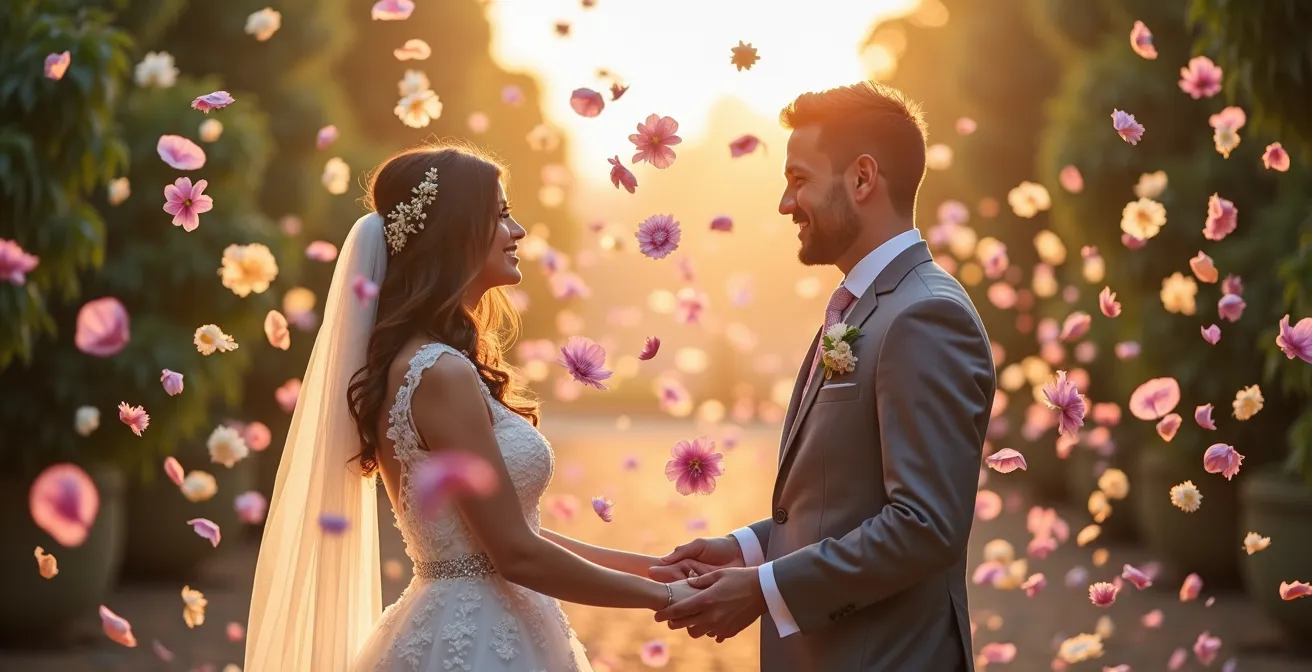
Achieving a stunning, photogenic petal toss without staining a wedding dress or incurring venue cleaning fees is entirely possible with logistical precision.
- Fresh, deeply colored petals (like red roses) contain water-soluble pigments that can permanently stain fabric under pressure.
- Venue “biodegradable” rules vary wildly; written approval for your specific petal choice is non-negotiable to avoid surprise fees.
- The quantity and type of petal directly impact the photographic “flutter effect,” requiring careful selection beyond just color.
Recommendation: Treat your petal toss and aisle design not as a decorative afterthought, but as a coordinated event. Test your petals, get venue policies in writing, and plan distribution like a military operation.
The vision is iconic: a joyful explosion of colorful petals as you walk back down the aisle, newly married. It’s a moment of pure celebration, creating the kind of photograph that defines a wedding album. But as a practical wedding coordinator, I see the hidden risks behind that beautiful image. The biggest fear? A vibrant red rose petal, crushed during a congratulatory hug, leaving a permanent pink stain on a pristine white wedding dress. The second? A hefty cleaning fee from a venue with strict policies on “natural” confetti that doesn’t disappear as promised.
Many couples simply choose their favorite flower and hope for the best, assuming “biodegradable” is a magic word that solves all problems. They focus on the aesthetics of petal cones or the romance of a swirled petal aisle. This approach often leads to disappointment, whether it’s a stained gown, a bill for two hours of sweeping, or an exit photo where the petals drop to the ground like stones instead of fluttering beautifully in the air. The truth is, a successful petal moment has very little to do with luck and everything to do with logistics.
This guide shifts the focus from simple aesthetics to practical execution. We will dissect the science of why certain petals stain and how to test them. We’ll provide the exact questions to ask your venue to get clear, written approval. We will move beyond just “how many petals” to understanding how different types create different photographic effects. This is your coordinator’s playbook for achieving that breathtaking, colorful petal exit, ensuring the only thing you take away are incredible memories and photos, not a dry-cleaning bill or a stained dress.
This article provides a complete logistical framework for planning every aspect of your wedding petals. From understanding the science of staining to choreographing the perfect exit photo, the following sections offer a step-by-step coordinator’s guide to a flawless petal experience.
Summary: The Coordinator’s Playbook for Flawless Wedding Petals
- Why red fresh rose petals are a disaster for a white wedding dress?
- Biodegradable rules: ensuring your venue doesn’t charge a cleaning fee
- How to lay a petal swirl that stays in place until the bride walks?
- How many liters of petals do you need for 100 guests to make a good photo?
- Cones vs. Baskets: the fastest way to get petals into hands before the exit
- Why a 5-foot aisle is too narrow for a dress with a train?
- The 30-second window: syncing lights and music to creating a “wow” entrance
- How to Design a Ceremony Area That Is Both Solemn and Photogenic?
Why red fresh rose petals are a disaster for a white wedding dress?
The danger of using fresh, deeply colored petals like red roses isn’t a myth; it’s a matter of chemistry. The vibrant color comes from water-soluble pigments called anthocyanins. When a fresh petal is crushed against fabric, especially under the pressure of a hug or by being sat on, the moisture from the petal acts as a solvent, transferring that pigment directly onto the fibers of the dress. For natural fabrics like silk or cotton, this can create a bond that is incredibly difficult, if not impossible, to remove, essentially acting as a natural dye.
The risk is not limited to red roses. Any intensely colored fresh flower, from deep purple lisianthus to vibrant pink peonies, poses a similar threat. This is why experienced coordinators often steer couples towards freeze-dried or properly air-dried petals. The preservation process removes the vast majority of the moisture, which is the key agent in color transfer. While no natural product is 100% risk-free, the potential for staining is dramatically reduced with preserved petals.
However, you should never take a supplier’s word for it. The only way to be certain is to perform a simple, non-negotiable test at home before committing to a bulk order. This is the same diligence a coordinator applies to every detail. Get a sample of your desired petals and press them firmly between two layers of a damp, white cotton cloth (like an old t-shirt). If any color transfers, you have your answer. It’s a five-minute test that can save you from a permanent, and heartbreaking, stain on the most important dress you’ll ever wear. Research from textile science shows that water-soluble anthocyanin pigments readily bond with natural fibers when pressure and moisture are present, confirming why fresh petals are so risky.
Ultimately, choosing petals that have been tested and proven to be colorfast is the foundational step in planning a worry-free celebration.
Biodegradable rules: ensuring your venue doesn’t charge a cleaning fee
The term “biodegradable” is one of the most misunderstood in wedding planning. For many venues, it’s a strict requirement, but their definition of what qualifies can vary significantly. A coordinator’s job is to eliminate ambiguity. Simply being “natural” is not enough. Some venues allow only small, light-colored, freeze-dried petals because they break down quickly and are less visible. Others may ban all fresh petals, not because of staining, but because they become a slippery, mushy mess that is difficult to sweep from lawns or cobblestones, leading to hefty cleaning fees.
Furthermore, some suppliers sell “colored” or dyed petals that are still marketed as biodegradable. While the petal itself may break down, the dye might not, potentially staining venue property like stone patios or light-colored carpets. This is a liability trap. The only way to protect yourself is to get specific approval in writing. Never accept a verbal “oh, natural petals are fine.” Send an email with a photo and description of your exact petal choice (e.g., “freeze-dried delphinium petals in ivory from Shropshire Petals”) and ask for written confirmation that they are approved and that their cleanup is included in your standard venue fee.
Case Study: The Shropshire Petals Biodegradable Standard
To understand the gold standard, look at suppliers like Shropshire Petals. This fourth-generation family farm grows and hand-picks flowers, drying them on-site. Their process ensures every petal is 100% biodegradable and eco-friendly, “as nature intended.” This level of quality and transparency is what you should be looking for, as it gives venues confidence and reduces your risk.
To navigate this conversation effectively, you need to ask the right questions. Don’t leave anything to interpretation. This checklist will help you secure the clarity you need to avoid any post-wedding financial surprises.
Your Action Plan: Venue Confetti Checklist
- Ask: Do you differentiate between fresh, freeze-dried, and air-dried petals? Which types are permitted?
- Clarify: Are there any restrictions on dyed or colored petals, even if they are biodegradable?
- Confirm: Is the cleanup of approved biodegradable material included in our standard venue fee, or is there an additional charge?
- Inquire: Are there designated ‘toss zones’ (e.g., only on the grass, not the patio) or restricted areas?
- Secure: Can we get final approval for our specific petal choice in writing via email to avoid any misunderstandings?
A proactive and documented conversation with your venue is the professional way to ensure your beautiful petal toss doesn’t end with an unexpected item on your final invoice.
How to lay a petal swirl that stays in place until the bride walks?
A beautiful petal swirl or a thick border along the aisle looks stunning—for about ten minutes. The two greatest enemies of an aisle design are wind (outdoors) and guest foot traffic (indoors and out). Creating a design that lasts until the processional begins requires a specific strategy and an understanding of petal physics. The key is a combination of timing, technique, and choosing the right material.
First, timing is everything. Petals should be the absolute last element of decor placed before guests are seated. Laying them too early is a recipe for disaster. Create a “ghost outline” of your design with chalk (on pavement) or string (on grass) earlier in the day. Your coordinator or a designated helper should then fill in this outline no more than 15-20 minutes before the ceremony starts. For indoor designs on a fabric aisle runner, a very fine mist of water sprayed on the runner just before laying the petals can help them adhere slightly, reducing displacement from air currents.
Second, the type of petal matters immensely. Light, airy petals like freeze-dried hydrangea are beautiful for tossing but are terrible for aisle designs as they fly away with the slightest breeze. You need petals with more weight. As a general rule, fresh petals have the most weight and wind resistance, but they carry the staining risk we’ve discussed. A safer and highly effective alternative is to use preserved rose petals or to mix lighter petals with heavier elements like dried lavender buds or tiny olive leaves. These heavier elements act as anchors, helping to keep the entire design in place.
This table from an analysis of petal properties illustrates the stability of different types.
| Petal Type | Weight Rating | Wind Resistance | Best Use |
|---|---|---|---|
| Fresh Rose Petals | Heavy | Excellent | Outdoor ceremonies |
| Freeze-dried Hydrangea | Very Light | Poor | Indoor only |
| Preserved Rose Petals | Medium-Heavy | Good | All venues |
| Delphinium Petals | Light | Fair | Protected areas |
| Mixed with Lavender | Medium | Good | Versatile option |
This strategic approach transforms a fragile decorative element into a resilient and reliable feature of your ceremony decor.
How many liters of petals do you need for 100 guests to make a good photo?
Calculating confetti quantity is a common source of stress for couples, who often either buy far too much or, more disappointingly, not enough. The goal isn’t just to give every guest some petals; it’s to create a dense, visible cloud of confetti in your photographs. From a coordinator’s perspective, this means we plan for the photo, not just for the guest count. The key variable is the “Flutter Factor”—the size, shape, and weight of the petal, which determines how long it stays airborne.
Small, heavy petals like those from bougainvillea or most roses will fall quickly, requiring a much larger volume (more liters) to make an impact in a photo. In contrast, large, light, and irregularly shaped petals like freeze-dried hydrangea or delphinium catch the air and float down slowly. This creates a longer-lasting, more magical “cloud” effect, meaning you need fewer liters per guest to achieve a great shot. Therefore, the question isn’t just “how many liters?” but “how many liters of *which* petal?”
As a baseline, a common recommendation from professional confetti suppliers is about 1 liter of petals for every 10-12 guests, assuming a good flutter factor. For 100 guests, this means you should start with a minimum of 8-10 liters of a high-flutter petal like delphinium or hydrangea. If you opt for heavier rose petals, you would need to increase that to 15-20 liters to get a similar visual effect. Many florists find a $40 bag of pre-prepared petals, often around 10 liters, is a sufficient starting point for a standard wedding toss.
This chart clarifies the relationship between petal type, quantity, and the all-important photo result.
| Petal Type | Flutter Rating (1-5) | Liters per 100 Guests | Photo Impact |
|---|---|---|---|
| Hydrangea | 5 | 8-10L | Excellent cloud effect |
| Delphinium | 4 | 10-12L | Good floating coverage |
| Rose | 2 | 15-20L | Fast falling, needs more |
| Bougainvillea | 3 | 12-15L | Moderate flutter |
Ultimately, investing in a smaller quantity of a high-flutter petal is often more effective and economical than buying a huge volume of heavy petals that will be on the ground before the photographer can even capture the moment.
Cones vs. Baskets: the fastest way to get petals into hands before the exit
The success of the confetti toss depends on one critical factor: getting the maximum amount of petals into the air at the exact same moment. This is a logistical challenge. If distribution is too slow or disorganized, half your guests will miss the cue, resulting in a sparse, underwhelming photo. The choice between cones, bags, or baskets isn’t just aesthetic; it’s a strategic decision about speed and efficiency.
From a coordinator’s viewpoint, the fastest and most foolproof method is active distribution. Assigning 2-3 designated people (ushers or bridesmaids) with large baskets to circulate among guests just *before* the exit is far more effective than a passive station. A “grab-and-go” cone display looks lovely, but it creates a bottleneck as guests slowly file past, and many may forget to take one. Pre-placing packets on chairs works for the ceremony but is less effective for a grand exit from the reception, as guests will have moved around.
The ultimate distribution strategy involves a “Confetti Captain”—one person from the wedding party responsible for coordinating the whole operation. Their job is to signal the distributors to start handing out petals, ensure most guests have a handful, and then give the final, clear signal for everyone to throw at once, ideally timed with a musical crescendo. This turns a potentially chaotic moment into a perfectly choreographed event. This level of coordination is what creates those truly epic confetti shots.
Creative Case Study: The Personalized Paper Plane Exit
Distribution can also be personalized. One wedding at Colshaw Hall featured a creative alternative: paper planes. This was deeply meaningful as the bride was a flight attendant. This shows how the method of “confetti” distribution can be woven into the couple’s personal story, making the moment even more special while still requiring a clear distribution plan.
By prioritizing speed and clear coordination over passive aesthetics, you guarantee that all your careful petal planning pays off in a single, spectacular moment.
Why a 5-foot aisle is too narrow for a dress with a train?
Aisle width is a detail often overlooked until the rehearsal, but it has a massive impact on both the bride’s comfort and the quality of the photography. A standard 5-foot (1.5-meter) aisle might seem adequate, but for a bride wearing a gown with any kind of volume or train, it can become a cramped and stressful path. The dress will constantly brush against the chairs and guests, potentially getting snagged or dirty before the ceremony even begins. Add a proud father or escort, and the space disappears entirely.
From a logistical standpoint, a narrow aisle also ruins the visual effect of both the dress and any petal decorations. The train won’t be able to fan out beautifully behind the bride, and any delicate petal swirls on the floor will be immediately disturbed and kicked aside. The solution is to calculate your required width with a simple formula: (Width of couple side-by-side) + (Full width of the dress train) + (Minimum 2-foot buffer zone). For most weddings, this means an aisle of at least 6-8 feet (1.8-2.4 meters) is a much safer and more photogenic minimum.
This extra space isn’t just for aesthetics; it’s crucial for the confetti toss itself. As wedding photographer Emma Hillier points out, a narrow path creates a logistical nightmare for the exit photo.
A narrow exit path forces guests into a tight line, meaning only the first few people can actually toss petals onto the couple
– Emma Hillier, Emma Hillier Photography Wedding Guide
A wider aisle allows guests to form a more spread-out “funnel,” ensuring that people all along the path can participate in the toss. This creates a much denser, more immersive cloud of petals from every angle, which is exactly what you need for that perfect, joy-filled photograph. The extra foot of space can make the difference between a sparse sprinkle and a celebratory blizzard.
Planning for ample space is a simple foresight that protects the dress, enhances the photos, and makes the entire processional and recessional feel more relaxed and grand.
The 30-second window: syncing lights and music to creating a “wow” entrance
The confetti toss itself is fleeting—a moment lasting no more than 30 seconds from start to finish. To elevate it from a simple activity to a true “wow” moment, it must be treated as a piece of performance art, with every element—music, lighting, and action—perfectly synchronized. This is the logistical choreography that separates an average exit from a spectacular one.
The process begins with your DJ or band. You must brief them on the plan. The toss shouldn’t happen in silence; it should be timed to coincide with a powerful musical crescendo. The music builds anticipation and provides an audible cue for the “Confetti Captain” to give the signal to throw. This ensures the peak of the song aligns with the peak of the visual action, creating a powerful emotional and sensory experience for everyone.
Simultaneously, the photography and videography team must be in on the plan. They need to be positioned correctly *before* you exit. As professional photographers often recommend, a location with a slightly darker background will make the confetti stand out more. More importantly, they may need to set up backlighting.
The Photographer’s Lighting Strategy
A key professional technique is to use backlighting for the confetti toss. By positioning a light source behind the couple, each individual petal is illuminated as it falls, making it glow and “pop” in the photos and video. This requires pre-planning the exit path and giving the photographer time to set up. A videographer might also switch to slow-motion settings just for this 30-second window to capture the floating petals in mesmerizing detail.
This level of coordination requires a brief but essential meeting between the coordinator, the Confetti Captain, the DJ, and the lead photographer about 10 minutes before the exit. This ensures everyone knows their role, their position, and their cue. It’s this behind-the-scenes teamwork that transforms a quick toss into a lasting, cinematic memory.
It’s the mastery of these final 30 seconds that validates all the careful planning that came before.
Key takeaways
- Always test petals for colorfastness on a damp white cloth before buying in bulk to prevent dress stains.
- Secure written, specific approval from your venue for your exact petal choice to avoid surprise cleaning fees.
- Choose petals based on their “Flutter Factor” (lightness and shape) for better photos, not just on color.
How to Design a Ceremony Area That Is Both Solemn and Photogenic?
Beyond the exit toss, petals can be used to design a ceremony space that feels both sacred and visually stunning. This is about using petals not just as scattered decoration, but as a deliberate architectural element to define the space. A thoughtful design enhances the solemnity of the vows while also being pre-planned for incredible photographs. It’s the final piece of an integrated petal strategy.
One powerful technique is to create a thick, unbroken circle of petals on the ground where the couple will stand to exchange their vows. This visually grounds them and delineates the sacred space. Using a single color, often white or ivory, creates a sense of purity and focus. This petal circle becomes a beautiful framing device in wide shots of the ceremony, drawing the eye directly to the couple. For a more dramatic effect, a gradient of colors can be used to line the aisle, transitioning from a darker shade at the entrance to the lightest shade at the altar, symbolizing the journey to that moment.
Petals can also be used to create vertical interest. By stringing individual petals on a thin fishing line, you can create cascading backdrops that move gently in the breeze. This is a fantastic way to add texture and color behind the altar, especially in a minimalist venue or outdoor setting. The quote about the origins of this tradition, as noted by the Polka Dot Wedding editorial team, reminds us of its deep-seated symbolism.
The tradition of throwing confetti began in Italy, where guests would throw grain, rice or flowers to bestow fertility and prosperity
– Polka Dot Wedding Editorial Team, Petal Confetti Paper Cones DIY Tutorial
Incorporating petals into the ceremony design itself transforms them from a momentary celebration into a meaningful part of the entire event. Whether lining the aisle, creating a sacred circle, or forming a delicate backdrop, a well-executed petal design ensures every photo, from the processional to the vows, is imbued with softness, color, and intention.
By applying the same logistical rigor to your decor as you do to your exit toss, you create a cohesive, beautiful, and—most importantly—stress-free wedding experience from start to finish. Now, the next step is to begin outlining your own petal-perfect plan.