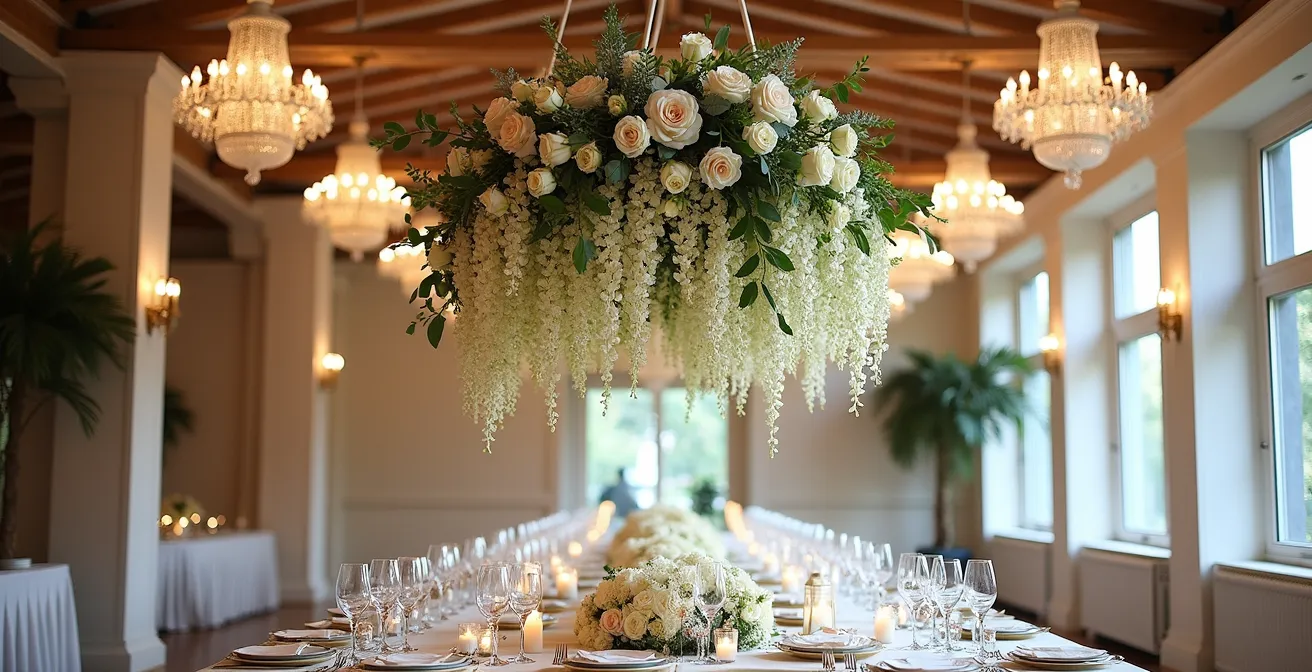
Safely hanging a floral cloud is an engineering project, not just a decorating task.
- Success depends on verifying the venue’s structural load capacity and using multiple, properly rated anchor points.
- Strategic use of high-quality artificial flowers significantly reduces weight and cost, while mitigating water drip and flammability risks.
Recommendation: Treat any large-scale installation as a technical construction. Always request structural documentation from your venue and work with a florist who understands weight distribution and professional rigging.
The vision is intoxicating: a lush cloud of flowers and greenery floating effortlessly above your guests, transforming a simple room into a breathtaking wonderland. It’s the centerpiece of countless wedding dreams, a statement of romance and opulence. But behind the ethereal beauty lies a stark reality of physics, liability, and logistics. Many couples are drawn to the magic but are rightly concerned about the practicalities: Will it be safe? Can our venue even support it? Why is the cost so high?
The common advice often stops at “check with your venue” or “use a professional,” which offers little real insight. The truth is, a suspended floral installation is less about arranging flowers and more about structural engineering. The difference between a dream-come-true and a potential disaster lies in understanding the forces at play: weight, gravity, tension, and the structural limits of the space. Ignoring these technical details is not an option when hundreds of pounds of material are hanging over the heads of your loved ones.
This guide will shift your perspective. We will move beyond simple decoration and delve into the technical craft required for these magnificent structures. This is not about discouraging your dream, but about empowering you with the knowledge to make it a reality—safely, smartly, and without unforeseen budget shocks. We will dissect the process from a technical florist’s point of view, focusing on the critical principles of weight distribution, structural integrity, and risk mitigation. By understanding the engineering, you can ask the right questions and ensure your suspended floral masterpiece is remembered for its beauty, not for a mishap.
In this detailed guide, we will break down the essential technical checks, safety protocols, and smart strategies you need to consider. The following sections will provide a clear roadmap for planning and executing a flawless hanging floral installation.
Summary: A Technical Guide to Installing Suspended Florals
- How to check if a venue ceiling can actually support a 50lb flower cloud?
- Why you need multiple attachment points for large installations?
- Gravity issues: preventing water from dripping on guests’ food
- Why using silk flowers high up saves weight and money?
- The hidden cost: renting a scissor lift and the timing required for setup
- How to hang floating candles or clouds safely in a standard tent?
- Flammability risks: treating dried palms with retardant for venue compliance
- How to Build a Large-Scale Floral Arch That Won’t Topple Over in the Wind?
How to check if a venue ceiling can actually support a 50lb flower cloud?
Before a single stem is ordered, the first and most critical step is a structural audit of your venue’s ceiling. This is not a casual glance upwards; it’s a technical verification process. A 50-pound floral cloud, once water is added, can easily exceed 70-80 pounds. This is a significant load that cosmetic structures are not designed to handle. Your florist or a hired rigger must differentiate between a structural beam (like steel I-beams or solid wood trusses) and a drop ceiling, which consists of lightweight tiles in a metal grid and has virtually zero load-bearing capacity.
The most reliable way to confirm capacity is to formally request the venue’s structural documentation. A professional venue, especially one accustomed to large events, should be able to provide rigging plots or a letter from a structural engineer specifying the maximum load per hanging point. If the venue manager is unsure or cannot provide this, it is a major red flag. In such cases, insisting on an assessment by a licensed structural engineer is a non-negotiable safety measure. This isn’t about being difficult; it’s about exercising due diligence to prevent catastrophic failure. You must also check the venue’s specific policies on suspended decor, as they may require special insurance riders or mandate the use of their in-house rigging team.
Action Plan: Professional Venue Assessment
- Request the venue’s structural documentation including weight capacity specifications and any existing rigging plots from the venue manager.
- Verify if the venue has existing anchor points, hooks, or suspended frames designed for installations.
- Inspect the ceiling material – differentiate between cosmetic drop ceilings and actual structural beams.
- Check venue policies regarding ceiling installations and insurance requirements for suspended decor.
- Determine if professional riggers or scissor lifts are required based on ceiling height and complexity.
Why you need multiple attachment points for large installations?
The principle of load distribution is the single most important safety concept in suspended design. Hanging a heavy installation from a single point concentrates all the force—the static weight of the arrangement plus any dynamic forces—onto one small area. This creates an immense amount of stress on the anchor point and the structure it’s attached to, dramatically increasing the risk of failure. A professional rigger or technical florist will never rely on a single anchor for any substantial overhead piece. Instead, they will distribute the load across multiple, strategically placed attachment points.
By using two, three, four, or more anchor points, the total weight of the installation is divided. For example, an 80-pound cloud supported by four points means each anchor is only bearing approximately 20 pounds of the load, assuming even distribution. This drastically reduces the stress on each individual point and on the ceiling structure itself, creating a much more stable and secure system. The hardware used is just as critical. Professional installations use weight-rated hardware, such as aircraft cable, shackles, and chain hoists, never decorative chains or unrated ropes. Each component in the system must have a working load limit that far exceeds the force it is expected to handle.
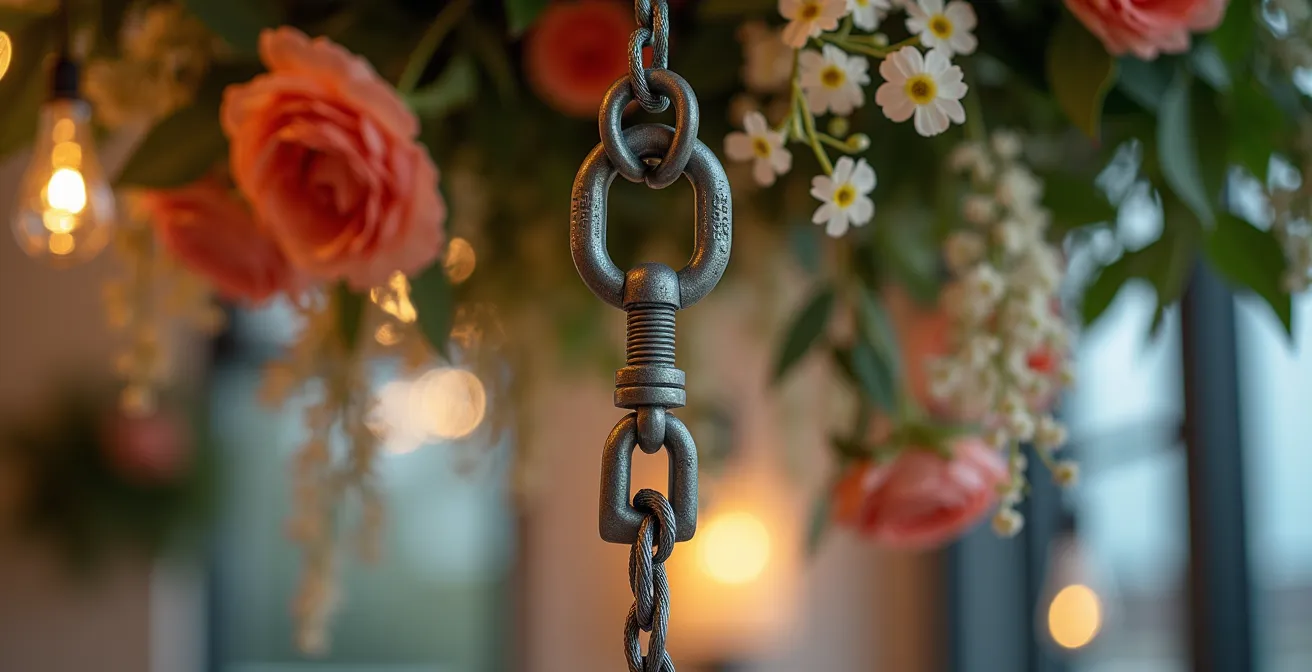
As this image of a professional rigging setup shows, the use of multiple cables converging on a central structure is standard practice. This redundancy is a key safety feature. If one anchor were to fail (an extremely unlikely event in a properly engineered system), the others would still be ableto support the load, preventing a complete collapse. This engineering-first approach is what separates a safe, professional installation from a dangerous amateur attempt.
Gravity issues: preventing water from dripping on guests’ food
Once an installation is safely in the air, the next challenge is managing hydration. Fresh flowers need water, but overhead water sources present a significant problem: the risk of dripping onto guests, their attire, or their meals. This is not only an annoyance but can also be a hygiene issue. The choice of water source is therefore a technical decision that balances flower longevity against weight and drip risk. The most common culprit for drips is traditional green floral foam. When saturated, it becomes incredibly heavy and is notorious for leaking, especially under the pressure of gravity in a hanging arrangement.
As expert florist Stone House Creative points out, the problems with foam go beyond just its weight and tendency to drip:
I try to use as little floral foam as possible in my work (it’s hazardous to the environment as it’s essentially a non-biodegradable single use plastic, and it’s bad for my health as it’s carcinogenic), and though I can’t always figure out a way to work without it, using foam isn’t best in hanging installations because it is very heavy and it often drips.
– Stone House Creative, Guide to Hanging Floral Installations
Smarter, lighter, and safer alternatives are essential for suspended work. Individual water vials or tubes can target specific delicate stems that need hydration, adding minimal weight and containing the water securely. An even better strategy is to design the installation with hardy flowers and foliage that can survive for hours without a direct water source. Stems like roses, carnations, eucalyptus, and many types of grasses are surprisingly resilient. A technical florist will often create the bulk of the structure with these hardy elements and strategically add water-vialed stems only where needed for visual impact.
This comparative table from a recent analysis of hydration methods clearly shows the trade-offs involved.
| Method | Weight Impact | Drip Risk | Best Use Case |
|---|---|---|---|
| Individual Water Vials | Light | Low | Small installations, selective fresh flowers |
| Floral Foam | Heavy | High | Not recommended for suspended work |
| No Water (Hardy Plants) | Lightest | None | Roses, carnations, woody stems |
| Water Tubes | Moderate | Low-Medium | Mixed fresh/artificial arrangements |
Why using silk flowers high up saves weight and money?
One of the most effective strategies for managing both the weight and the cost of large suspended installations is the judicious use of high-quality artificial flowers and foliage. For arrangements high above eye level, the subtle differences between real and top-tier silk flowers become virtually indistinguishable to guests. This allows for the creation of a grand, voluminous look without the two biggest associated problems: immense weight and prohibitive cost. The weight savings are particularly significant; a structure made primarily of artificials can be half the weight of its all-fresh counterpart. A recent analysis found a typical 50% weight reduction when using high-quality artificials in place of fresh, water-soaked stems.
This dramatic weight reduction has a cascading effect on the entire project. A lighter structure requires less robust—and therefore less expensive—rigging hardware. It places less stress on the venue’s ceiling, potentially opening up possibilities in venues with lower load limits. It also simplifies the installation process, requiring less manpower and time. As many professional designers will attest, artificials form the backbone of most large-scale hanging pieces. The base and bulk of the installation are created with lightweight, reusable artificial greenery and blooms. Then, for that touch of authentic scent and texture, fresh flowers can be strategically tucked into the arrangement just before the event begins. This hybrid approach offers the best of both worlds: the scale and safety of artificials with the premium feel of fresh florals.
Furthermore, the cost savings are twofold. Not only are high-quality artificials often less expensive per stem than their fresh equivalents (especially for out-of-season blooms), but they are also reusable. Your florist can amortize their cost over many events, which should translate into a more favorable rental price for you compared to the one-time cost of purchasing thousands of fresh stems.
The hidden cost: renting a scissor lift and the timing required for setup
The quote for your floral cloud often focuses on the flowers and the design labor, but one of the most significant “hidden costs” is access. If your installation is being hung from a ceiling higher than a standard 10-12 feet, a simple ladder will not be safe or sufficient. This is where specialized equipment like a scissor lift or mobile scaffolding becomes a necessity, and this introduces major logistical and financial considerations that must be planned for in advance.
First, there is the rental cost of the equipment itself, which can run several hundred dollars per day. This cost must be factored into the overall budget from the beginning. Second, the venue must be able to accommodate the equipment. Is there a loading bay or large doorway for the scissor lift to enter the building? Is the flooring strong enough to support its weight without causing damage? These are critical questions for the venue manager. Third, and most importantly, is the timing. A floral team can’t work on a complex overhead installation while caterers are setting tables and other vendors are working below. This means the installation must often happen “after hours”—either very early in the morning on the wedding day or sometimes the day before.
This need for exclusive access to the space can create scheduling conflicts and may incur additional fees from the venue for the extra time. A complex installation can take a team of several florists 4 to 8 hours or more to rig, build, and perfect. This entire window of time needs to be secured and coordinated with the venue and all other vendors. Overlooking the need for specialized access equipment and the extensive time required for its use is one of the most common reasons for last-minute budget shocks and stressful day-of scrambles.
How to hang floating candles or clouds safely in a standard tent?
Wedding tents present a unique structural challenge. Unlike a building with engineered steel beams, the frame of a tent is not typically designed to support significant, concentrated loads. Attempting to hang a heavy floral cloud directly from the tent’s support poles or fabric ceiling is extremely dangerous and almost universally prohibited by rental companies. So, how do you achieve that floating, ethereal look in a tent? The professional solution is to build an independent, ground-supported structure inside the tent.
This is most often accomplished using a system of aluminum or steel trussing. A “goal post” or a more complex box truss is erected inside the tent, standing on its own base plates. This truss system creates a new, structurally sound grid from which to hang florals, lighting, and other decor. The entire weight of the installation is transferred directly to the ground through the truss legs, placing zero stress on the tent’s frame. This is the same technology used in concerts and stage productions and is the gold standard for safe overhead rigging in temporary structures.
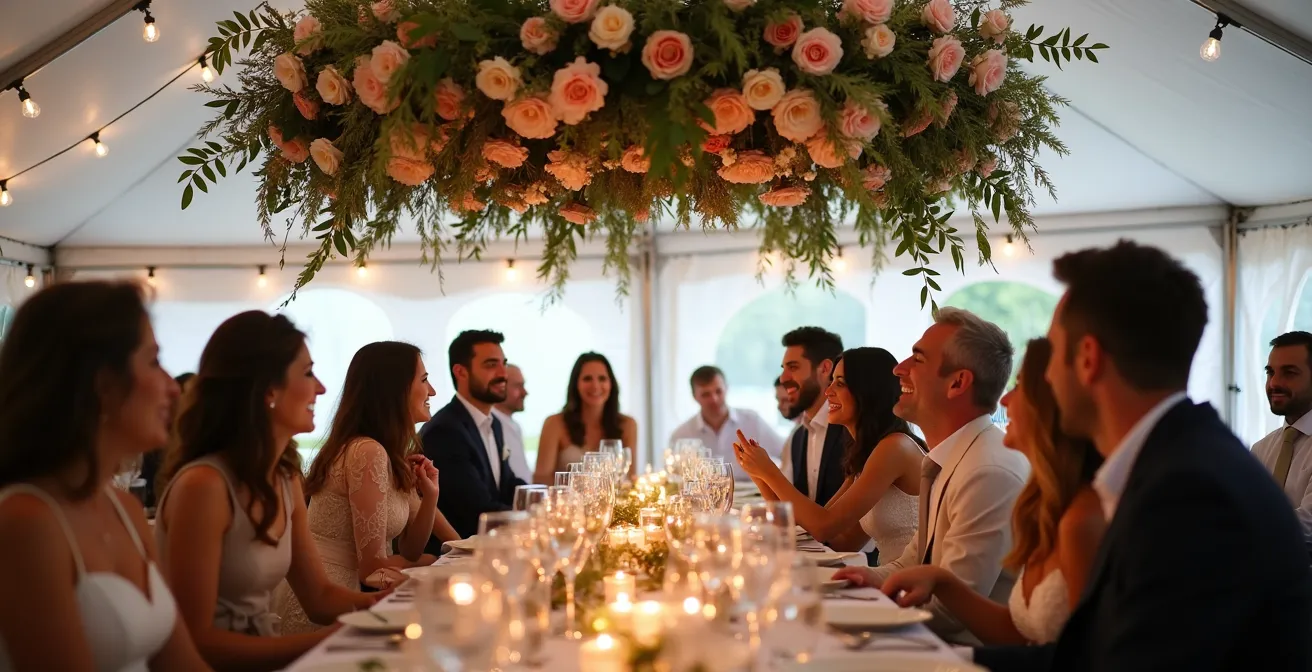
While the trussing itself can be artfully concealed with fabric or integrated into the design, its primary purpose is safety and structural integrity. For smaller, lighter elements like individual floating candles (using battery-operated LEDs, never real flame), a lighter-duty system of securely tensioned cables between the tent’s main uprights might be possible, but this must be approved by the tent rental company and installed by a professional. For any installation of significant weight, a ground-supported truss is the only responsible method.
Flammability risks: treating dried palms with retardant for venue compliance
In the age of boho-chic weddings, dried materials like pampas grass, dried palms, and other preserved botanicals are incredibly popular. While beautiful, they introduce a significant risk that fresh florals do not: flammability. Dried plant matter is highly combustible, and when used in large quantities, especially near lighting or candles (even enclosed ones), it can pose a serious fire hazard. Consequently, most public venues are bound by strict fire codes that regulate the use of decorative materials.
Many venues will require that all dried or fabric materials used in decor meet specific fire safety standards. In the United States, for example, a common requirement is compliance with the NFPA 701 standard for flame-resistant fabrics and materials. This means your florist can’t simply use any dried pampas grass they find. The materials must either be certified as flame-retardant from the supplier or be treated on-site with a specialized fire-retardant spray. This treatment is a non-negotiable step for venue compliance and, more importantly, for the safety of everyone at the event.
Your florist must be aware of these requirements and be prepared to provide documentation (a certificate of treatment or the product specifications for the retardant spray) to the venue’s fire marshal or manager. Ignoring this step can have severe consequences, from the venue forcing the removal of all your decor on the day of the wedding to being held liable in the event of a fire. When discussing designs that include large amounts of dried materials, always bring up fire safety and ensure your florist has a clear plan for treatment and compliance.
Key Takeaways
- Structural verification of the venue’s ceiling is the mandatory first step before any design work begins.
- Distributing weight across multiple, rated anchor points is the core principle of safe suspended installations.
- Strategic use of hardy or high-quality artificial flowers is the key to mitigating weight, cost, and water-drip issues.
How to Build a Large-Scale Floral Arch That Won’t Topple Over in the Wind?
The engineering principles that apply to suspended florals are just as relevant to large-scale, ground-based structures like ceremonial arches and chuppahs. While they aren’t at risk of falling from a ceiling, they face a different adversary: wind. An outdoor arch, especially one heavily decorated with flowers, acts like a giant sail. A strong gust of wind can exert tremendous force, and if the structure isn’t properly anchored and balanced, it can easily topple over, posing a serious risk to the wedding party and guests. The key to stability lies in a low center of gravity and a robust anchoring method.
The base of the arch is its foundation for stability. Simply relying on the arch’s own frame is never enough. The structure must be heavily weighted at its lowest points. This can be achieved with sandbags, custom-built ballast boxes filled with water or sand, or by securing the base to heavy-duty ground stakes driven deep into the earth. The choice of method depends on the ground surface (stakes are impossible on a stone patio) and the expected wind conditions.
Don’t forget to accurately balance the materials on all sides of your structure. For example, the more you can distribute weight on the ends of an arch, the more sturdy it will be.
– Details Flowers Blog, A Florists’ Guide to Large Flower Installations
This advice highlights the importance of symmetrical weight distribution. An asymmetrical floral design can shift the arch’s center of gravity, making it more prone to tipping in one direction. A technical florist will counteract this by adding hidden counterweights to the lighter side, ensuring the entire structure remains balanced and stable. The following table provides a clear comparison of common stabilization techniques.
| Method | Wind Resistance | Setup Complexity | Cost |
|---|---|---|---|
| Weighted Ballast | Moderate | Simple | $50-200 |
| Ground Stakes | High | Moderate | $100-300 |
| Sandbag Base | Good | Simple | $75-150 |
| Professional Rigging | Excellent | Complex | $500+ |
By approaching your floral decor with an engineering mindset—whether it’s suspended from a ceiling or standing on the ground—you transform a source of anxiety into a well-executed project. For a truly breathtaking and worry-free result, collaborate with professionals who prioritize these technical principles as much as the artistry.