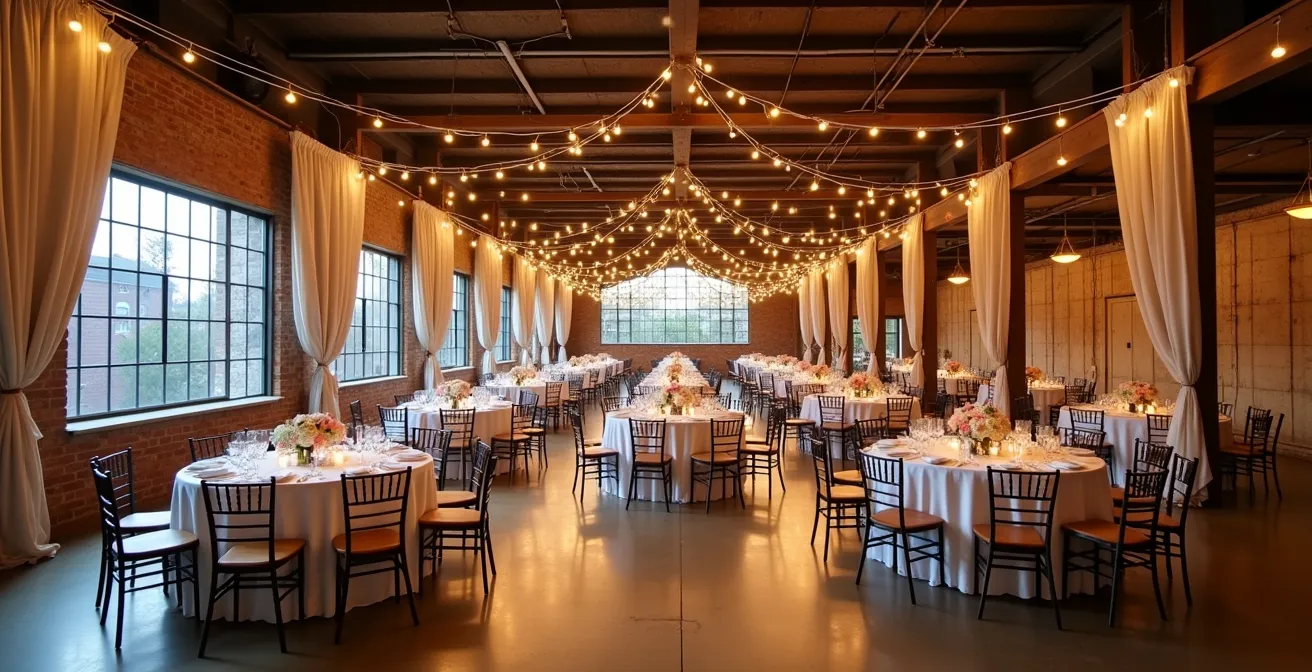
The secret to an intimate warehouse wedding isn’t filling the space with decor, but strategically sculpting your guests’ perception of it.
- Create a lower “visual horizon” with lighting to make the ceiling feel closer and the room cozier.
- Use soft materials like drapes and rugs not just for looks, but to absorb sound and allow for real conversation.
Recommendation: Focus on managing sightlines, sound, and movement to create psychological “rooms without walls” that feel personal and connected, rather than simply adding more stuff.
You fell in love with the soaring ceilings, the raw brick, and the industrial soul of a warehouse venue. It’s cool, it’s chic, it’s a blank canvas for your dream wedding. But now, a quiet fear creeps in: how do you keep this vast, echoing space from feeling cold, empty, and impersonal? How do you ensure your guests feel connected and cozy, not lost in a cavernous hall?
The common advice is to simply fill the void: add more flowers, more tables, more everything. Many guides will tell you to just “use string lights” or “create zones.” But this approach often misses the fundamental point. It treats the symptom—emptiness—without addressing the root cause: the human experience within the space. A warehouse’s concrete floors and metal beams are unforgiving; they bounce sound and light, creating an environment that can feel disconnected and overwhelming.
What if the real key isn’t about filling the space, but about skillfully manipulating it? The secret lies in becoming an architect of intimacy. It’s about understanding how to manage sightlines, control acoustics, and guide movement to create psychological rooms without walls. This guide moves beyond generic tips to give you the specialist’s strategy. We will explore how to use light to build a false ceiling, how textiles can turn a shouting match into a conversation, and how to design a layout that encourages exploration and connection.
By the end, you won’t just see a big, empty room. You will see a series of opportunities to sculpt an experience, turning that cool, industrial space into a warm, unforgettable celebration of intimacy.
This article will guide you through the essential strategies for transforming your venue. Below is a summary of the key areas we will cover, from mastering lighting to creating flow and managing your budget effectively.
Summary: A Specialist’s Guide to an Intimate Warehouse Wedding
- How to use string lights to create a “false ceiling” of intimacy?
- Why you need drapes and rugs to stop conversation from becoming a shouting match?
- Avoiding “islands”: how to connect pockets so no one feels excluded?
- Bookcases or Boxwood walls: dividing a room without building walls
- How to encourage movement between the bar and the lounge?
- Why tall, thin centerpieces make a low ceiling feel higher?
- Ficus vs. Birch: which rental trees create the best forest effect indoors?
- How to Decorate a Massive Hall Without Spending a Fortune on Flowers?
How to use string lights to create a “false ceiling” of intimacy?
The single most powerful tool for taming a cavernous warehouse is light. High ceilings create a sense of awe but also distance. The key to intimacy is to create a lower “visual horizon”—a psychological ceiling that brings the perceived height of the room down to a human scale. A dense canopy of string lights, hung at a height of 10 to 12 feet, effectively tricks the eye into ignoring the dark, empty space above, making the area below feel instantly cozier and more contained.
This isn’t just about hanging a few strands. A successful lighting strategy is layered. Your string light canopy provides the warm, ambient glow. But you must also consider task lighting for tables and accent lighting to add depth. The goal is to create pools of light that define different areas. The warmth of the light itself is also critical; lighting experts recommend using warm color temperatures between 2700K-3000K for maximum warmth and a candle-lit ambiance. This golden glow softens industrial materials like concrete and steel, replacing a cold feeling with one of warmth and romance.
Case Study: Victoria Warehouse Manchester’s Magical Transformation
An industrial wedding at Victoria Warehouse in Manchester perfectly illustrates this principle. The couple wanted to transform the raw space into a romantic, atmospheric room. They achieved this by filling the venue with a dense canopy of fairy lights and complementing them with countless candles in jars. This multi-layered approach, combining a low-hanging “false ceiling” of lights with accent candlelight, created a magical and intimate environment that completely redefined the industrial setting.
To implement this, think in three layers: create a canopy of warm Edison bulbs or LED strands for ambient light, add dedicated pin spots on each table so guests can see their food and each other, and finally, use uplighting on walls, columns, or draped fabric to highlight architectural features and add visual interest. Dimmable systems are a must, allowing you to adjust the atmosphere from a bright welcome to a dim, romantic dance floor later in the evening.
Why you need drapes and rugs to stop conversation from becoming a shouting match?
In a warehouse venue, sound behaves like a bouncy ball in a tiled room. Hard surfaces like concrete, brick, and glass reflect sound waves, creating a cacophony of echoes and reverberation. This high level of background noise forces guests to raise their voices to be heard, turning conversation into a tiring, shouting match. This is where acoustic softening becomes as crucial as visual decor. Soft, porous materials are the key to absorbing sound and creating an environment where guests can connect comfortably.
Heavy drapes, plush area rugs, and upholstered furniture act like acoustic sponges. They trap sound waves, preventing them from bouncing around the room. This dramatically lowers the ambient noise level and improves speech intelligibility. You’re not just “softening the look” of the industrial space; you are fundamentally changing its acoustic properties to make it functional for a social event. Don’t underestimate the power of a few strategically placed area rugs under lounge seating or a large drape behind the head table.
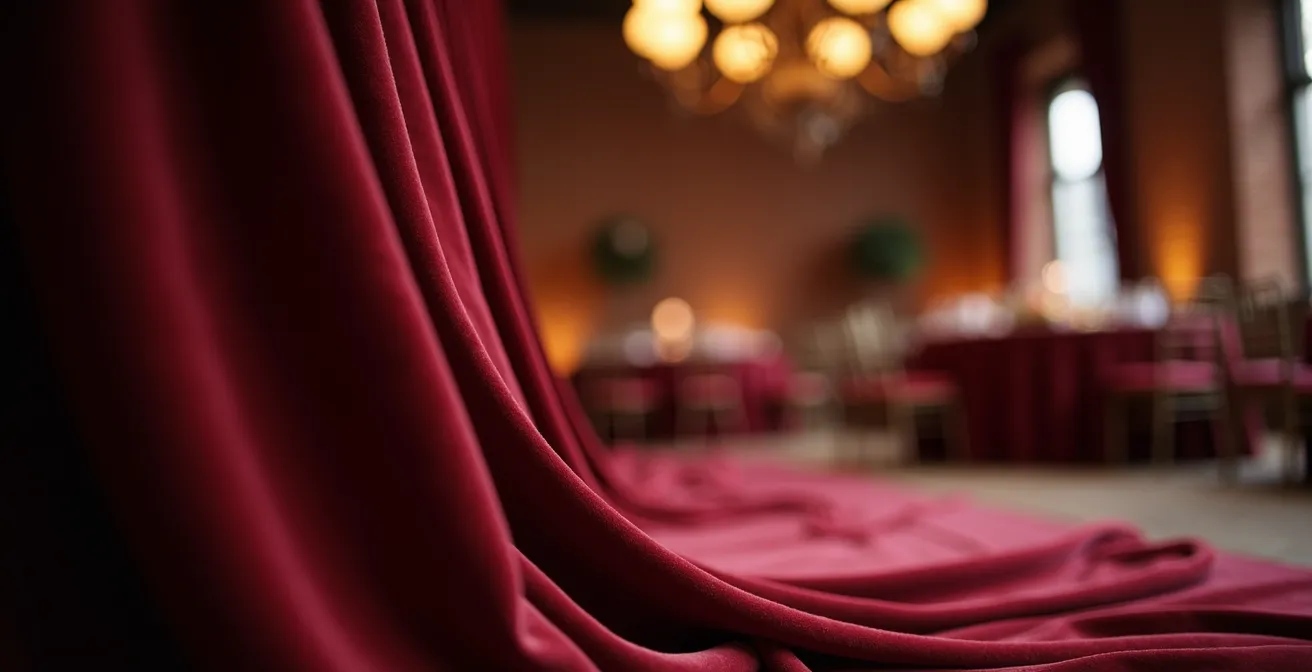
The choice of fabric is not purely aesthetic. Different materials have vastly different sound-absorbing capabilities, measured by a Noise Reduction Coefficient (NRC). Heavy, plush fabrics like velvet are excellent sound absorbers and add a touch of luxury, while light, airy fabrics like chiffon do very little to tame a room’s echo. The following table breaks down the acoustic and visual properties of common decor fabrics.
This data, based on industry knowledge like that shared by experts at The Knot, helps in making informed decisions for both your budget and your guests’ comfort.
| Fabric Type | Sound Absorption | Visual Impact | Cost Level |
|---|---|---|---|
| Velvet/Velour | Excellent (NRC 0.35-0.40) | Luxurious, Rich | High |
| Heavy Cotton Canvas | Good (NRC 0.25-0.30) | Rustic, Natural | Medium |
| Chiffon/Organza | Poor (NRC 0.05-0.10) | Ethereal, Light | Low |
| Wool Felt Panels | Excellent (NRC 0.40-0.45) | Modern, Textured | High |
Avoiding “islands”: how to connect pockets so no one feels excluded?
Once you’ve successfully created intimate “pockets”—a lounge area here, a dining section there—you face a new challenge: preventing them from becoming isolated islands. If guests feel “stuck” in one zone, the grand scale of the venue can re-emerge as a feeling of separation. The solution is to design clear and compelling pathways that encourage flow and exploration. This is the art of sensory wayfinding, using visual and experiential cues to guide guests from one area to another, making the entire venue feel like one cohesive, explorable space.
This connection isn’t just about leaving an empty path. It’s about creating a visual and psychological thread. Repeating design elements—like the same type of lantern, a specific floral variety, or a consistent color accent—act as “breadcrumbs,” subconsciously telling guests that the space ahead is part of the same experience. The width of pathways is also crucial; a 6 to 8-foot wide channel feels inviting for groups to move through, whereas a narrow path can feel like a bottleneck. Small “mini-experiences” like a display of family photos or a single high-top table placed in a transitional space can also break up a long walk and make the journey itself part of the event.
This concept of connection also relates to managing sightlines. As wedding planning expert Samantha Wiley notes, it’s about making a space feel smaller and more connected. In her advice on transforming large spaces, she states, “By draping the ceiling, you’re moving your line of sight down which gives the illusion of a smaller space.” This same principle applies horizontally; by creating clear visual paths and connecting elements, you make the distance between zones feel shorter and more manageable.
Your Action Plan: Creating Flow Between Zones
- Points of contact: Identify your key zones (e.g., bar, dining, lounge, dance floor) and the transitional spaces between them.
- Collecte: Inventory your repeating design elements. Plan to place a visual “breadcrumb” (e.g., a lantern, a small floral arrangement) every 10-15 feet along key pathways.
- Cohérence: Ensure pathways are wide enough (6-8 feet) for comfortable movement. Check that furniture arrangements don’t create dead ends or barriers.
- Mémorabilité/émotion: Place a “mini-experience” in a key transitional space. Is it a unique art piece or a guest book station? This turns a pathway into a destination.
- Plan d’intégration: Review your floor plan. Where are the psychological barriers? Add a repeating element or a small cocktail table to bridge the gap and encourage movement.
Bookcases or Boxwood walls: dividing a room without building walls
To create the “psychological rooms” that are the foundation of intimacy, you need dividers. But in an industrial venue, building actual walls is out of the question, and even solid dividers can feel clunky and defeat the purpose of the open-plan aesthetic. The most elegant solution is to use permeable dividers: structures that define a space without completely obstructing the view. These maintain a sense of connection to the larger venue while creating the distinct zones you need.
Open-backed bookcases are a perfect example. They can be filled with candles, photos, and small floral arrangements, acting as a beautiful decor element while creating a clear boundary for a lounge or dining area. Guests can still see through them, preventing anyone from feeling cut off from the main event. Other creative options that fit the industrial-chic aesthetic include artfully stacked wooden pallets, industrial metal screens, or even curtains made of metal chains. The key is to choose dividers that add to the venue’s character rather than fight it.
Case Study: The Permeable Divider Strategy
Successful industrial-chic weddings often embrace this strategy. Instead of solid walls, they use creative, permeable dividers that enhance the warehouse vibe. For example, an industrial shelving unit can be used to create a backdrop for a dessert display while simultaneously dividing it from the dance floor. This approach is not just about division; it’s about dual-functionality, where the divider itself becomes a feature of the event, like a whiskey bar or a favor station.
The choice of divider impacts not only the visual flow but also the level of privacy and the overall mood. A solid boxwood wall creates a dramatic reveal for a ceremony-to-reception flip, while soft fabric drapes offer flexibility and a romantic feel. As this table from an analysis on using the same room for ceremony and reception shows, each option has its own benefits.
| Divider Type | Visual Effect | Functionality | Setup Time |
|---|---|---|---|
| Boxwood Walls | Solid, Creates Surprise | Complete Privacy | 2-3 hours |
| Open Bookcases | Permeable, Maintains Connection | Display/Storage | 1-2 hours |
| Fabric Drapes | Soft, Romantic | Flexible Coverage | 1 hour |
| Industrial Screens | Modern, Architectural | Partial Division | 30 minutes |
How to encourage movement between the bar and the lounge?
Even with beautiful, connected zones, guests can become static. The bar area buzzes with energy while the carefully curated lounge sits empty. Encouraging natural movement is an advanced form of experiential design that requires thinking about psychological pulls. The most effective method is the “Anchor and Satellite” strategy. You establish a primary “Anchor” destination—almost always the bar—and then create compelling “Satellite” destinations that pull guests away from the anchor.
The satellite must offer something the anchor does not. If the bar is loud and high-energy, the lounge should be quieter, with comfortable seating perfect for conversation. But a quiet space isn’t enough of a draw on its own. You need to activate it. A dessert station, a photo booth, a guest book, or a specialty tasting bar (e.g., whiskey or cigars) can transform a passive lounge into an active satellite destination. Scheduling timed events, like announcing “The late-night taco bar is now open in the lounge at 10 PM,” creates a powerful incentive for a mass migration of guests.
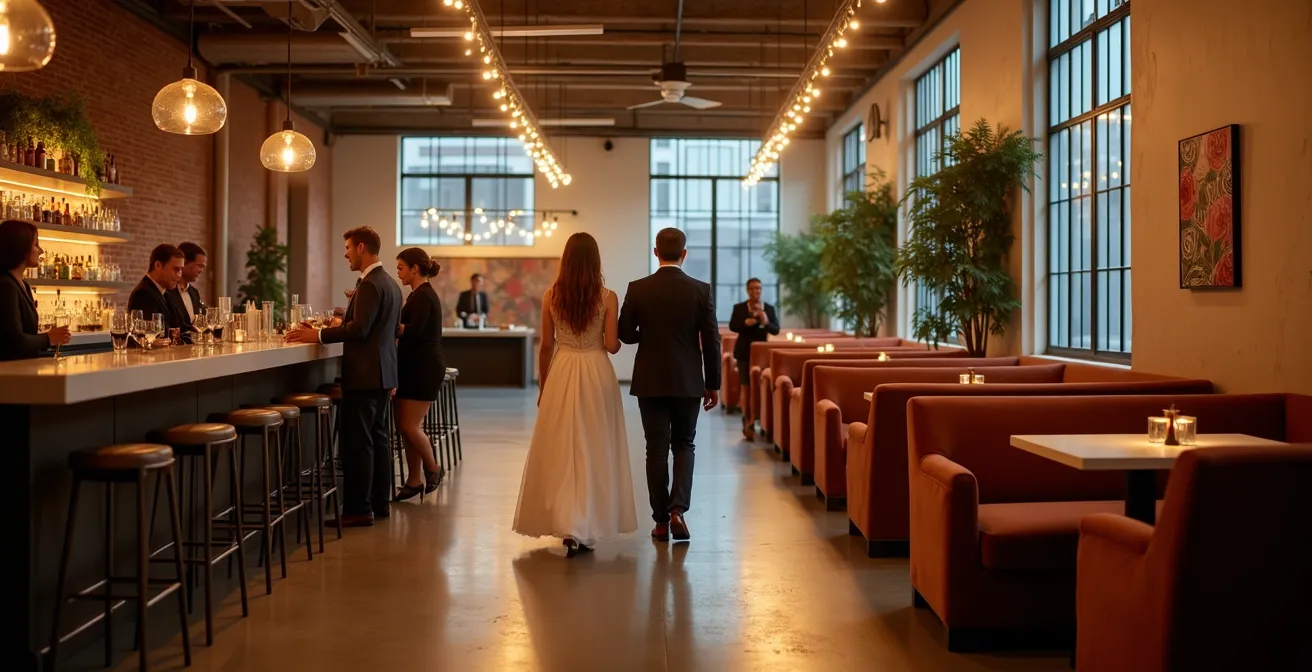
You can also use more subtle sensory cues. Transition the music from upbeat tracks near the bar to quieter jazz or instrumental music in the lounge. Use lighting to create a visually interesting path between the two zones. Even enticing aromas can play a role; the smell of fresh coffee from a dessert bar or warm donuts can be a powerful, non-verbal invitation. This is sensory wayfinding in its most sophisticated form, creating an environment where guests *want* to explore because each area offers a unique and rewarding experience.
- Establish a primary ‘Anchor’: The bar should be easily accessible and consistently high-energy.
- Create compelling ‘Satellites’: These are destinations with a unique offering, like a photo booth, dessert station, or specialty drink bar.
- Use sensory transitions: Shift music volume and style between zones. Guide guests with pathways of light.
- Schedule timed events: Announce the opening of a food station or a special activity in a satellite zone to create a surge of movement.
Why tall, thin centerpieces make a low ceiling feel higher?
This question contains a common design misconception. In reality, tall, bulky centerpieces in a room with a low ceiling tend to make the space feel more cramped and crowded, as they visually “eat up” the limited vertical space. The principle of using tall centerpieces is actually most effective in venues with very high ceilings, like a warehouse. In this context, they serve a crucial purpose: connecting the “human plane” of the tabletops to the vast, soaring ceiling above.
Without vertical elements, guest tables can feel like small, disconnected islands at the bottom of a giant box. As noted by wedding experts from The Knot, “In rooms with high ceilings and a lot of floor space, tall centerpieces and large tables will be the most impactful.” Tall, slender arrangements—like branches of cherry blossom, delphiniums, or gladioli—draw the eye upward, acknowledging the grand scale of the room while creating visual interest that bridges the gap between the tables and the ceiling. This makes the entire volume of the room feel intentional and decorated, rather than just the bottom five feet.
So, to reframe the question: how do you use verticality to your advantage?
- In high-ceilinged rooms: Use tall, thin centerpieces to draw the eye up and connect the tables to the ceiling. This makes the space feel cohesive.
- If you have a lower “false ceiling” of string lights: Your centerpieces should stay below this line to reinforce the sense of intimacy. Taller arrangements would pierce this visual barrier and break the illusion.
Case Study: Suspended Installations as an Alternative
A clever alternative to table-based centerpieces is to use suspended installations. One industrial wedding successfully hung large floral and greenery arrangements directly above the dining tables. This achieved the goal of connecting the human plane to the ceiling and adding vertical interest, but it did so without cluttering the tables themselves. This allowed for easier conversation across the table and reinforced the intimate visual horizon created by the installations.
Ficus vs. Birch: which rental trees create the best forest effect indoors?
Bringing trees indoors is a fantastic way to soften an industrial space, act as natural room dividers, and create a magical, forest-like atmosphere. But not all rental trees are created equal. The choice between a dense Ficus and an airy Birch, for example, depends entirely on the specific effect you want to achieve. It’s a choice between creating visual screens or emphasizing vertical lines.
Ficus trees are dense and leafy, with dark green foliage. They are excellent for creating privacy and acting as solid visual barriers. A row of Ficus trees can form a lush, living wall to screen off a service area or create a very private, enclosed lounge. Their density provides a strong sense of enclosure and works well to create solid “walls” for your psychological rooms. However, they can also feel heavy if overused.
Birch trees, on the other hand, are prized for their tall, slender, light-colored trunks. Their foliage is often sparser, creating a more delicate, ethereal effect. Birches are perfect for emphasizing the verticality of a warehouse. A cluster of Birch trunks creates a beautiful architectural element that draws the eye upward without feeling heavy. They work as permeable dividers, suggesting a boundary without completely blocking the view. Their light bark also stands out beautifully against dark brick or concrete, especially when up-lit.
Regardless of your choice, the strategy for creating a convincing “forest” is the same. Avoid dotting single trees around the room, which looks sparse and artificial. Instead, follow these steps for a more natural and high-impact effect:
- Cluster for Authenticity: Group trees in clusters of 3, 5, or 7 at varying heights to mimic a natural grove.
- Use as Anchors: Use these clusters as natural anchor points for stringing lights, creating a truly integrated design.
- Uplight for Drama: Place uplights at the base of the trees. This casts dramatic shadows of branches onto the walls and ceiling, multiplying the forest effect.
- Conceal the Base: Hide the rental pots and bases with a layer of moss, ferns, or other smaller plants to complete the illusion.
Key takeaways
- The key to warehouse weddings is sculpting perception, not just filling space. Focus on managing sightlines, sound, and movement.
- Create a “false ceiling” with string lights and use soft materials for “acoustic softening” to enable comfortable conversation.
- Use “permeable dividers” like bookcases and “sensory wayfinding” to connect zones and encourage guest flow.
How to Decorate a Massive Hall Without Spending a Fortune on Flowers?
The scale of a warehouse venue can feel financially intimidating, especially when it comes to decor. The thought of filling that much space with flowers is enough to break any budget. The secret is to shift your spending away from numerous small items and focus on high-impact, large-scale, and often non-floral, elements. Strategic lighting, for instance, offers the biggest bang for your buck; an analysis shows that gobo projectors and uplighting can transform warehouse walls for up to 70% less than the cost of covering them with physical decor.
Instead of spreading your budget thin with small centerpieces on every table, embrace the “abundance strategy” or the “one show-stopper” approach. The abundance strategy involves using a massive quantity of a single, inexpensive item. The visual impact comes from the sheer volume. The “one show-stopper” involves focusing your entire decor budget on a single, breathtaking installation—like a massive ribbon chandelier over the dance floor or a stunning fabric canopy over the dining area. This creates a focal point that defines the entire space.
Case Study: The 500 Paper Lantern Wedding
A savvy couple on a limited budget transformed a warehouse venue using the abundance strategy to perfection. Instead of costly flowers, they invested in 500 white paper lanterns of varying sizes. Hung at different heights throughout the venue and combined with simple uplighting, this massive quantity of a single, inexpensive element created a stunning, cohesive, and dream-like design that filled the enormous space for a fraction of what a traditional floral budget would have been.
Think beyond flowers and embrace creative, budget-friendly alternatives that fit the scale of your venue.
- Gobo Projectors: These are essentially custom stencils for lights. Use them to “paint” patterns, your monogram, or abstract textures across a vast brick wall or the dance floor.
- Non-Floral Organics: Create beautiful, textured garlands and centerpieces using eucalyptus, olive branches, artichokes, pomegranates, or other fruits and greenery.
- Mass-Use Materials: Think beyond paper lanterns. Hundreds of strands of ribbon, coffee filters dyed to your wedding color, or balloons can create incredible installations for a low cost.
Now that you’re equipped with these specialist strategies, you can approach your warehouse venue not as a challenge to be filled, but as a canvas to be sculpted. By focusing on the human experience of light, sound, and space, you can create a wedding that is both impressively grand and deeply intimate.