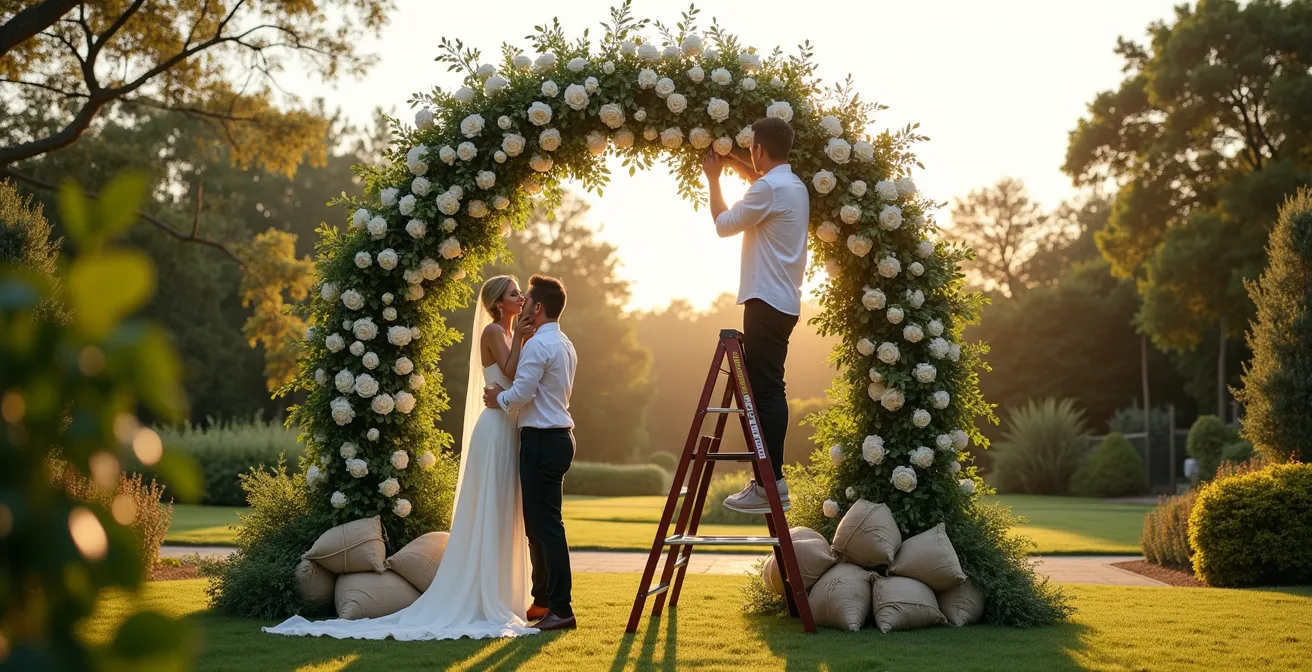
A magnificent floral arch’s success isn’t determined by its flowers, but by the unseen engineering that keeps it standing against the elements.
- Prioritize counterweight mechanics and structural load calculations over simple aesthetics.
- Understand the physics of the “sail effect” to design a structure that can withstand wind.
Recommendation: Always consult with your venue about certified load ratings and have a professional rigger for any suspended floral installations.
The dream of a massive, nine-foot floral arch as the centerpiece of an outdoor ceremony is a powerful one. It promises breathtaking photos and a truly immersive experience for guests. However, the common advice often focuses on aesthetics—the types of flowers, the color palette, the overall shape. This approach dangerously overlooks the most critical aspect: a large-scale floral installation is not just a decoration; it’s a temporary architectural structure.
Many couples and even some decorators might assume a “sturdy base” is enough, without understanding the forces at play. The reality is that wind, uneven ground, and the sheer weight of hundreds of water-soaked stems create a significant engineering challenge. Without a professional, safety-first approach, that dream backdrop can quickly become a 200-pound liability, posing a real risk to you and your guests.
But what if the secret to a stunning and safe arch wasn’t just in choosing the right flowers, but in understanding the physics that govern them? The true key lies in shifting focus from aesthetics to engineering. It’s about thinking like a structural florist, where every decision—from the base mechanics to the choice of foliage—is dictated by principles of weight distribution, load-bearing capacity, and aerodynamic design.
This guide will walk you through the structural principles and logistical planning required to ensure your large-scale floral arch is not only beautiful but fundamentally sound. We will deconstruct the mechanics, compare the core materials, analyze the environmental forces, and plan the complex logistics that professionals use to execute these ambitious designs flawlessly.
To navigate this complex topic, this article breaks down the core engineering and logistical challenges into distinct, manageable sections. The following summary provides a roadmap to building a floral arch that is as safe as it is spectacular.
Summary: Building a Structurally Sound Floral Masterpiece
- Sandbags and base plates: hiding the ugly mechanics of a 9-foot arch
- Chicken wire vs. Floral foam: which holds heavy branches more securely?
- The “sail effect”: how to prevent your floral backdrop from blowing away?
- Logistics of moving a 200lb structure during cocktail hour
- How many stems does it really take to cover a 10-foot arch completely?
- How to check if a venue ceiling can actually support a 50lb flower cloud?
- Arch vs. Ground circle: framing the couple without blocking the view
- How to Install Suspended Florals Without Risking Safety or Budget?
Sandbags and base plates: hiding the ugly mechanics of a 9-foot arch
The foundation of any large-scale arch isn’t the flowers; it’s the unglamorous, heavy-duty hardware at its base. An arch is essentially a tall, top-heavy lever, and without sufficient counterweight, even a moderate breeze can cause it to topple. The goal is to create a low, wide, and heavy center of gravity. This is achieved through a combination of heavy steel base plates and sandbags, which provide the necessary ballast.
Professionals don’t guess the weight; they calculate it. Factors like the arch’s height, surface area, and expected wind conditions determine the minimum required weight. For a typical 9-foot arch in an open area, this can easily mean 50-75 pounds of counterweight, before even adding the flowers. As an example of professional practice, Calgary-based florist Flowers by Janie emphasizes using structures with heavy metal base plates and often rents additional weights for outdoor ceremonies to ensure absolute stability.
The “ugly” mechanics are then concealed with draped fabric, loose foliage, or clusters of floral arrangements at the base, seamlessly integrating the safety measures into the design. Never compromise on the weight of your base; it is the single most important factor in preventing a catastrophic failure. A beautiful arch that falls over is not beautiful at all.
Chicken wire vs. Floral foam: which holds heavy branches more securely?
The internal mechanics of your arch—the material that actually holds the stems—are just as critical as its base. For decades, green floral foam has been the standard. However, when it comes to large-scale structures bearing heavy branches and dense foliage, foam has significant structural weaknesses. It can crumble under the torque of long stems and becomes incredibly heavy when saturated with water, adding immense weight to the overall structure.
Enter chicken wire. From a structural standpoint, it is a vastly superior material for large installations. It’s lighter, allows stems to drink directly from a hidden water source, and can be reused. Most importantly, it creates a flexible, interconnected matrix that distributes weight and tensional load across the entire structure, rather than concentrating stress on a single insertion point. Research from agricultural extensions confirms this, noting that some florists use a layer of chicken wire on top of fresh flower foam specifically to provide rigidity for large stems.
This table breaks down the key performance differences from a structural perspective.
| Factor | Floral Foam | Chicken Wire |
|---|---|---|
| Heavy Branch Support | Fails under tension/leverage | Excels at distributing tensional loads |
| Water Source | Limited moisture retention | Stems directly in water |
| Reusability | Single use only | Can be sanitized and reused |
| Weight When Wet | Very heavy | Lighter than wet foam |
| Structural Integrity | Can crack under stress | Maintains shape under pressure |
To get the best of both worlds, many professionals use a hybrid technique. This involves creating a chicken wire “exoskeleton” around blocks of floral foam. The foam provides a quick-to-hydrate water source, while the wire cage provides the overarching structural integrity, preventing the foam from cracking and ensuring heavy stems are securely anchored.
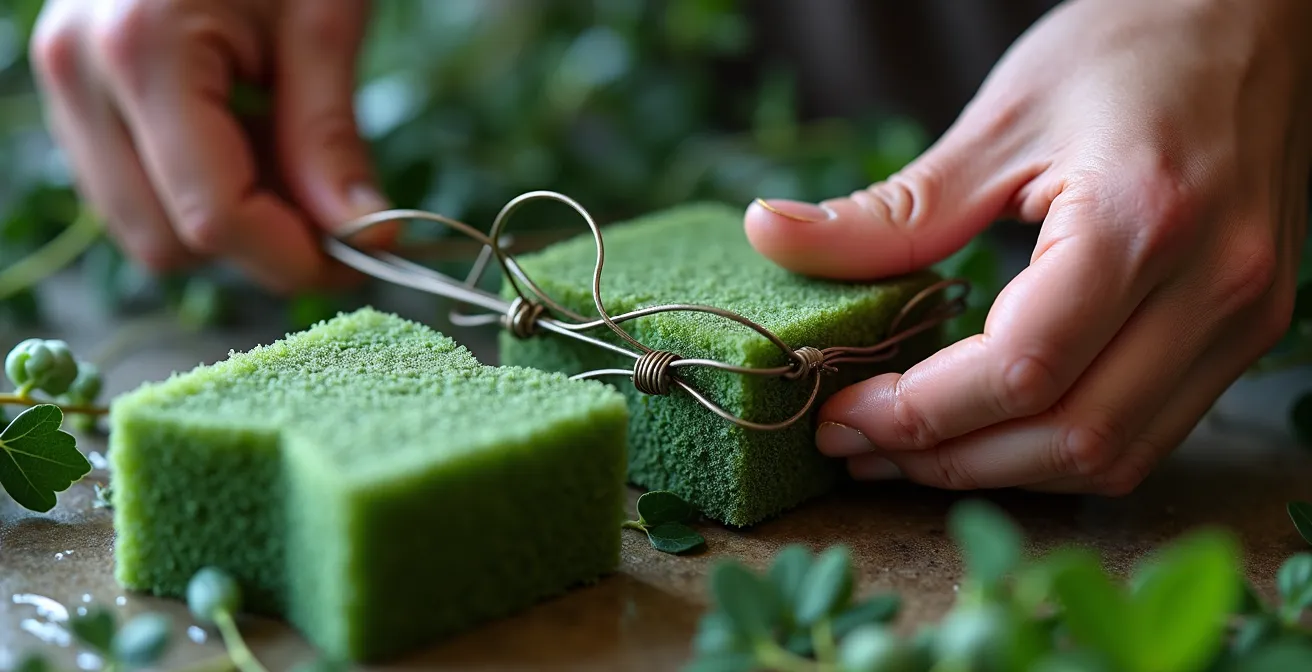
This hybrid approach demonstrates a deep understanding of material science, allowing for both creative freedom and structural security. It’s a hallmark of a true structural florist.
The “sail effect”: how to prevent your floral backdrop from blowing away?
A large floral arch, especially one densely packed with flowers and foliage, presents a solid surface to the wind. This creates a phenomenon known as the “sail effect”. Just like the sail on a boat, the arch catches the wind, which then exerts a powerful, consistent force on the entire structure. This force is what causes arches to lean, shift, and ultimately topple over. Underestimating this effect is one of the most common and dangerous mistakes in outdoor event design.
The solution is not to simply add more weight, but to design the arch with aerodynamic principles in mind. The goal is to reduce the surface area that can catch wind and allow air to pass through the structure. This dramatically lessens the force exerted on it. Professional florists and designers employ several strategies to mitigate the sail effect and ensure the structure’s stability even in breezy conditions.
These strategies move beyond simple anchoring and involve thoughtful design from the very beginning. They treat the wind as a predictable force to be managed, not an unpredictable enemy to be fought.
Wind-Resistant Design Strategies: Your Action Plan
- Create ‘wind windows’ by leaving strategic gaps in your floral design for air to pass through.
- Use lighter, air-permeable materials like grasses and asparagus fern in wind-exposed sections.
- Position heavier, denser florals lower on the structure where wind impact is reduced.
- Install modular panels with breakaway zip ties for emergency removal in sudden gusts.
- Add tent pegs or ground anchors – use 7-12 inch stakes for outdoor installations.
By incorporating these techniques, you transform the arch from a solid wall into a semi-permeable screen. It’s a sophisticated approach that prioritizes physics over brute force, ensuring the arch remains standing without requiring an excessive amount of visually intrusive counterweight.
Logistics of moving a 200lb structure during cocktail hour
Repurposing the ceremony arch as a backdrop for the sweetheart table or photo booth is a popular and cost-effective idea. However, the logistics of moving a 200-pound, nine-foot-tall, delicate structure through a crowded venue during cocktail hour is a high-stakes operation. This is not a simple task for two helpers; it’s a choreographed procedure that requires a dedicated team, a clear plan, and precise communication.
A professional team treats this move with the seriousness of a stage crew in a theater. The process is planned down to the minute to ensure it happens safely and efficiently while guests are occupied elsewhere. The team typically consists of designated lifters (usually four, one at each corner) and one or two spotters whose only job is to clear the path, watch for obstacles (like guests, tables, or uneven terrain), and communicate potential hazards to the lifters.
The entire operation should be timed to coincide with a moment when the path from the ceremony site to the reception area is completely clear. Attempting this move while guests are mingling is a recipe for disaster. Here is what a professional minute-by-minute plan looks like.
Arch Movement Choreography: A 15-Minute Plan
- T-minus 15 min: Team Lead confirms guest movement to the cocktail area and ensures the path is clear.
- T-minus 10 min: The Path Clearer walks the entire route, removing any stray chairs, glasses, or other obstacles.
- T-minus 5 min: The 4 Lifters position themselves at the corners of the arch. The 2 Spotters take positions at the front and rear.
- T-0: On the Team Lead’s verbal count, all lifters perform a synchronized lift.
- T+2 min: The team moves at a steady, deliberate pace, with Spotters calling out turns and potential hazards ahead.
- T+5 min: The arch is placed in its final reception position. If it’s on casters, they are locked immediately.
This level of planning is why labor and delivery costs for large installations are significant. It’s a specialized skill that ensures the investment you made in your arch is protected and that the transition happens without incident.
How many stems does it really take to cover a 10-foot arch completely?
One of the most common questions is about quantity: how many flowers are needed for that lush, fully covered look? While the exact number depends on the flower types and design density, a professional baseline provides a crucial starting point for budgeting and planning. For a completely adorned 10-foot arch, wholesale floral experts estimate that you’ll need approximately 150–300 stems.
However, achieving a high-end look is not just about cramming in as many stems as possible. It’s about creating the illusion of fullness through a technique called density hacking. This involves strategic layering to create depth and texture, making the arch look far more lush than the stem count would suggest. A skilled florist doesn’t just cover the surface; they build in layers from back to front.
This process typically involves three distinct layers:
- The Base Layer: This is the deepest layer, right against the structure. It uses large-leaf foliage like salal or camellia to cover the mechanics and create a dark, shadowed backdrop.
- The Mid-Layer: This layer adds texture and shape. It consists of lighter, airier foliage (like eucalyptus or ferns) and filler flowers (like spray roses or waxflower).
- The Focal Layer: This is the top-most layer, featuring the “star” blooms like roses, peonies, or hydrangeas. These are the last to be added and are placed strategically to draw the eye.
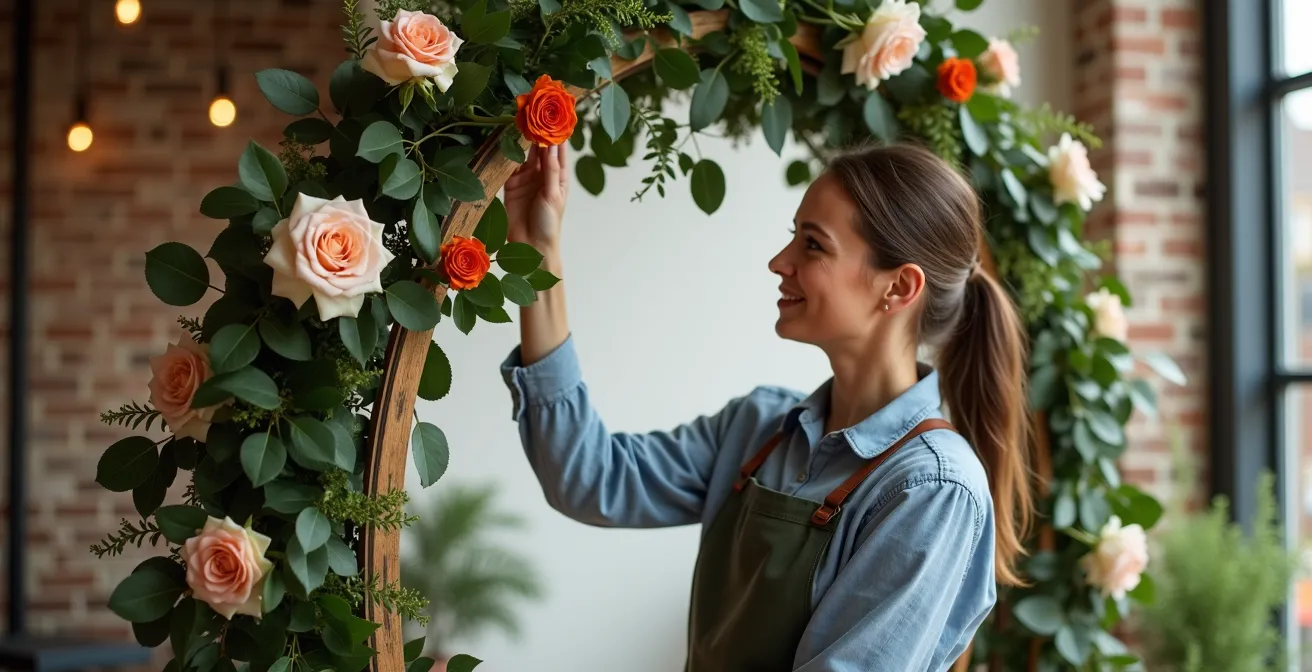
This layering method not only creates a visually stunning, three-dimensional effect but is also structurally intelligent. By placing heavier foliage deep inside and lighter flowers on the exterior, the florist maintains control over the arch’s center of gravity and overall weight.
How to check if a venue ceiling can actually support a 50lb flower cloud?
Suspended floral installations, or “flower clouds,” are breathtaking, but they introduce a new level of risk. Unlike a ground-based arch, a suspended piece relies entirely on the structural integrity of the venue’s ceiling. Never assume that an existing hook, beam, or chandelier mount is safe for use. A 50-pound static installation can exert far more force when it’s being hoisted or if it experiences any movement. According to wedding installation safety experts, a 50lb static installation can exert 100-150lbs of dynamic force during setup or if it starts to swing.
Before you even begin designing a suspended piece, your florist or a certified rigger must have a detailed conversation with the venue manager. This isn’t a casual chat; it’s a safety-critical audit of the venue’s capabilities. You need to ask specific, technical questions to get a clear “yes” or “no” on whether the installation is possible. An ambiguous answer from the venue should always be treated as a “no.”
To ensure nothing is missed, a professional will use a checklist to vet the venue’s rigging points and policies. This is a non-negotiable first step in the planning process.
Your Pre-Installation Safety Audit Checklist: Questions for the Venue Manager
- What is the certified load rating of this specific hanging point?
- Can I see the structural or rigging plot for this room?
- Are there any restrictions on hardware (e.g., must use beam clamps, no drilling)?
- Who is your exclusive or preferred rigging partner we must work with?
- Has anyone hung similar weight installations from this point before? Can you provide references?
- What is your liability insurance requirement for aerial work and suspended decorations?
If a venue manager cannot provide a clear, confident answer to the question about the certified load rating, the project must not proceed. The safety of your guests is paramount, and when it comes to gravity, there are no second chances.
Arch vs. Ground circle: framing the couple without blocking the view
While a traditional arch creates a classic vertical frame, it isn’t always the best structural or aesthetic choice. In venues with a stunning natural vista—like a mountain range, an ocean horizon, or a beautiful vineyard—a tall arch can obstruct the very view you chose the location for. Furthermore, as we’ve discussed, tall arches are inherently less stable and require significant engineering to be safe.
An increasingly popular and structurally superior alternative is the ground circle or “broken arch.” This design creates a lush, semi-circular arrangement of florals on the ground, framing the couple from below. This approach offers several distinct advantages from both a safety and a photographic perspective. Its low center of gravity makes it inherently stable, requiring minimal to no extra anchoring. It also creates a wide, cinematic frame for photos that incorporates the background, rather than blocking it.
Choosing between these two styles is a strategic decision that balances aesthetics, safety, and budget. As a case in point, flimsy structures like copper pipe arches are often light and trendy, but as noted by floral professionals, they are less advisable for outdoor use as they cannot hold much weight and are vulnerable to wind. A ground circle avoids this issue entirely.
| Factor | Traditional Arch | Ground Circle |
|---|---|---|
| Photo Frame | Vertical ‘portrait’ frame | Wide-angle ‘cinematic’ frame |
| Guest Experience | Formal, presentational stage | Inclusive, immersive feeling |
| View Obstruction | Can block background vista | Preserves scenic views |
| Stability | Requires significant anchoring | Low center of gravity, inherently stable |
| Cost for Lush Look | Higher due to safety requirements | More cost-effective |
The ground circle isn’t a compromise; it’s often a more intelligent design solution that enhances the venue, improves safety, and can be more budget-friendly while still delivering a massive visual impact.
Key Takeaways
- Structural Engineering First: A large floral installation is an engineering project before it is an art project. Prioritize weight, balance, and structural integrity above all else.
- Understand the Physics: Concepts like the “sail effect” and “dynamic load” are not abstract ideas; they are real forces that can cause catastrophic failure if ignored.
- Logistics are Not an Afterthought: The budget and plan must account for professional labor for construction, movement, and breakdown. This is a skilled, high-risk job.
How to Install Suspended Florals Without Risking Safety or Budget?
The only way to install suspended florals without risking safety or budget is to treat the project as a professional rigging operation, not as a simple decoration task. The allure of a floating cloud of flowers is strong, but gravity is unforgiving. The “Redundancy Principle” is the absolute, non-negotiable rule of any safe overhead installation.
The Redundancy Principle: Never Trust a Single Point
– Professional Rigging Standards, Wedding Installation Safety Guidelines
This principle means that every component of the suspension system must have a backup. There should be at least two attachment points to the ceiling, each capable of holding the entire weight independently. Every hardware component, from clamps to cables, must have a redundant counterpart. There is zero room for error.
This level of safety has significant, often unforeseen, budget implications. A realistic budget for a suspended installation goes far beyond the cost of flowers and the florist’s design time. It must include several critical line items that are essential for a safe and professional execution. Ignoring these costs is not only unrealistic but also dangerously negligent.
Hidden Budget Line Items for Suspended Installations
- Certified rigger consultation: $500-1500
- Scissor lift or scaffolding rental: $300-600 per day
- Specialized insurance rider for aerial work: $200-500
- Extra labor for extended and complex installation: 4-6 hours at $50-75/hour per person
- Professional chain hoists or motor rental: $150-300 each
- Safety cables, rated shackles, and redundant hardware: $100-200
Ultimately, a safe installation is an expensive installation. When you hire a professional florist who insists on these measures, they are not upselling you; they are protecting you, your guests, and their team. If the budget cannot accommodate these essential safety costs, the responsible decision is to opt for a ground-based design.
To ensure your statement floral piece is both breathtaking and completely secure, the next logical step is to engage a professional florist who explicitly discusses structural integrity and safety protocols in their initial proposal. Ask them about their experience with large-scale installations and how they plan to manage the specific challenges of your venue.