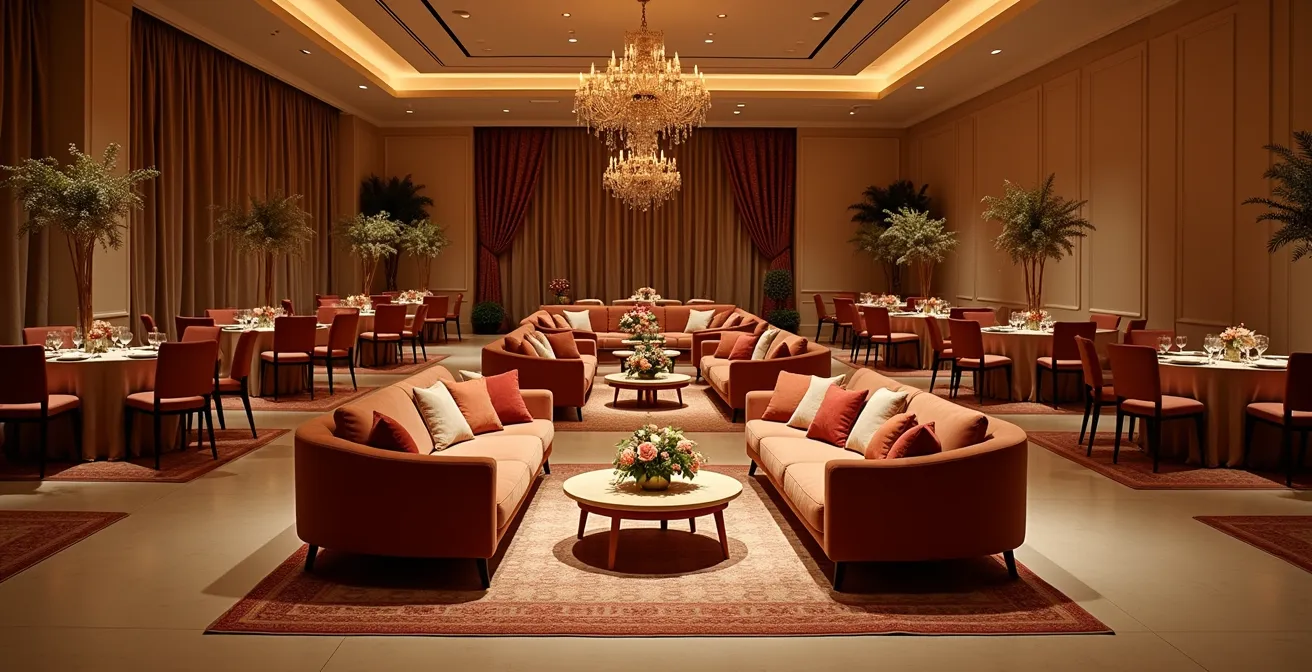
A large guest list doesn’t have to mean chaos; the key is using lounge furniture not as passive decoration, but as a strategic tool for guest engineering.
- Define clear “destinations” with area rugs and focused lighting to subconsciously guide guests and prevent them from congregating in pathways.
- Use a mix of individual armchairs and flexible seating over long sofas to create “permeable barriers” that encourage interaction and prevent energy sinks near the dance floor.
Recommendation: Think like a flow logistician. Analyze your floor plan for pathways, bottlenecks, and high-traffic zones before placing a single piece of furniture.
For couples planning a wedding with a large guest count, the fear is palpable: a beautiful reception descending into chaos. You envision bottlenecks at the bar, a cramped buffet line, and guests awkwardly standing with no place to go. The common advice is to add a “lounge area,” a cozy corner with a sofa and some pillows. But this advice treats furniture as mere decoration, a passive element meant to look pretty in photos. It misses the fundamental point. Do people actually use these lounges? They do, but only when they are deployed with intention.
The truth is that your reception’s floor plan is a dynamic system, and every piece of furniture is a tool that can either hinder or help. From a logistical standpoint, sofas are barriers, rugs are signals, and armchairs are conversational catalysts. Viewing your layout through this lens transforms you from a decorator into a flow logistician, capable of engineering the guest experience. It’s not about just filling space; it’s about directing movement, managing energy, and solving guest frustrations before they even arise. The difference between a congested, stressful event and a smooth, flowing celebration lies in this strategic shift in perspective.
This guide deconstructs the principles of guest engineering. We will move beyond aesthetics to explore the precise rules of placement, quantity, and configuration. You will learn how to use furniture to create psychological boundaries, calculate the exact number of seats you need, and arrange them to foster interaction while keeping critical pathways clear for guests and staff alike. By mastering these logistical concepts, you can proactively design a reception that feels spacious, comfortable, and effortlessly elegant, no matter the size of your guest list.
To help you master these concepts, this article breaks down the core logistical principles for engineering guest flow. Each section addresses a critical variable in your floor plan equation, providing the data and strategies needed to build a seamless reception experience.
Summary: Using Wedding Lounge Seating to Engineer Guest Flow
- How area rugs subconsciously tell guests “stop and sit here”?
- The 10-20% rule: exactly how many lounge seats you need for 150 people?
- Why placing sofas on the dance floor edge kills the party energy?
- Why separate armchairs are better for guest interaction than one long sofa?
- Moving heavy furniture: do you have the crew to flip the room in 1 hour?
- Why placing the lounge too far from the bar guarantees it stays empty?
- Why you need 60 inches between tables for efficient plated service?
- How to Use Design to Solve Guest Frustrations Before They Happen?
How area rugs subconsciously tell guests “stop and sit here”?
In a large, open reception space, guests often drift aimlessly or cluster in inconvenient areas like doorways and bar queues. They lack environmental cues telling them where it is appropriate to pause and gather. This is where the concept of perceptual boundaries becomes a powerful logistical tool. An area rug is the most effective instrument for creating these boundaries. It doesn’t physically block anyone, but it psychologically transforms an open floor into a designated “destination.” The shift in texture and color underfoot acts as a subconscious stop sign, signaling to guests that they have entered a specific zone intended for relaxation and conversation.
This effect is rooted in familiar domestic behavior; a rug defines a living room, creating a cozy and socially acceptable space to settle. At a wedding, this simple textile addition achieves several goals simultaneously. As design experts note, rugs are a secret to making a space feel like a deliberate area. By layering them, you create familiar spots to relax. Furthermore, textiles like rugs and pillows help dampen noise in large, echoey venues, making conversation easier and the environment more intimate. This acoustic benefit further reinforces the lounge as a desirable place to be, pulling people out of high-traffic corridors.
Beyond rugs, this principle can be extended with other sensory cues. You can create “pools” of intimate space using focused, warmer lighting that naturally draws guests in. Incorporating different floor textures, or clustering plants and decorative screens, can also create these perceptual boundaries without erecting physical barriers. The goal is to give guests clear, non-verbal instructions on how to use the space, directing flow and preventing congestion by creating appealing, well-defined zones for pausing. It’s the first step in engineering a predictable and comfortable guest experience.
The 10-20% rule: exactly how many lounge seats you need for 150 people?
A common mistake in reception planning is either providing no lounge seating or providing far too much, wasting budget and space. The key is to see lounge seating not as a replacement for dining tables, but as a transitional space for specific moments like cocktail hour or for guests taking a break from dancing. A widely cited guideline suggests you only need lounge space for about 10-15% of your guest list capacity. For a 150-person wedding, this would mean planning for roughly 15 to 23 seats. This number prevents the lounge from sitting empty while still offering a comfortable alternative for a meaningful portion of your guests at any given time.
However, this rule is just a baseline. A true logistician must adjust the formula based on a critical variable: your guest demographics. An older crowd or a wedding with a longer cocktail hour will have a higher demand for comfortable seating. In this case, you might increase capacity to 25%. Conversely, a younger, dance-focused crowd may only utilize 10% of the seating. The ratio of “seats” (comfortable armchairs, sofas) to “perches” (ottomans, poufs, stools) also shifts. Older guests will need more supportive seats, while younger guests are happy to perch for short conversations.
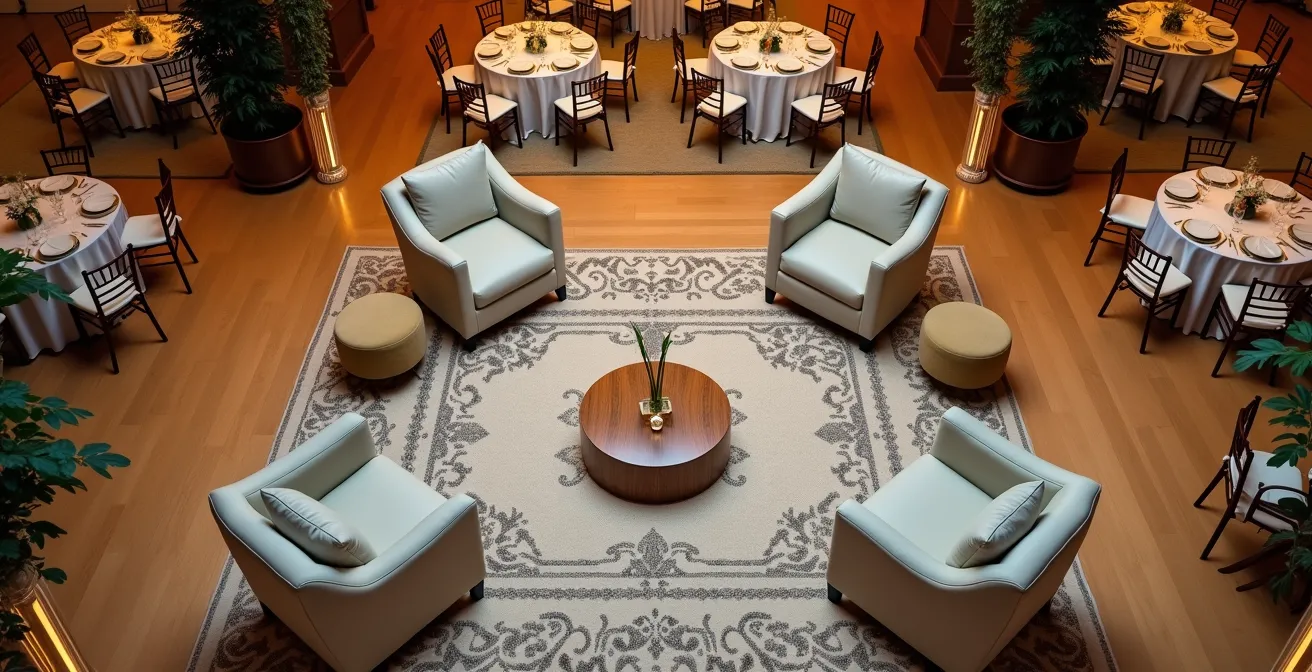
To apply this with precision, a demographic-based approach is essential. Consider the following breakdown for a 150-guest event.
| Guest Demographics | Recommended Capacity | Seat vs Perch Ratio |
|---|---|---|
| Older crowd/Longer cocktail hour | 25% (38 seats for 150 guests) | 70% seats, 30% perches |
| Standard mixed age | 15% (23 seats for 150 guests) | 60% seats, 40% perches |
| Younger/Dance-focused | 10% (15 seats for 150 guests) | 40% seats, 60% perches |
By using this nuanced approach, you move from guessing to strategically allocating resources. You provide exactly what your specific guests need, ensuring the lounge is a functional and well-used asset rather than an oversized, empty statement piece.
Why placing sofas on the dance floor edge kills the party energy?
The dance floor is the energy nucleus of your reception. The goal of any surrounding furniture should be to support and feed this energy, not to contain or block it. A common layout mistake is to line the entire perimeter of the dance floor with long sofas, creating what is effectively a solid wall. While the intention might be to give guests a place to watch, the result is an “energy sink.” This solid barrier creates a hard psychological and physical divide between the dancers and the observers. It makes it harder for guests to spontaneously join the fun and can make those on the dance floor feel like they are on display in an arena.
The solution is to create permeable boundaries. Instead of a solid wall, the furniture should act as a porous membrane that allows energy and people to flow freely between the lounge and the dance floor. This is achieved by breaking up long seating arrangements into smaller, more open clusters. Grouping furniture in squares or circles, for instance, encourages socializing among those seated and creates natural pathways for others to walk through. This arrangement allows guests to feel connected to the action without being trapped by a wall of furniture.
The optimal placement is a matter of strategic distance. As event planner Emily Murphy of Manette Gracie Weddings and Events advises, the best location is slightly removed from the immediate chaos.
For reception wedding lounge spaces, we like to place them a bit off the dance floor, so it’s not too noisy for a conversation, but not too far away to miss the fun or remove them from the action.
– Emily Murphy, Manette Gracie Weddings and Events
This “buffer zone” strikes a perfect balance. It’s close enough for guests to feel the music and energy, encouraging them to join in, but far enough to allow for comfortable conversation without shouting. This placement turns the lounge into a launchpad for the dance floor, not a barricade against it.
Why separate armchairs are better for guest interaction than one long sofa?
The primary function of a lounge area, beyond rest, is to facilitate social interaction. However, not all seating arrangements are created equal. A long sofa, while seeming efficient, is often a social dead end. It creates the “middle seat” problem, where strangers are forced into close proximity, discouraging conversation. Furthermore, it promotes a linear, presentational style of seating (sociofugal), where everyone faces the same direction, much like watching a play. This setup is poor for creating the dynamic, multi-directional conversations that make a reception feel alive.
The more effective approach is to build conversational clusters using a mix of smaller, more flexible pieces. Separate armchairs, loveseats, and poufs are logistically superior because they can be arranged in sociopetal configurations—that is, positioned to face each other. This circular or semi-circular arrangement naturally encourages eye contact and interaction. It breaks down large groups into smaller, more intimate conversational pods. According to design experts, a highly effective formula involves combining one sofa with two slipper chairs, a coffee table, and two to three poufs. This mix provides variety and flexibility, allowing guests to self-organize comfortably.

To maximize this effect, focus on the following principles for creating these sociopetal arrangements:
- Position armchairs facing each other across from a sofa or loveseat to create an immediate conversational grouping that invites people to join.
- Mix different seating heights and styles, such as low poufs and higher-backed armchairs, to accommodate various guest preferences and create visual interest.
- Arrange chairs in circles or semi-circles rather than straight lines to eliminate awkward gaps and ensure everyone feels included in the conversation.
- Include flexible pieces like poufs or ottomans that guests can easily move to join different groups or create their own small clusters.
This modular approach turns a static seating area into a dynamic social hub. It empowers guests to connect more naturally, preventing the lounge from becoming a silent waiting room and instead making it a vibrant node in your reception’s social network.
Moving heavy furniture: do you have the crew to flip the room in 1 hour?
One of the most complex logistical challenges for a large event is the “room flip”—the process of transforming a space from one function to another, typically from ceremony to reception. This maneuver requires a detailed strategic plan and, most critically, a dedicated and prepared crew. Attempting a flip without proper planning is a recipe for disaster, leading to delays that leave guests waiting in a hallway and a stressed-out coordination team. The success of a flip hinges on treating furniture not as static objects, but as pieces on a chessboard that must be moved with precision and speed.
A successful flip is a choreographed operation. The first step is creating detailed floor plans that map out both the “before” (ceremony) and “after” (reception) layouts. These plans must clearly mark the movement paths for each piece of furniture to avoid collisions and bottlenecks during the transition. For example, pre-staged reception tables can be held in an adjacent area and moved into the main space once ceremony chairs are cleared. This requires designating clear storage zones for furniture that is being removed or added. The entire process must be timed, with a realistic goal—often around one hour—and a built-in buffer to account for unexpected issues.
Executing this plan requires more than just a blueprint; it requires the right personnel and equipment. Lightweight furniture materials like rattan or aluminum frames are far easier and faster to move than heavy, upholstered pieces. If heavy sofas are part of your lounge design, confirm with your rental company if they have hidden casters to facilitate movement. The most important element is communication. Your flip plan must be shared and walked through with the venue staff, your wedding planner, and any designated “flip crew” members well before the event day. Without this, you risk chaos.
Your Essential Room Flip Checklist: From Blueprint to Execution
- Designate a flip captain: Assign one person the authority to coordinate the entire transition process and be the single point of contact.
- Conduct a pre-event walkthrough: Tour the space with your flip captain and venue staff to identify potential obstacles like narrow doorways or stairs.
- Create detailed “before” and “after” floor plans: Map out both the ceremony and reception layouts, including precise furniture placement and movement paths.
- Mark designated storage zones: Clearly identify where furniture not needed for a specific phase will be temporarily stored to keep pathways clear.
- Choose lightweight or mobile furniture: Opt for materials like rattan or aluminum, or select pieces with hidden casters to speed up movement.
Why placing the lounge too far from the bar guarantees it stays empty?
In the ecosystem of a wedding reception, the bar exerts a powerful gravitational pull. It is a primary destination for guests upon arrival and a frequent stop throughout the evening. Any functional area, especially a lounge designed for relaxation and conversation, must acknowledge this force. Placing a lounge area in a remote, isolated corner of the venue—no matter how beautifully decorated—is a logistical error that almost guarantees it will remain empty. Guests are unlikely to make a separate, long journey to a seating area after getting a drink; they will instead cluster around the bar itself, creating the very congestion you want to avoid.
The solution is to leverage the bar’s magnetic pull by positioning the lounge in close proximity. This creates a natural and effortless flow: guests grab a drink and then immediately see a comfortable place to sit and enjoy it. This simple adjacency turns the two areas into a single, cohesive social hub. It thins the crowd directly at the bar by giving people a designated place to move to, keeping the service area clear for others. The “30-second rule” is a good guideline: a guest should be able to walk from the bar to the lounge in 30 seconds or less.
For very large events, a single bar can become a massive bottleneck. In this scenario, a more advanced logistical approach is to decentralize. By setting up two or more smaller bars in different areas of the room, you immediately spread out traffic. Each bar can then be supported by its own small cluster of lounge seating or high-top cocktail tables. This “node” strategy breaks one large crowd into several smaller, more manageable groups. Crucially, this prevents a primary bar from being placed too near the main entrance, which can cause a major traffic jam as arriving guests collide with those in the bar queue. The lounge is therefore not just an add-on, but an integral part of your bar and traffic management strategy.
Why you need 60 inches between tables for efficient plated service?
While guest flow is a primary concern, the operational flow for your catering staff is just as critical to a seamless reception. A floor plan that feels spacious to a guest can be a logistical nightmare for a server carrying a tray of hot food or a busser clearing plates. Insufficient space between tables creates choke points that slow down service, increase the risk of accidents, and ultimately impact the guest experience. The industry standard for ensuring efficient service is to maintain clear and wide pathways, especially in high-traffic zones.
The magic number for main service arteries is 60 inches (5 feet). This width is not arbitrary; it’s calculated to allow two people—such as a server and a guest—to pass each other comfortably, or for a server to navigate around a guest pulling out their chair without disruption. According to seating experts, ensuring there are 60 inches of minimum pathway width between tables is essential for servers to move seamlessly throughout the venue. This prevents staff from having to ask guests to move or awkwardly squeeze past, ensuring that plated service is both elegant and efficient. This rule applies not just between dining tables but also between tables and any other fixed object like a wall, pillar, or lounge furniture cluster.
This focus on logistical spacing extends to other key areas of the reception. For instance, the area around the dance floor and DJ booth should have an even larger buffer of 6 to 10 feet to accommodate equipment, speakers, and the natural ebb and flow of dancers. Similarly, vendor access routes to the kitchen or service stations must be kept completely clear. When placing your beautiful lounge furniture, you must ensure it does not encroach on these vital pathways. A sofa that blocks a server’s path to three tables can delay food for 30 guests. Therefore, every placement decision must be checked against the needs of both guest comfort and service efficiency.
Key Takeaways
- Lounge seating is a tool for traffic engineering, not just decoration. Use rugs and lighting to create “perceptual boundaries” that define zones.
- Calculate seating for 10-20% of your guest list, but adjust this percentage and the seat-to-perch ratio based on your specific guest demographics.
- Avoid creating “energy sinks” by using open, clustered seating (sociopetal) instead of solid walls of sofas, especially near the dance floor and bar.
How to Use Design to Solve Guest Frustrations Before They Happen?
The ultimate level of flow logistics is proactive design: anticipating the needs and potential frustrations of your guests and solving them with your floor plan before they ever occur. A truly thoughtful host considers the experience from the perspective of every single attendee, especially those who might require special accommodations. This means moving beyond a one-size-fits-all layout and designing for specific guest archetypes. Your floor plan becomes a statement of inclusivity and care, ensuring everyone feels comfortable and integrated into the celebration.
Consider the diverse needs within your guest list. Elderly family members will deeply appreciate a sturdy armchair with good back support, placed away from the thumping bass of the DJ and with a clear, short path to the restrooms. Parents with young children might appreciate a quieter, low-level family zone with soft ottomans where toddlers can rest, strategically positioned to have sight lines to the main action. For guests in wheelchairs, accessible design is non-negotiable; this means ensuring wider aisles, no unexpected stairs, and seating arrangements that allow them to join a conversational group without feeling isolated on the periphery.
By identifying these archetypes, you can design specific solutions for them. This level of detail transforms a generic space into a deeply personal and considerate environment. It is the difference between simply hosting an event and creating a truly welcoming experience for every person you’ve invited.
| Guest Archetype | Design Solution | Key Features |
|---|---|---|
| The Elder | Sturdy armchair placement | Good back support, away from loud music, near restrooms |
| The Parent | Low-level family zone | Ottomans for toddlers, sight lines to kids’ area |
| The Introvert | Quiet two-person vignette | Away from main hub, soft lighting, intimate scale |
| Mobility-Limited | Accessible pathways | No stairs, wider aisles, stable armrests for support |
This proactive approach prevents frustration. An elderly guest won’t have to search for a comfortable chair, and a friend with social anxiety will naturally find a quieter space to recharge. By using design as a problem-solving tool, you demonstrate a level of care that your guests will feel, even if they can’t articulate exactly why the space feels so comfortable and easy to navigate.
By adopting the mindset of a flow logistician, you can transform your wedding reception from a potentially chaotic gathering into a seamlessly choreographed experience. Every piece of furniture becomes a strategic asset in your plan to guide movement, foster connection, and ensure the comfort of every guest. To put these principles into practice, the next logical step is to create a detailed floor plan that maps out these zones and pathways.