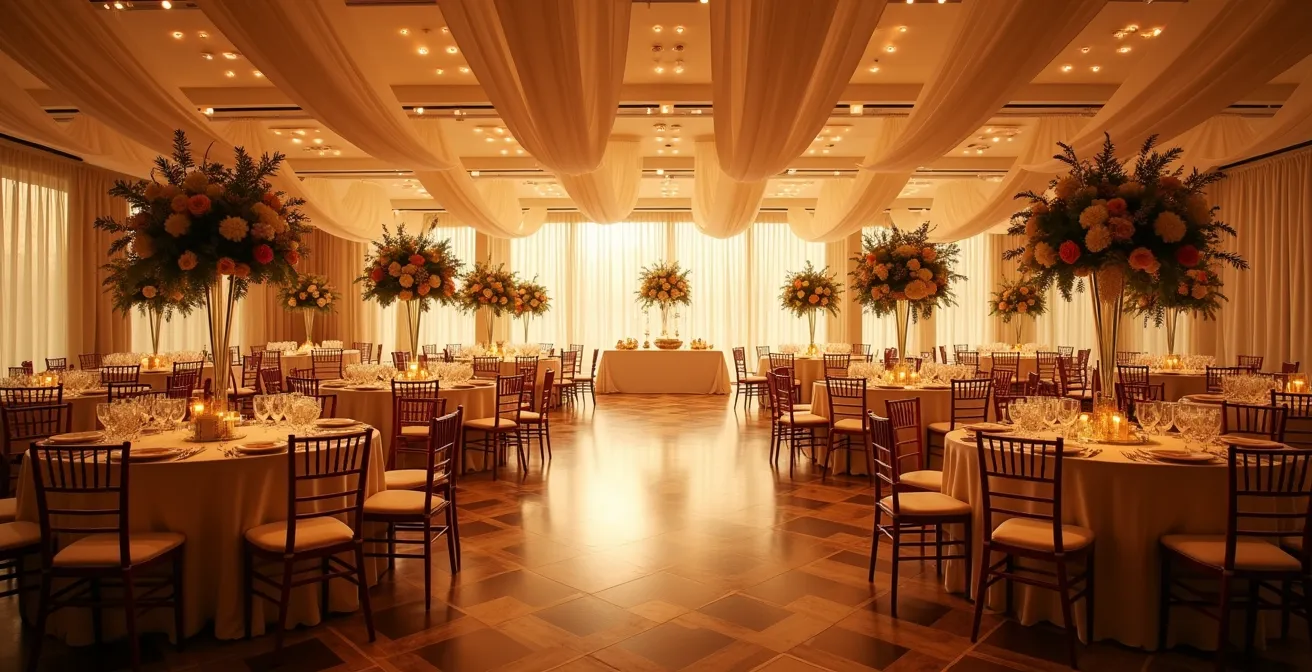
The secret to transforming a bland hotel ballroom isn’t just decoration; it’s architectural illusion.
- Instead of trying to cover flaws like ugly carpets, strategically draw the eye upward using vertical lighting and tall centerpieces.
- Swap out standard banquet chairs. As the most numerous item in the room, upgrading chairs offers the single highest return on visual impact.
Recommendation: Focus your budget on manipulating the room’s perceived height and shape to create intimate, personalized zones, rather than spreading it thin on superficial decor.
You found the perfect wedding date, the hotel package was a great deal, but there’s one sinking feeling you can’t shake: the ballroom. It’s a sea of swirly, patterned carpet, beige temporary walls, and the kind of chairs that scream “corporate conference.” You’re picturing your dream wedding, but all you can see is a high school prom venue. The conventional advice is to throw money at the problem with flowers and linens, hoping to cover the mundane. But this rarely works. The room’s inherent “boxiness” and corporate feel often overpower these decorative touches, leaving you with a beautifully decorated conference room, not a transformed romantic space.
The core issue isn’t a lack of decoration, but a lack of atmosphere and architectural character. So, what if the solution wasn’t about hiding the flaws, but about rendering them irrelevant? What if you could use strategic design to create an entirely new perceptual experience for your guests? This is the art of architectural illusion. It’s about manipulating light, volume, and layout to make your guests forget they’re in a standard hotel ballroom altogether. It’s a game of strategic distraction, where you become the director of your guests’ attention.
This guide will move beyond the basics of uplighting and chair covers. We will delve into the expert techniques that venue designers use to fundamentally alter a space. We’ll explore how to leverage verticality to erase the floor from your guests’ consciousness, why changing one piece of furniture is the most powerful move you can make, and how to carve intimate, magical pockets out of a vast, impersonal hall. Prepare to stop decorating and start redesigning.
In this article, we’ll guide you through the expert strategies that turn a generic space into a personal and unforgettable venue. You will discover a clear roadmap to master the art of venue transformation.
Summary: From Bland Ballroom to Breathtaking Venue
- The distraction technique: drawing the eye up to avoid the busy floor
- Why swapping out the “banquet chair” is the #1 transformational move?
- Hazers and fog: what hotels typically ban and how it affects your party?
- Covering the dividers: making a partitioned room feel permanent
- Tall centerpieces: the secret to filling the vertical volume of a ballroom
- Avoiding the high school prom look in large rectangular halls
- Gobo projection: creating “dappled leaf” shadows on the walls
- How to Create Intimate Pockets in a Giant Warehouse Venue?
The distraction technique: drawing the eye up to avoid the busy floor
The single biggest sin of most hotel ballrooms is the floor. That busy, patterned carpet is designed to hide stains, not to complement your romantic aesthetic. The most common mistake couples make is trying to fight it directly, either by ignoring it or attempting to cover it with an expensive, temporary dance floor. The expert solution is far more elegant: make the floor invisible. This is achieved through strategic distraction, a technique that forces your guests’ eyes to look up, focusing on the beautiful elements you’ve created above their eye line.
The most powerful tool for this is vertical uplighting. By placing lighting fixtures around the perimeter of the room, you create dramatic columns of light that shoot up the walls and toward the ceiling. This immediately adds height, drama, and a sense of architectural importance to a plain room. The light itself becomes a feature, drawing attention away from the ground and creating a sophisticated ambiance that no floral arrangement alone can achieve. The interplay of light and shadow on the walls adds a texture and depth that transforms flat surfaces into a dynamic canvas.
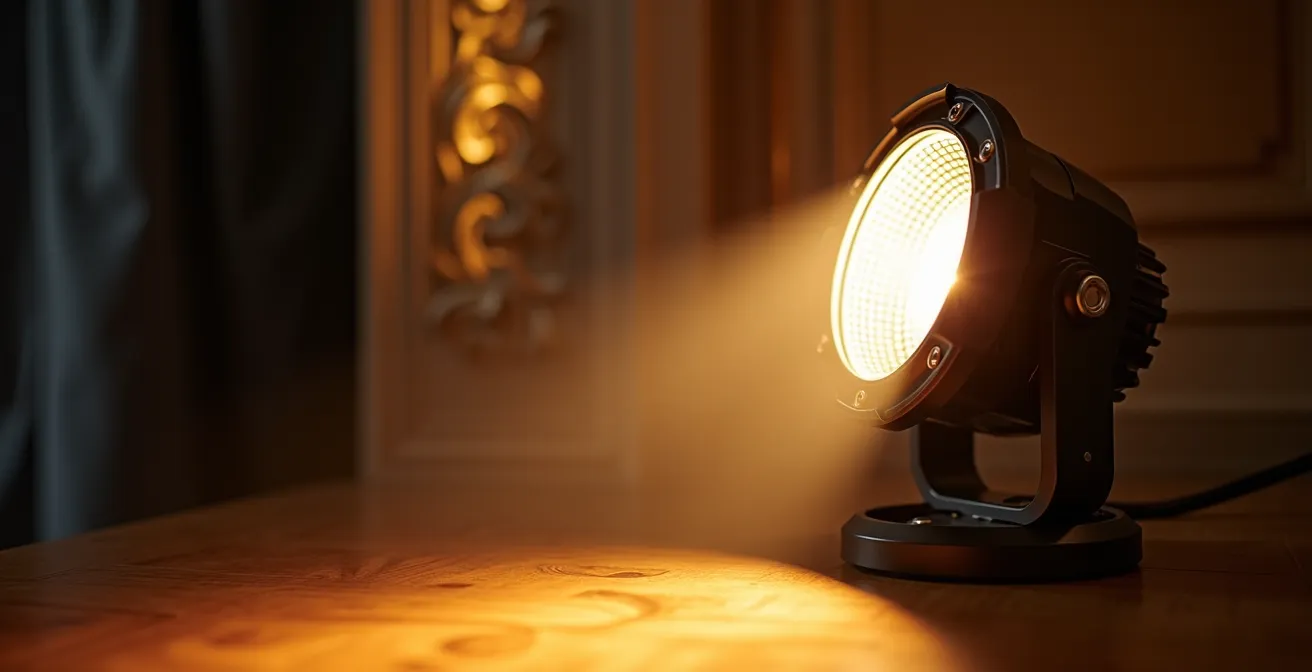
As you can see, the light itself becomes an architectural element. It doesn’t just illuminate the room; it redefines its boundaries. For a truly professional effect, remember that consistency is key. You’ll need enough fixtures to create a cohesive look; in fact, wedding planners often suggest that at least 20 ambient LED uplights are needed to properly transform an average-sized ballroom. This investment in lighting is the foundational step in your architectural illusion, setting the stage for everything else.
Your Action Plan: Mastering Vertical Design
- Perimeter Uplighting: Install uplighting fixtures around the room’s perimeter, spaced approximately 8-10 feet apart, to create strong vertical columns of light.
- Suspended Elements: Add chandeliers, pendant lights, or even floral installations at varying heights to create a visual journey for the eye and fill the upper volume of the room.
- Textural Projection: Use gobo projectors to cast subtle patterns (like leaves or abstract shapes) onto the ceiling and upper walls, adding another layer of visual interest.
- Centerpiece Height: Ensure your centerpieces have significant verticality, with tall floral arrangements or candelabras drawing the eye upward from the tables.
- Focal Point Highlight: Use a dedicated spotlight on a key feature, like your wedding cake or the sweetheart table, to create a powerful focal point that commands attention.
Why swapping out the “banquet chair” is the #1 transformational move?
If you can only make one significant change to your ballroom, make it the chairs. It may sound trivial, but nothing screams “hotel conference” louder than a standard, cushion-backed banquet chair. Think about it: chairs are the single most numerous piece of furniture in the room. They are everywhere. Upgrading them isn’t just a decorative choice; it’s a fundamental shift in the room’s entire character. A beautiful Chiavari, Cross-back, or Ghost chair doesn’t just provide seating; it acts as a repeating sculptural element that defines the space.
The visual impact is immediate and profound. Standard banquet chairs are bulky and dark, absorbing light and visually cluttering the space. An elegant rental chair, like the classic Chiavari, has an open back and delicate spindles, allowing light and sightlines to pass through. This instantly makes the room feel larger, brighter, and more refined. For a 150-guest wedding, you’re looking at 150 individual style statements that work in unison. According to wedding planners, this is one of the highest-ROI moves you can make, as it impacts guest comfort, your photos, and the overall atmosphere more than almost any other single rental item.
The cost of renting chairs is a critical factor, but viewing it in terms of visual impact helps contextualize the investment. A simple upgrade can elevate the entire aesthetic from standard to stunning, as shown by data from an analysis of wedding rental costs.
| Chair Type | Average Cost per Chair | Visual Impact | Best For |
|---|---|---|---|
| Standard Folding | $1.50-$3 | Basic | Budget-conscious outdoor weddings |
| Chiavari | $5-$10 | Elegant | Classic ballroom transformations |
| Ghost/Acrylic | $7-$15 | Modern & Airy | Contemporary minimalist venues |
| Cross-back | $5-$10 | Rustic Charm | Modern farmhouse aesthetic |
While the budget increase is real—an upgrade from standard to Chiavari chairs can add $600-$1,200 for a 150-guest wedding—planners consistently report that it’s a worthy expense. An analysis on the subject confirms that for a 150-guest wedding, the added cost for upgrading to Chiavari chairs significantly impacts atmosphere and style, making it a high-return investment for visual transformation. You are not just renting seats; you are renting 150 pieces of architecture that will redefine your space.
Hazers and fog: what hotels typically ban and how it affects your party?
One of the most effective ways to create an ethereal, party-ready atmosphere is with haze or fog. A light haze catches lighting beams, making them visible in mid-air and creating a truly immersive, concert-like experience, especially on the dance floor. However, this is where you often collide with hotel policy. Most hotels have a strict ban on haze or fog machines because their sensitive, interconnected fire alarm systems can be triggered by the airborne particles, leading to a full building evacuation—the ultimate party killer.
This ban can feel like a major roadblock to creating a dynamic party vibe. But as an expert, you should see it as a creative challenge, not a dead end. First, always open a dialogue with the venue. Some may permit a “water-based” hazer (which produces finer, less dense particles than oil-based fog) if you agree to a controlled test with their maintenance staff present. Offering to limit its use to specific moments, like the first dance, can also help your case. But if the answer is a hard no, it’s time to pivot to even more creative alternatives that don’t rely on airborne particles.
Think about effects that create a similar sense of drama without lingering in the air. For example, a Nashville music industry wedding, unable to use haze, opted for synchronized CO2 blasts. These bursts of cold, white gas created epic, high-energy moments on the dance floor that dissipated instantly. Combined with gold lighting and live music, the effect was so memorable it became a talking point of the night. Other options include “dry ice” effects for a low-lying fog that stays below smoke detectors or using advanced lighting that creates beam effects through patterns and movement rather than haze.
Covering the dividers: making a partitioned room feel permanent
Draping walls, uplighting and creating environments with rentals and seating areas can make an otherwise traditional wedding venue extraordinary.
– Mary Dougherty, Mary Dougherty Photography
Many hotel ballrooms are not single, cohesive spaces but rather larger halls subdivided by movable, accordion-style air walls. These dividers, with their visible tracks and seams, are a dead giveaway of the room’s temporary and impersonal nature. The solution is to completely erase them from view with floor-to-ceiling fabric draping, a technique often called “pipe and drape.” This is another pillar of architectural illusion, as it allows you to create entirely new, soft, and elegant walls, making the room feel intentional and permanent.
Draping does more than just hide ugly walls; it fundamentally changes the room’s acoustics and feel. The fabric softens sound, reducing the echo common in large halls and creating a more intimate and comfortable atmosphere. When combined with uplighting, the draped fabric catches the light beautifully, creating a soft, romantic glow that panelled walls never could. You can choose from a range of colors and textures, from sheer white voiles for an airy, dreamy look to rich, dark velvets for a dramatic, moody vibe. This is your chance to literally build a new room inside the old one.
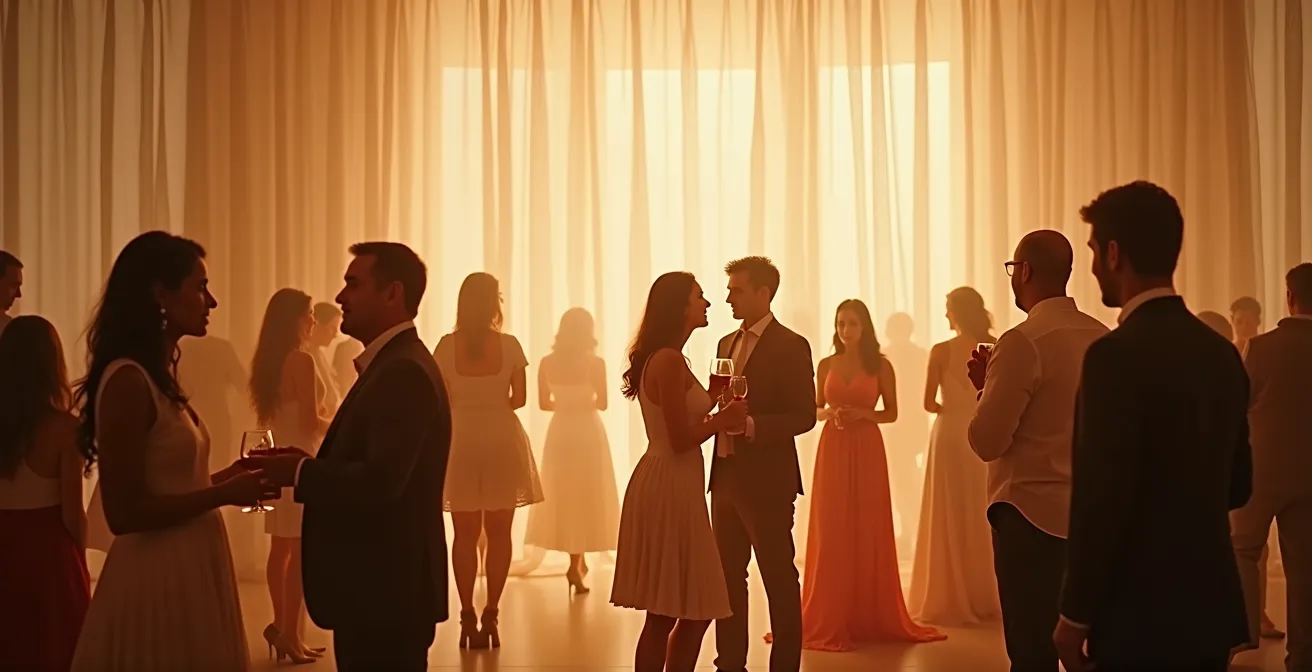
A well-executed draping strategy can be truly transformative. In one notable case, a dark, standard ballroom was turned into a vibrant, Palm Springs-inspired supper club. The designers used swathes of bright white fabric, lush greenery, and bold furniture to completely mask the room’s original structure. The result was a glamorous, sophisticated space that felt custom-built and permanent, successfully blending classic and modern elements. This proves that with strategic draping, the original walls of the room become completely irrelevant.
Tall centerpieces: the secret to filling the vertical volume of a ballroom
Once you’ve drawn the eye upward with lighting, you need to give it something beautiful to look at. This is where tall centerpieces come in. In a room with high ceilings—a common feature of ballrooms—short, low centerpieces can feel lost and squat, failing to make any real impact on the space. They leave a vast, empty “dead zone” between the tabletops and the ceiling. Filling this vertical volume is crucial to making the room feel lush, complete, and intentionally designed. Tall centerpieces are the secret weapon for achieving this.
The key is height. Wedding design experts suggest using centerpieces that are at least 30 inches tall in ballrooms with high ceilings. This ensures the arrangements rise above the seated eye-level, so they don’t block conversation across the table. The volume of the arrangement—be it flowers, branches, or candelabras—should be “high and tight,” concentrated at the top. This creates a dramatic visual canopy over each table, adding to the sense of intimacy and grandeur.
To maximize the effect, don’t make every centerpiece identical. Create a dynamic landscape by alternating between tall, dramatic arrangements and lower, fuller ones on different tables. This creates rhythm and visual interest throughout the room. You can also incorporate non-floral elements like towering Manzanita branches, elegant candelabras, or even sculptural light fixtures. To make these tall arrangements truly pop, use pin spotlighting—a narrow beam of light focused directly on each centerpiece. This technique illuminates the arrangement, making it a radiant focal point and casting beautiful, dramatic shadows that add to the room’s overall texture and mood.
Avoiding the high school prom look in large rectangular halls
The default layout for a hotel ballroom reception is tragically predictable: a large, empty dance floor in the center, with dining tables arranged rigidly around the perimeter. This is the “high school prom” layout, and it’s a primary contributor to that generic, impersonal feeling. It creates a vast, intimidating void in the middle of the room and forces guests to the sidelines. A truly transformed space breaks free from this rigid symmetry and instead focuses on creating dynamic, asymmetrical zones that encourage movement and interaction.
Instead of one massive space, think of your ballroom as a collection of smaller, curated experiences. Create a sophisticated lounge area in one corner with rented sofas, armchairs, and a coffee table. Place the bar in another area to create a natural gathering spot. Mix up the table shapes and sizes—a combination of long rectangular tables and classic round ones adds far more visual interest than a uniform sea of circles. This approach, creating smaller vignettes, not only adds character but also keeps the energy of the reception dynamic. Guests are encouraged to move between zones, from the high-energy dance floor to a quiet conversation in the lounge.
Lighting is your best friend in defining these zones. As Kevin Dennis of Fantasy Sound Event Services notes in a piece for The Knot, uplighting is crucial because it can highlight the venue in ways traditional lighting can’t, while also eliminating the harsh fluorescent lights that kill any decorative effort. You can use different colored uplighting to define the lounge area versus the dance floor, or use spotlights to highlight the cake table as its own special vignette. By breaking up the rectangle, you replace the prom-night emptiness with the sophisticated flow of a high-end event.
Gobo projection: creating “dappled leaf” shadows on the walls
Once your structural elements like draping and uplighting are in place, it’s time to add layers of texture and personality. This is where gobo projection shines. A “gobo” is a small stencil placed inside a specialized lighting fixture that projects a pattern onto a surface. While commonly used to project a couple’s monogram onto the dance floor, its transformative power goes far beyond that. The most sophisticated use of gobos is to “paint” the walls and ceiling with light and shadow, creating organic, atmospheric textures.
Imagine washing the bland ballroom walls with the soft, dappled light of a forest floor, or projecting a subtle, elegant damask pattern onto the ceiling. These nature-inspired or architectural patterns add immense depth and character to the space. They break up the monotony of flat, draped walls and create a sense of place that feels anything but generic. This is a far more subtle and high-end approach than a bright monogram, turning the room’s surfaces into an integral part of your decor.
A great example of this was at Union Station in Dallas, where gobo projections were used to cast intricate patterns across the venue’s massive ceiling, adding significant ambiance and turning the architecture itself into a design element. You can even layer multiple gobo patterns for a more complex effect—for instance, a soft, out-of-focus wash of color as a base, with a sharper, more defined pattern projected over it. By coordinating the gobo design with your overall wedding theme (e.g., leafy patterns for a garden theme, art deco shapes for a vintage theme), you ensure a cohesive and deeply personalized environment.
Key Takeaways
- Think vertically: The key to masking flaws like ugly carpets is to draw the eye upward with strategic uplighting and tall centerpieces.
- Chairs are architecture: Upgrading from standard banquet chairs is the single most impactful visual change you can make, as they are the most numerous item in the room.
- Create zones, not a box: Avoid the “prom layout” by using furniture and lighting to divide the large room into smaller, intimate pockets like lounges and distinct bar areas.
How to Create Intimate Pockets in a Giant Warehouse Venue?
The final, and perhaps most crucial, element of transforming a large, impersonal space—whether it’s a ballroom or a warehouse—is the creation of intimate pockets. All the techniques we’ve discussed—lighting, draping, furniture, and layout—culminate in this goal: breaking down a single, cavernous room into a series of smaller, more human-scale environments. This is what truly makes a space feel personal, luxurious, and inviting. It’s the difference between hosting a party in a hall and curating an experience for your guests.
This “zoning” strategy is a proven concept; event transformation specialists have demonstrated that even a 10,000 sq ft warehouse can be successfully transformed using strategic lighting zones. In a ballroom context, this means using furniture and decor as functional dividers. Position two sofas back-to-back to create a natural separation for a lounge area. Use tall plants or decorative screens to create soft walls. Define different zones with area rugs that contrast with the main flooring. Each pocket should have its own slightly different vibe, encouraging guests to explore the space throughout the evening.
Lighting is paramount in this strategy. A large ballroom was successfully divided into intimate zones by dramatically shifting the lighting throughout the night. By dimming lights in the dining area after dinner, lighting hundreds of candles, and using brilliant blue uplighting to signal the start of the party on the dance floor, the team created a palpable change in ambiance. This made different areas feel like entirely separate spaces while still maintaining a cohesive flow. This is the pinnacle of architectural illusion: using nothing but light and strategic placement to build and rebuild the room around your guests as the night progresses.
By mastering these techniques of architectural illusion, you can take any generic ballroom and mold it into a space that is uniquely and beautifully yours. Your wedding day should reflect your personality, not the hotel’s standard-issue decor. Start planning your transformation today to ensure your venue is as unforgettable as the celebration itself.