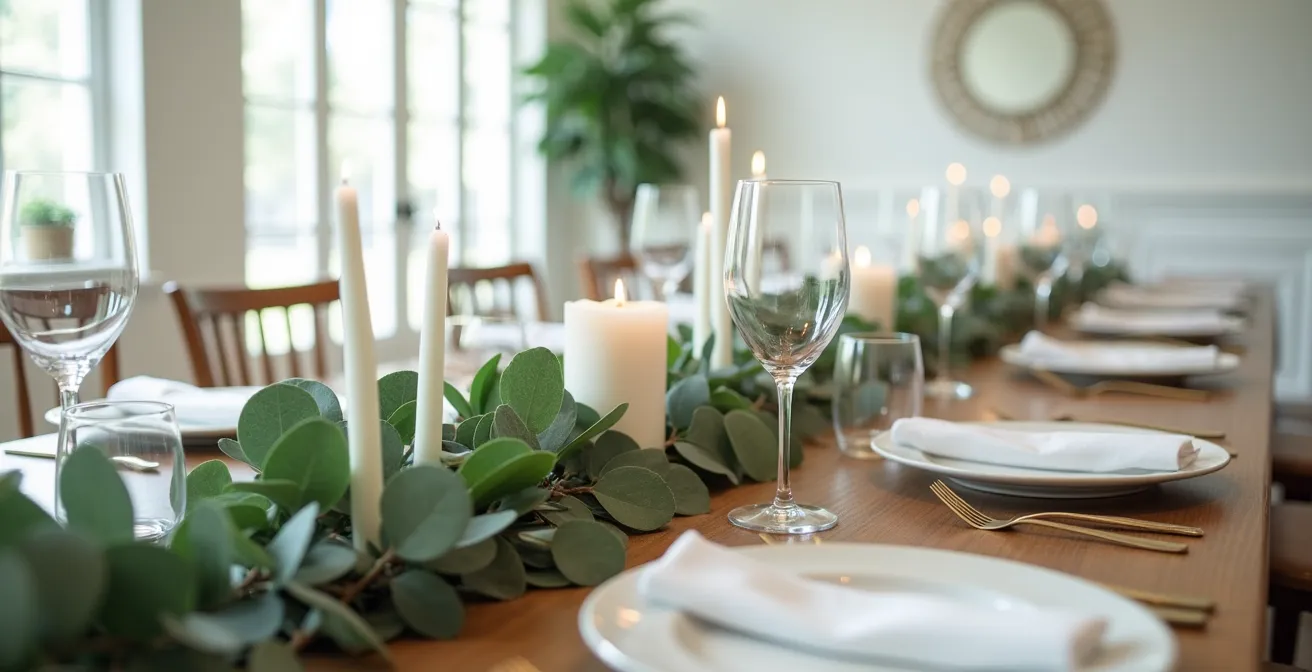
The secret to a lush eucalyptus runner isn’t just adding more greenery; it’s building it with architectural intention.
- Create volume by selecting the right varieties and building height with hidden structures, not just laying a flat garland.
- Plan your table’s spatial real estate to ensure the runner, plates, and candles fit comfortably without looking cramped.
- Use pre-wired modular sections for rapid, stress-free assembly on the day of the event.
Recommendation: Treat your tablescape like a blueprint. Plan for layers, structure, and workflow before a single leaf is placed on the table.
The image is everywhere: a long, rustic farm table graced with a cascade of fresh eucalyptus. It promises effortless elegance and a touch of organic beauty. Yet, for many couples, the reality falls short. The runner looks sparse, flat, and starts to wilt before the main course is even served. The dream of a lush, vibrant tablescape quickly wilts into a disappointing, limp line of greenery. The common advice—”just buy a long garland”—ignores the fundamental principles of design and logistics that separate an amateur attempt from a breathtaking, professional installation.
Most guides focus on the what, not the how. They tell you to use Silver Dollar eucalyptus and add some candles, but they don’t explain the architectural strategy required. They fail to address the crucial question of spatial planning: how to fit a voluminous runner, full place settings, and ambient lighting on a standard table without it feeling chaotic. They offer no solutions for managing the powerful scent that can interfere with the culinary experience, nor do they provide a professional workflow for ensuring the greenery looks as fresh at the end of the night as it did at the beginning.
But what if the key wasn’t simply decorating, but tablescape architecture? This guide reframes the process. We will move beyond simple placement and into strategic construction. We won’t just suggest materials; we’ll analyze their properties to maximize volume and coverage for your budget. We’ll build height without foam, manage scent through zoning, and plan the table’s layout with a designer’s eye for space and function.
By adopting the mindset of an architect, you will learn to build a eucalyptus runner that has structure, volume, and longevity. This article will deconstruct the process, from selecting the most effective varieties and pre-assembling modular sections to coordinating with vendors for a seamless day-of execution. The result will be the lush, flowy, and vibrant centerpiece you envisioned.
This comprehensive guide breaks down the architectural approach to styling your greenery. The following sections will walk you through every critical decision, from material selection to day-of workflow, ensuring your tablescape is a structural and aesthetic triumph.
Summary: How to Style Eucalyptus Runners That Look Lush and Don’t Dry Out?
- Which variety lays flatter and covers more table surface for the money?
- Techniques for adding height to a greenery runner without using foam
- Does the smell of eucalyptus ruin the taste of the wine?
- Why you need an 8-foot wide table to fit a runner, candles, and plates comfortably?
- How to wire greenery bunches beforehand to speed up venue access time?
- Chiffon runner vs. Naked wood: which creates a better frame for centerpieces?
- Why you must lay runners before the florist arrives, not after?
- How to Style Gauze Runners So They Look Flowy, Not Messy?
Which variety lays flatter and covers more table surface for the money?
The foundation of a lush, cost-effective runner lies in selecting the right raw materials. Not all eucalyptus is created equal. The default choice, Silver Dollar, is popular for a reason: its large, round leaves lay naturally flat, providing excellent surface coverage. However, a tablescape architect knows that true volume and texture come from a strategic blend of varieties. For pure fill and maximum volume, Gunni and Parvifolia eucalyptus are superior choices, offering a high density of smaller leaves per stem that create a fuller look for less cost.
The professional technique isn’t to use one variety, but to layer them. Start with a base of cheaper, robust greens like Salal or Ruscus to build the initial shape and length. Then, layer the high-impact (but more expensive) Silver Dollar eucalyptus on top for its classic look. Finally, intersperse clusters of Seeded eucalyptus at regular intervals. The seeds add a third dimension of texture and visual interest, breaking up the monotony and making the entire arrangement appear more dynamic and abundant.
This layered approach is the most efficient use of your budget. By using less expensive greens for the structural base, you can dedicate your premium eucalyptus stems to the most visible areas, achieving a high-end look without the corresponding price tag. The key is to think in terms of function: some greens build the foundation, while others provide the star power.
To better understand the trade-offs, this analysis breaks down the most common varieties by their key architectural properties, as detailed by floral experts at FiftyFlowers in their guide to event design.
| Variety | Flatness Factor | Coverage per Stem | Cost-Effectiveness | Best Use |
|---|---|---|---|---|
| Silver Dollar | Excellent (naturally flat) | Large round leaves, symmetrical | High – most popular, widely available | Classic runners, cohesive look |
| Seeded | Good (flexible stems) | Medium – clusters create texture | High – adds dimension without bulk | Textured runners, cascading edges |
| Baby Blue | Poor (upright structure) | Low – stacked parallel leaves | Medium – better for height | Adding vertical dimension |
| Gunni | Very Good (tapered shape) | High – many small leaves per stem | Very High – maximum volume | Filling gaps, amplifying arrangements |
| Parvifolia | Very Good (similar to Gunni) | High – pointed leaves, dense | High – good Gunni substitute | Year-round availability backup |
Techniques for adding height to a greenery runner without using foam
A flat runner is a dead runner. To achieve that coveted lush, dimensional look, you must build structural height. Floral foam is a common shortcut, but it’s environmentally unfriendly and can make the arrangement look stiff. An architect’s approach uses the greenery itself and hidden supports to create organic, flowing elevation. The most effective method is the “mounding” technique: gather a 3-to-4-foot section of the runner, pinch it together, and secure it with floral wire. This instantly creates a dense, voluminous mound of foliage.
To create more dramatic and varied elevation, integrate hidden pedestals. Small, overturned bowls, wooden blocks, or even sturdy candle bases can be placed at two-foot intervals along the table’s centerline before the runner is laid. The greenery is then draped over these supports, creating natural peaks and valleys. This method gives the runner a dynamic, undulating shape that feels alive and abundant. The key is to ensure these supports are completely concealed by the foliage.
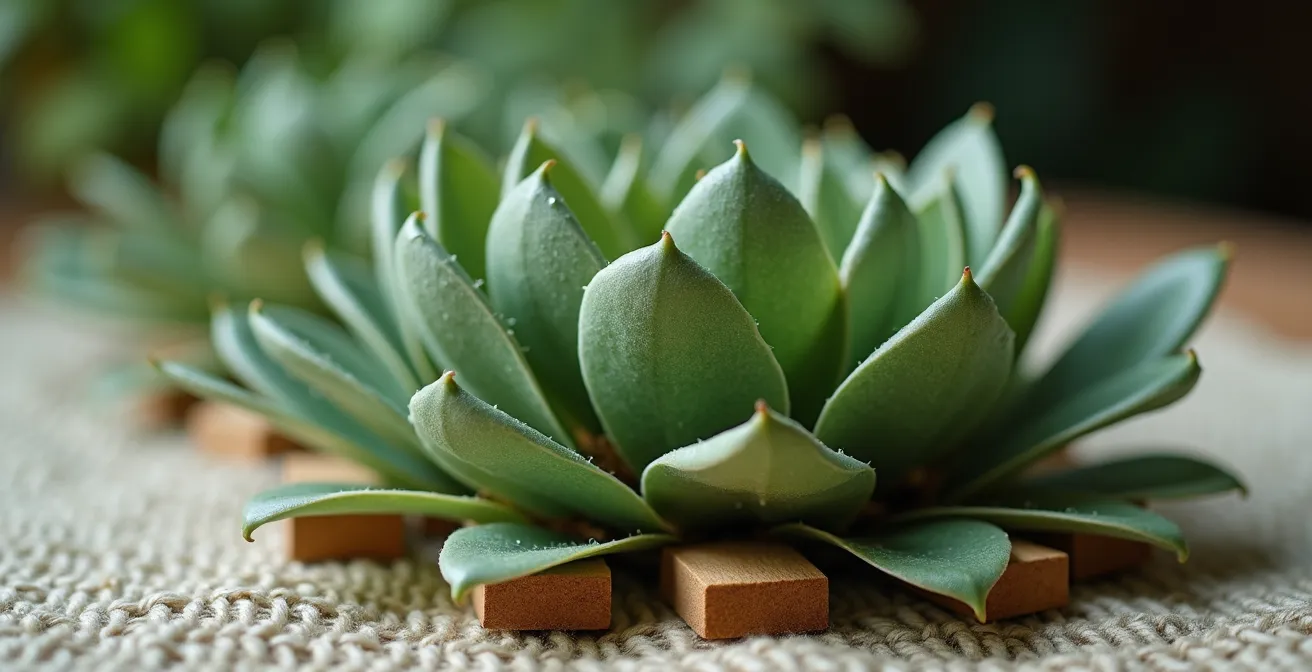
For an even more robust structure, create a branch armature. Use rigid, woody branches like Forsythia or Manzanita as a base skeleton down the center of the table. Wire your eucalyptus bunches directly onto this armature, varying their height and angle. This technique provides a strong, internal framework that guarantees volume and stability throughout the event. Finally, weave the runner around taller elements like candle holders and bud vases. This integrates the runner with the rest of the tablescape, creating the illusion of a single, unified centerpiece with effortless height.
These foam-free techniques are the secret to professional-looking runners. They create a more natural, organic feel while ensuring your runner has the volume and presence to make a real statement. The goal is to build an arrangement that flows, rather than one that is simply placed.
Does the smell of eucalyptus ruin the taste of the wine?
A tablescape architect considers all sensory inputs, not just the visual. The strong, medicinal scent of eucalyptus, while pleasant to some, can be a major issue at a wedding, especially a wine-heavy event. The potent aromatic compounds in eucalyptus can overpower the delicate bouquet of fine wines and even alter the perceived taste of food. This is a critical detail that is often overlooked in the pursuit of aesthetics. Ignoring it can inadvertently sabotage the culinary experience you’ve so carefully planned.
The solution is not to abandon eucalyptus entirely, but to practice scent zoning. First, select your varieties wisely. Gunni Eucalyptus, with its smaller leaves and milder scent, is a much better choice for dining tables than the more pungent varieties. Professional florists often recommend substituting eucalyptus with olive or bay branches for the sections closest to guests’ place settings. Olive branches are an ancient symbol of peace and provide a subtle, pleasant aroma that complements food and wine rather than competing with it.
Next, strategically place the most aromatic elements. Concentrate the stronger-scented eucalyptus varieties at the ends of the table, at least three feet away from the nearest wine glass. Use the less pungent Silver Dollar or Parvifolia in the central dining zones. The timing of your prep is also crucial. Assemble the runners on the day of the event in a well-ventilated space to allow the initial intense scent to dissipate. If possible, store the completed runners in a chilled wine room; the cold maintains freshness while taming the aroma. A light spritz with water every few hours before guests arrive keeps the leaves hydrated without concentrating the essential oils.
Why you need an 8-foot wide table to fit a runner, candles, and plates comfortably?
Many couples underestimate the sheer amount of table real estate a lush runner consumes. A common mistake is trying to force a wide, voluminous runner, full place settings, and multiple candles onto a standard 6-foot-wide banquet table. The result is a cramped, chaotic mess where charger plates hang off the edge and candles pose a fire risk. A tablescape architect knows that a comfortable and safe layout is a non-negotiable part of the design blueprint. For a traditional, centered runner with ample room for all elements, an 8-foot-wide table (or a wider farm table) is essential.
The math is simple. A standard dinner plate or charger is 10-12 inches in diameter. A full place setting with glassware and cutlery requires at least 15-18 inches of depth from the table edge. On an 8-foot (96-inch) wide table, two opposing place settings consume about 36 inches. This leaves a generous central corridor of up to 24 inches for your runner and decor. This space allows for a runner that is 14-16 inches wide, with an adequate safety zone around real candles.
On a 6-foot (72-inch) table, however, the same place settings leave only a 12-inch central space. This forces you to use a very thin runner (10 inches max), which often looks sparse, or to use compact place settings, which can feel inadequate. Real candles become a hazard, making LEDs the only safe option. According to professional florist calculations from Flower Moxie, the amount of greenery needed also changes dramatically; it takes a full bunch of Silver Dollar eucalyptus to cover just one foot of an 8-foot table runner, showcasing the density required for a lush look that demands space.
If you are working with narrower tables, you must adjust your architectural plan. The best solution is an “offset runner” technique, where the greenery is placed closer to one side of the table, creating a more artistic, asymmetrical layout that frees up space for place settings on the other side.
This table real estate formula demonstrates the direct relationship between table width and your design possibilities.
| Table Width | Max Runner Width | Place Setting Space | Candle Safety Zone | Layout Solution |
|---|---|---|---|---|
| 6 feet | 10-12 inches | Limited – requires compact settings | Minimal – use LED candles | Offset Runner technique |
| 8 feet | 14-16 inches | Comfortable – standard chargers fit | Adequate – real candles safe | Traditional centered runner |
| Custom/Farm tables | 18+ inches | Generous – multiple courses possible | Excellent – multiple candle heights | Cascading runner with spillover |
How to wire greenery bunches beforehand to speed up venue access time?
Venue access is often limited to a few short hours, making on-site assembly a high-stress race against time. The professional solution is the Modular Runner Method: pre-assembling the runner in manageable sections beforehand. Instead of trying to construct a 40-foot garland in one go, you build it in shorter, 3-foot pre-wired sections that are easy to transport and can be connected on-site in minutes. This is the single most effective strategy for a fast, flawless setup.
The technique involves creating mixed bunches of greenery—a base of Silver Dollar, filler like Ruscus, and a textural accent of Seeded eucalyptus—and wiring them tightly together. Each 3-foot section is built as a complete mini-runner. The critical step is to leave a 3-inch tail of floral wire at each end of the section, which you fashion into a small connector loop. These loops are how you will quickly link the sections together at the venue.
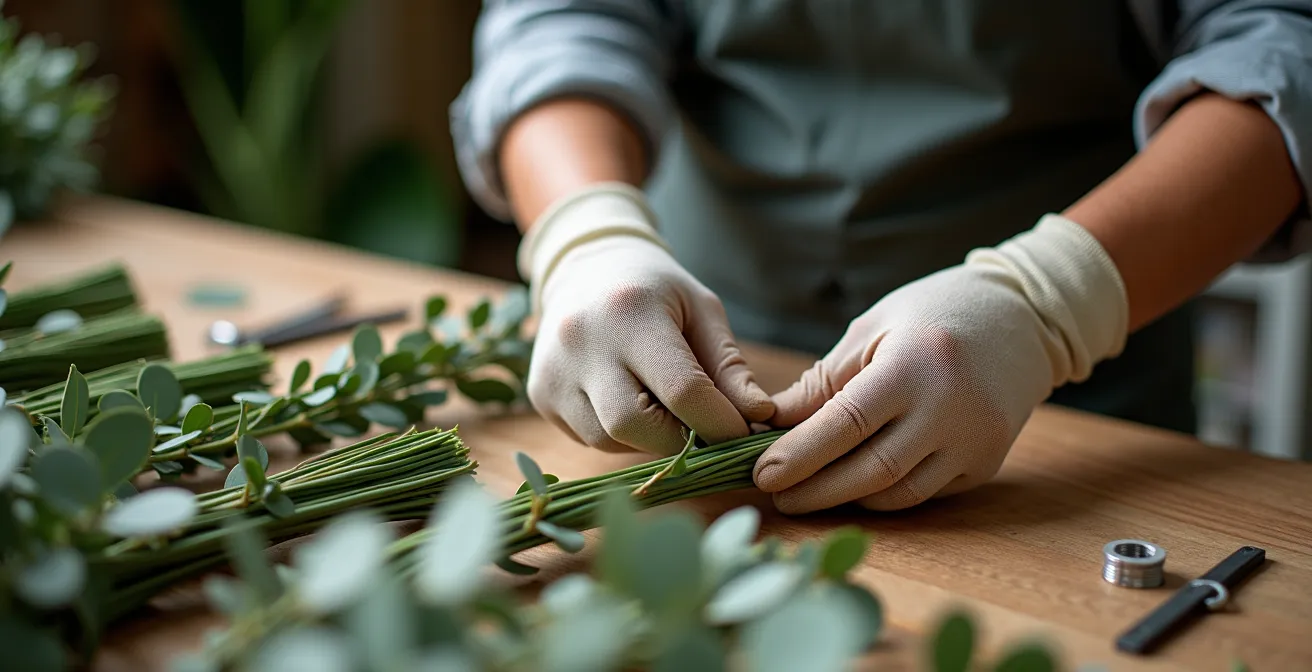
These pre-wired sections should be created 1-2 days before the event. To keep them fresh, store them in large plastic bags (like contractor bags) in a cool, dark place, ideally a refrigerator or a cool basement. Do not seal the bags completely, to allow for some air circulation and prevent mold. On the day of the wedding, transport the sections in coolers or insulated boxes. The on-site “assembly” is then reduced to simply laying out the sections and twisting the connector loops together. What would have taken hours of frantic work can be completed in under 15 minutes for 40 feet of runner.
This modular approach is a cornerstone of professional event floristry. It de-risks the setup process, guarantees a consistent and high-quality result, and frees up valuable time for final finessing.
Action Plan: The Modular Runner Method for Quick Assembly
- Create 3-foot pre-wired sections instead of one long runner for easy transport and handling.
- Use 3 inches of floral wire to create secure connector loops at the end of each modular section.
- Pre-assemble mixed greenery bunches: combine a Silver Dollar base with Ruscus filler and a Seeded accent for texture.
- Store completed wired sections in plastic bags in a refrigerator or cool room 1-2 days before the event to maintain freshness.
- On-site, connect the sections by twisting the loops together; assembly for 40 feet of runner should take under 15 minutes.
Chiffon runner vs. Naked wood: which creates a better frame for centerpieces?
The surface beneath your eucalyptus runner is not just a backdrop; it is an active element in your tablescape architecture. The choice between a fabric runner, like chiffon or gauze, and a naked wood table fundamentally changes how light interacts with the greenery and, therefore, its overall appearance. While a naked wood farm table offers rustic charm, a fabric runner provides a superior frame for your centerpiece by manipulating light and adding softness.
A fabric runner acts as a reflector. Light from candles or overhead fixtures bounces off the fabric and up into the eucalyptus garland. This upward-cast light illuminates the undersides of the leaves, highlighting their texture, shape, and subtle color variations. It creates a more three-dimensional, vibrant appearance, making the greenery look fuller and more alive. As event designers have found, even a dark navy satin tablecloth under a runner can create a sophisticated look because the fabric’s sheen reflects the light from LED candles upward into the foliage.
In contrast, a naked wood surface absorbs light. This can cause the underside of your runner to fall into shadow, making it appear flatter and less detailed. The hard texture of the wood also creates a stark contrast with the soft foliage, which can sometimes look disjointed. A soft chiffon or gauze runner provides a crucial transitional layer, blurring the line between the hard table and the organic greenery. It adds a layer of softness and movement that complements the natural flow of the eucalyptus, creating a more cohesive and thoughtfully designed tablescape.
The fabric also helps to ground the centerpiece. It provides a clear visual axis and a defined space for the greenery, making the entire arrangement feel more intentional and less like it was simply placed on the table. For a truly professional look, the fabric runner is an indispensable architectural element.
Why you must lay runners before the florist arrives, not after?
The sequence of operations on a wedding day is a tightly choreographed dance, and one of the most critical steps in tablescape architecture is the order of decor placement. The rule is absolute: fabric runners must be laid by the planner or catering staff *before* the florist begins their work. Attempting to slide a fabric runner underneath a fully constructed, multi-section eucalyptus garland is not just difficult; it’s a recipe for disaster. It risks destroying the centerpiece you’ve invested so much time and money into.
A professionally made eucalyptus runner is not a single, flexible object. It is a series of carefully constructed sections held together by numerous wire connection points. As detailed in professional florist guidelines, a simple 4-foot runner can require securing four separate bunches with multiple wires. Trying to lift this fragile structure to slip a runner underneath will inevitably snag the fabric, dislodge leaves, and break the delicate wire connections, causing the entire arrangement to fall apart. It’s a costly and time-consuming mistake that can send your day-of timeline into a tailspin.
The correct, professional workflow is a clear, sequential process designed for efficiency and safety:
- Event Planner/Catering: Lays and secures all fabric runners (chiffon, gauze, linen). This establishes the central axis and visual guide for all subsequent decor.
- Florist: Places the pre-assembled greenery runners directly onto the fabric, using it as a precise positioning guide. They then add any larger floral centerpieces, ensuring symmetrical placement.
- Catering Staff: Sets the plates, glassware, and flatware around the now-established and immovable decor.
- Final Touch: The florist performs a final misting of the greenery after all other elements are in place to ensure maximum freshness.
Adhering to this sequence is not a suggestion; it is a logistical necessity. It protects the integrity of the floral designs, ensures a clean and efficient setup, and prevents unnecessary stress and damage on a day when time is the most precious commodity.
Key takeaways
- Architectural Approach: Treat your runner not as a decoration, but as a structure to be built with layers, height, and volume.
- Material Strategy: Blend cost-effective filler greens like Gunni with high-impact varieties like Silver Dollar to maximize lushness on a budget.
- Logistical Planning: Use modular, pre-wired sections for rapid on-site assembly and adhere to a strict workflow where fabric runners are placed *before* any greenery.
How to Style Gauze Runners So They Look Flowy, Not Messy?
While a eucalyptus garland provides structure and lushness, a gauze or chiffon runner underneath provides the flow and softness. However, there is a fine line between “artfully flowy” and “just plain messy.” The key is a technique of calculated casualness. You are not simply draping the fabric; you are sculpting it. The goal is to create graceful, organic curves and puddles, not a wrinkled, haphazard strip of cloth. This requires a specific, intentional technique.
Begin by thinking of the fabric runner as a riverbed for your eucalyptus. First, iron or steam the gauze runner thoroughly. Wrinkles are the enemy of a flowy look. Start at one end of the table and gather a 3-to-4-foot section of the fabric in your hands. Create one large, deliberate S-shaped curve along the centerline of the table. Once you are happy with the shape, gently pull the next section of fabric taut before creating the next S-curve. This contrast between gathered curves and taut straightaways is what creates a dynamic, intentional look.
To keep these delicate folds in place, especially in outdoor or high-traffic settings, use hidden weights. Small fishing weights, clear glass beads, or decorative stones can be tucked discreetly into the pockets of the folds to anchor them. This is particularly crucial for the “puddles” of fabric that drape onto the floor. An artfully arranged puddle secured with a hidden weight looks elegant; an unsecured one will inevitably be kicked and tangled, looking messy and becoming a trip hazard. As shown in case studies of professional setups, event designers begin their entire centerpiece process by first layering and ironing the table runners, demonstrating that this foundation is essential. The pre-pressed gauze provides the critical flowy base upon which the entire greenery arrangement is built.
By applying this calculated technique of gathering, pulling, and weighting, you control the chaos. You are the architect of the flow, ensuring the gauze runner serves as a graceful, elegant foundation that enhances, rather than detracts from, your stunning eucalyptus centerpiece.