The longevity of your wedding flowers depends more on structural mechanics and plant biology than on aesthetics.
- Strategic flower selection based on environmental resilience, not just color, is the primary defense against wilting.
- Professional hydration techniques and modular construction are non-negotiable for ensuring arrangements survive heat and transport.
Recommendation: Prioritize discussing bloom durability and logistical challenges with your florist, focusing on how arrangements will be built to last the entire event, not just for the photos.
The scene is all too common: breathtaking floral arches from the ceremony are reduced to a sad, drooping backdrop by the time speeches begin. Bouquets that were vibrant and full during the “I do’s” look tired and limp in the reception photos. For couples investing a significant portion of their budget into flowers, especially for a summer wedding, the fear of wilted blooms is a major source of anxiety. The internet is full of simple tips like “choose hardy flowers” or “keep them in water,” but this advice barely scratches the surface of what’s required for a 10+ hour event.
These platitudes fail to address the real-world challenges: extreme heat, direct sunlight, gusty winds, and the logistical nightmare of moving large, delicate structures from one location to another. The secret to floral longevity isn’t a simple trick; it’s a matter of professional expertise that blends plant science with engineering principles. It’s about understanding the cellular hydration of a bloom, the physics of a centerpiece, and the structural integrity of a hanging installation.
But what if the key to long-lasting flowers wasn’t just choosing the “right” ones, but understanding the mechanical and biological reasons they fail? This guide moves beyond Pinterest trends to reveal a master florist’s perspective. We will dissect the science of why some flowers collapse under pressure while others thrive. We will explore the professional techniques used to build arrangements that are not only beautiful but are engineered to endure. From the mechanics of hanging installations to the botany of heat resistance, you will learn how to have a conversation with your florist that ensures your flowers remain a stunning feature from the first kiss to the final dance.
This article will guide you through the critical mechanical and biological factors that determine the lifespan of your wedding flowers. Follow along to discover the professional strategies that keep every petal perfect throughout your special day.
Summary: How to Select Floral Arrangements That Won’t Wilt Before the Cake Cutting?
- How to keep hanging flowers fresh without a water source for 8 hours?
- Why choosing peonies in August is a recipe for a drooping disaster?
- Tall vs. Low: stopping your arrangements from blocking guest eye contact
- Roses or Proteas: which blooms withstand direct sunlight and wind better?
- How to move an arch to the sweetheart table without it falling apart?
- Why peonies collapse faster than roses in 30°C heat and how to save them?
- Gravity issues: preventing water from dripping on guests’ food
- Why Peonies Cost So Much and How to Get the Look When They’re Out of Season?
How to keep hanging flowers fresh without a water source for 8 hours?
Hanging floral installations are stunning, but they represent the ultimate challenge in floral design: a complete separation from a water source. The success of these pieces relies entirely on two factors: superior flower selection and meticulous pre-hydration. Not all flowers are created equal in their ability to withstand these conditions. The key is choosing blooms with low transpiration rates—the speed at which they lose water through their petals. This is a battle of biology before it’s a matter of artistry.
Professional florists use a multi-step process to ensure maximum cellular hydration before a single stem is hung. This involves conditioning flowers for up to 24 hours in a professional-grade floral food solution, followed by the application of an anti-transpirant spray. This invisible wax-like seal drastically reduces moisture loss. For particularly delicate blooms, stems can be individually wrapped with a hidden, damp medium. This isn’t just “keeping flowers fresh”; it’s a calculated, scientific approach to ensure they perform for the entire event.
The following table ranks common wedding flowers by their ability to survive out of water, a crucial guide for planning any hanging installation.
| Tier | Flower Types | Survival Time | Care Requirements |
|---|---|---|---|
| Tier 1 (Champions) | Orchids, Succulents, Anthurium, Proteas | 8+ hours | Minimal – naturally resilient |
| Tier 2 (Reliable) | Carnations, Roses (well-hydrated), Lisianthus | 4-6 hours | Pre-hydration essential |
| Tier 3 (High-Risk) | Hydrangeas, Astilbe, Lilies of the Valley | <3 hours | Requires water tubes or foam |
Ultimately, a successful hanging installation is a testament to a florist’s technical skill. It requires an intimate knowledge of plant physiology to create a gravity-defying moment that lasts.
Why choosing peonies in August is a recipe for a drooping disaster?
The desire for peonies is timeless, but their natural bloom cycle is not. Peonies are a late spring/early summer flower, with a peak season from April to June in the Northern Hemisphere. Requesting them for an August wedding sets off a chain of logistical and biological challenges that almost guarantees a disappointing result. The “peonies” you see in August are not fresh from a local farm; they are stressed-out international travelers.
To meet off-season demand, these flowers are typically air-freighted from the Southern Hemisphere, a journey of over 6,000 miles. This 48-to-72-hour trip involves significant temperature fluctuations and exposure to ethylene gas, a natural plant hormone that accelerates aging and petal drop. By the time they arrive at your venue, their cellular structure is fundamentally weakened. They may look beautiful upon arrival, but they lack the resilience to withstand a full wedding day, drooping hours after being arranged.
A knowledgeable florist will steer you away from this pitfall and toward beautiful, seasonally appropriate alternatives that provide the same lush, romantic aesthetic without the risk. The goal is to achieve the *look* you love with blooms that are at their peak of strength and beauty. Here are some professional-approved substitutions:
- ‘Juliet’ or ‘Patience’ David Austin Roses: These garden roses have a high petal count and can be gently reflexed (petals flipped back) to mimic a peony’s fullness.
- Double Tulips (in spring): When clustered, 3-4 stems of these multi-petaled tulips can create a volume comparable to a single peony.
- Ranunculus Clusters: Grouping 5-7 stems of these delicate, swirling blooms offers a similar romantic texture and appeal.
- ‘Alabaster’ Garden Roses: Choosing fully open blooms with over 40 petals provides an authentic peony-like appearance with far greater stability.
Opting for a robust, in-season alternative isn’t a compromise; it’s a strategic decision to ensure your flowers look as incredible at the end of the night as they did at the beginning.
Tall vs. Low: stopping your arrangements from blocking guest eye contact
Centerpiece height is a classic floral design dilemma. While tall, dramatic arrangements can create a “wow” factor, they often commit the cardinal sin of event design: blocking conversation. Guests are forced to peer around a dense wall of stems and leaves, effectively isolating them from those across the table. Low, lush arrangements are an easy solution, but they don’t provide the same vertical impact. The professional solution lies not in choosing one or the other, but in mastering the physics of social interaction.
The key is to respect what designers call the “conversation window.” According to interior design research, this is the critical zone for comfortable eye contact. An analysis confirms that the optimal ‘conversation window’ sits between 14-24 inches from the table surface. A skilled florist engineers arrangements to keep this space completely clear. This is achieved either by keeping arrangements below 14 inches or by elevating them significantly above the 24-inch mark.
The most elegant solution for achieving height without obstruction is the “floating cloud” effect, as seen in the illustration below. By using slender, often transparent stands, the main floral mass is lifted high above the sightline, creating drama and impact while preserving the all-important social connection underneath.
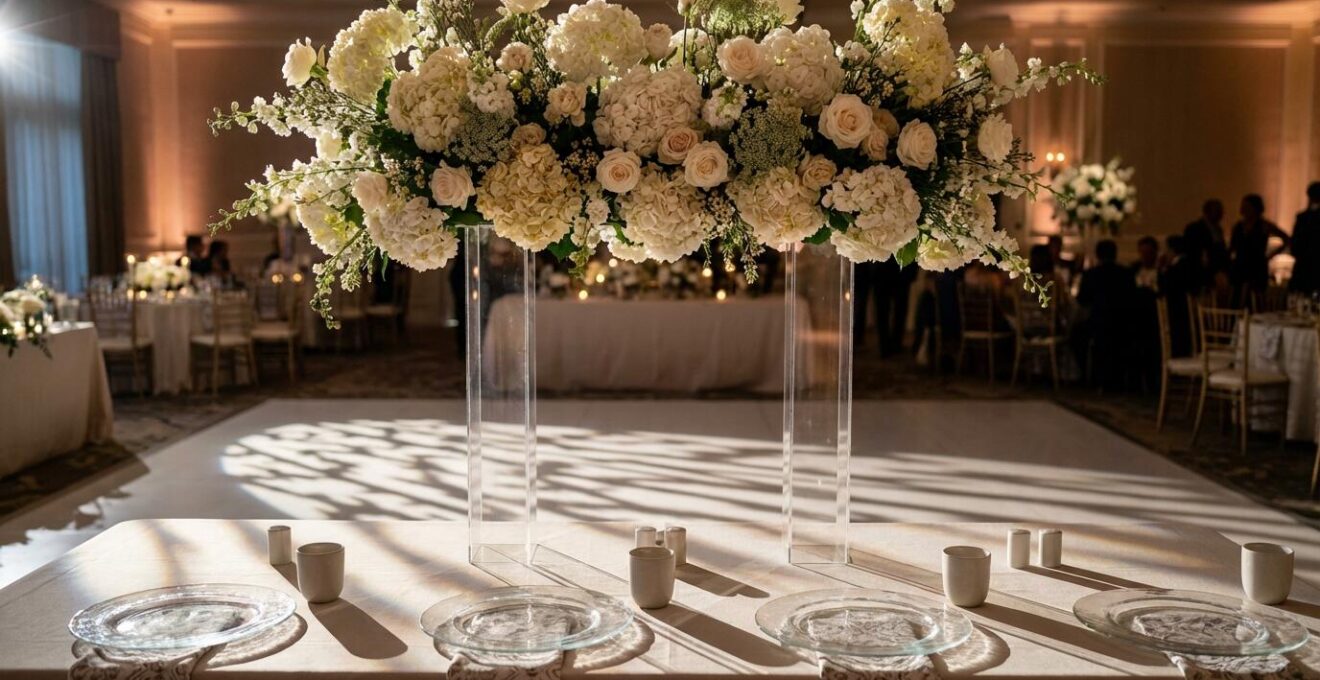
As this image demonstrates, the structural mechanics of the arrangement are paramount. The design prioritizes guest experience over simple floral density. It’s a sophisticated approach that proves that great floral design considers human dynamics as much as it does color and form. A centerpiece that kills conversation is a design failure, no matter how beautiful it is.
When discussing centerpieces with your florist, frame the conversation around “preserving the conversation window.” This signals that you prioritize guest experience, allowing your florist to propose mechanically sound and beautiful solutions.
Roses or Proteas: which blooms withstand direct sunlight and wind better?
For an outdoor ceremony, especially in summer, flower selection becomes a question of environmental resilience. The delicate petals of a classic rose and the robust structure of a protea offer a stark contrast in performance under harsh conditions. While a rose symbolizes classic romance, it is biologically ill-equipped for a battle against direct sun and high wind. Proteas, on the other hand, are botanical warriors.
Proteas evolved in the sun-drenched, windy fynbos region of South Africa. Their unique structure is a direct result of this harsh environment. What appear to be large petals are actually leathery bracts, which are modified leaves. These bracts are far more resistant to water loss (transpiration) and physical damage than the delicate petals of a rose. Research from floral experts confirms that certain flowers, like orchids and carnations, share this kind of resilience, but proteas are in a class of their own, minimizing water loss by up to 70% compared to roses. Their woody stems also provide superior resistance to snapping in the wind.
A rose, in contrast, will begin to show signs of wilting within two hours of direct 30°C (86°F) sun, its petals quickly becoming brittle and scorched. The following scorecard makes the performance difference clear.
| Condition | Proteas Performance | Roses Performance | Winner |
|---|---|---|---|
| Direct Sun (30°C+) | Excellent – evolved for harsh sun | Poor – wilts within 2 hours | Proteas |
| High Wind (>15 mph) | Superior – woody stems resist breaking | Moderate – petals shred easily | Proteas |
| Dappled Shade | Good | Excellent with hydration | Tie |
| Water Requirements | Minimal – drought tolerant | High – needs constant moisture | Proteas |
Choosing a protea over a rose for an exposed ceremony arch or bouquet isn’t a stylistic compromise; it’s a smart, strategic decision that guarantees your flowers will look as strong and vibrant as the vows you’re making.
How to move an arch to the sweetheart table without it falling apart?
Repurposing the ceremony arch as a backdrop for the sweetheart table is a smart, sustainable, and increasingly popular trend. A recent survey shows that a growing number of couples are embracing this eco-conscious approach, with 68% of 2025 couples planning to repurpose floral arrangements between the ceremony and reception. However, the execution is fraught with peril. A poorly constructed arch, not designed for movement, can easily disintegrate during transport, turning a moment of sustainable elegance into a logistical disaster.
The secret to a successful move lies in modular floral mechanics. A professional florist will anticipate the move during the initial design phase, building the arch not as a single, monolithic piece, but as several interlocking sections. Typically, this involves a large top garland and two separate side pieces, all secured with heavy-duty zip ties that can be easily and quickly snipped.
A seamless transition also requires a dedicated and prepared team. It’s not a job for random guests. The coordinator should assign at least two ushers to the task, armed with a “go-bag” containing essentials for the move and reassembly. The process must be swift, occurring immediately after the ceremony while guests are at cocktail hour, to ensure the structure is in place before the reception entrance. This level of planning is what separates a professional execution from an amateur attempt.
Your Action Plan: The Modular Arch Construction & Move Protocol
- Design Phase: Confirm with your florist that the arch will be built in 3 detachable sections (top garland + two side pieces) secured with removable zip ties.
- Prep the Move Team: Assign 2 ushers and the day-of coordinator to the task. Provide them with a ‘go-bag’ containing floral wire, extra zip ties, and pruning shears.
- Execution: The team must detach the sections immediately after the ceremony concludes, transporting each piece on a flat, stable surface to prevent crushing.
- Reassembly: Position the pieces behind the sweetheart table, reconnect them with fresh zip ties, and insert fresh water tubes into any stems that look stressed or exposed.
- Final Check: The coordinator should do a final check for stability and aesthetics before guests enter the reception space.
By discussing modular design with your florist from the outset, you ensure that your beautiful ceremony backdrop gets the second life it deserves, flawlessly and without a single petal out of place.
Why peonies collapse faster than roses in 30°C heat and how to save them?
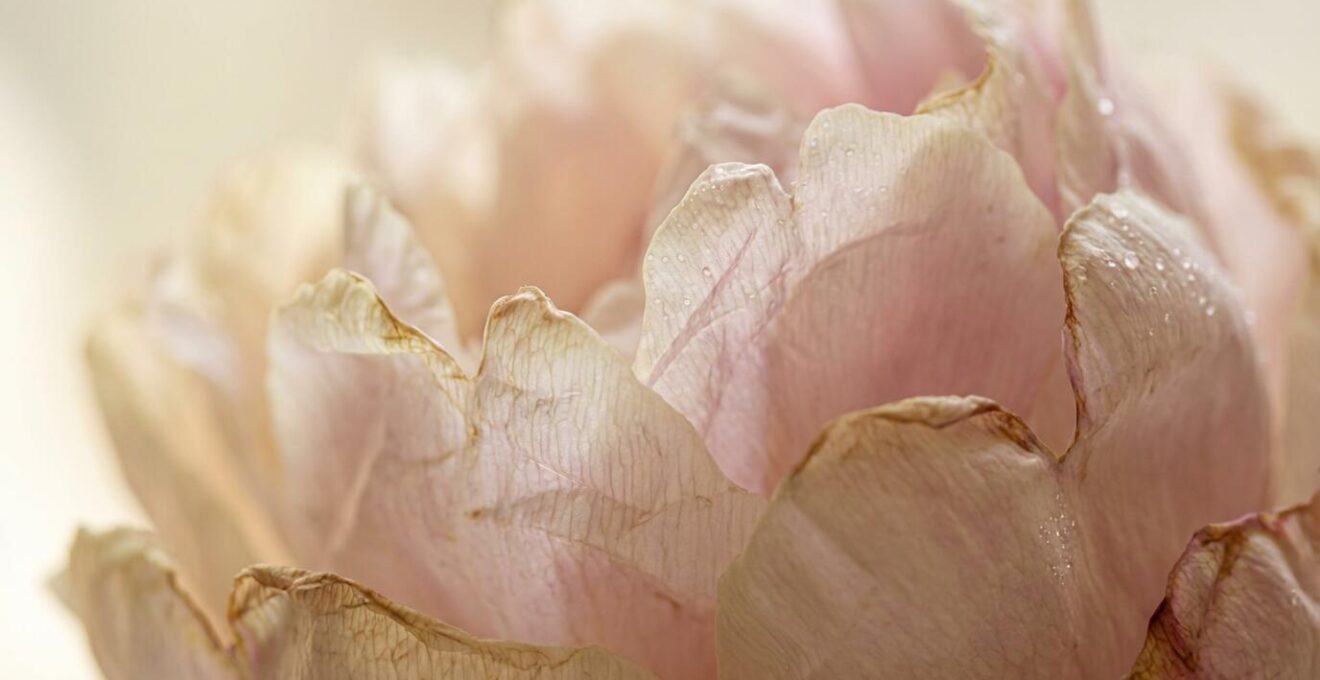
It’s a heartbreaking floral tragedy: a lush peony bouquet, perfect in the morning, looks like a deflated balloon by the afternoon reception. The reason for this rapid decline in high heat is a simple, brutal matter of biology and surface area. While a rose is certainly vulnerable to heat, a peony is exponentially more so due to its very structure. Its magnificent, dense ball of petals is its greatest weakness.
The science is straightforward: a fully open peony bloom can have over 100 delicate, paper-thin petals. This creates a massive surface area—up to three times that of a standard rose. In 30°C (86°F) heat, this large surface area dramatically accelerates the rate of transpiration, or water evaporation from the petals. The peony simply cannot draw water up its stem fast enough to compensate for the rapid moisture loss, leading to a swift and catastrophic collapse of its cellular structure. The flower literally wilts under the weight of its own beauty.
While prevention is the best strategy (i.e., not using peonies in high heat), an emergency revival is sometimes possible if caught early. This isn’t about misting the petals, which is often ineffective. It requires a full-scale intervention to force rehydration.
- Immediate Action: Submerge the entire stem and as much of the foliage as possible into a bucket of cool (never icy) water that contains professional flower food.
- Rest Period: Allow the bloom to rest in this solution for at least 20 minutes in a cool, shaded area, away from any direct sun or drafts.
- Underwater Cut: While the stem is still submerged, use sharp shears to re-cut it at a 45° angle. This prevents an air bubble from entering the stem and blocking water uptake.
- Support Hydration: If the bouquet is pre-constructed, ensure it has a small, soaked foam holder at its base to provide a continuous water source directly to the stems.
Recognizing this inherent vulnerability allows for better planning, either by choosing more resilient flowers or by having an emergency protocol in place to save a wilting bouquet before it’s too late.
Gravity issues: preventing water from dripping on guests’ food
One of the most overlooked—and potentially disastrous—failures of floral mechanics is the dreaded drip. An elevated centerpiece or hanging installation that slowly leaks water onto a guest’s plate or a wedding cake is more than an inconvenience; it’s a mark of unprofessionalism. This issue almost always stems from the improper use of floral foam, the green brick-like material used as a water source and structural base.
The problem arises from two common mistakes: improperly soaking the foam and failing to let it drain. Florists in a hurry might force the foam block underwater, which traps air pockets inside. These air pockets prevent the foam from becoming fully saturated and can lead to water being released unexpectedly later. The correct method is to allow the foam to sink naturally into the water on its own. Equally important is the draining period. A freshly soaked foam block must be allowed to sit on a draining rack for at least 10 minutes to release any excess, unabsorbed water before being placed in its final container.
Many forward-thinking florists are now advocating for foam-free mechanics altogether, citing both environmental concerns and the elimination of drip risks. Sustainable alternatives like using reusable vessels with an internal water reservoir or employing a “kenzan” (a Japanese flower frog with sharp pins) in a shallow pool of water are gaining popularity. These methods provide a reliable, contained water source that completely removes the possibility of a gravity-fed leak. The “Double-Vessel Defense”—placing the primary arrangement container inside a slightly larger, watertight decorative vessel—is another foolproof method.
When discussing elevated arrangements, ask your florist about their method for containing water. Whether they use a meticulous foam-soaking protocol or foam-free mechanics, their answer will tell you a lot about their technical expertise and attention to detail.
Key Takeaways
- Flower longevity is determined by plant biology and structural mechanics, not just aesthetics.
- Strategic selection based on environmental resilience (heat, wind, time out of water) is the first line of defense against wilting.
- Professional techniques like modular construction, proper hydration protocols, and respecting the “conversation window” are signs of a true master florist.
Why Peonies Cost So Much and How to Get the Look When They’re Out of Season?
The peony holds a special, almost mythical status in the wedding world, and its price tag reflects that. Several factors contribute to its high cost. First, they have an exceptionally short peak growing season of only a few weeks in late spring. This limited availability creates intense demand. Second, peony plants take years to mature and produce the large, lush blooms prized by couples, making them a long-term investment for growers. Finally, as discussed, their fragility means that shipping them off-season incurs significant transportation and spoilage costs, which are passed on to the consumer.
This reality is reflected in planning timelines. To secure sought-after blooms like peonies during their peak, you must book well in advance. Data from 2023 shows that couples booked their wedding flowers approximately 5.7 months (171 days) ahead of their date. For a high-demand flower, even more lead time is advisable. But when peonies are simply not an option, either due to season or budget, a skilled florist has an arsenal of stunning alternatives that capture their romantic essence.
The following matrix breaks down the best peony substitutes, considering cost, seasonality, and styling tips to achieve that coveted look.
| Alternative Flower | Cost Range | Peak Season | Styling Tip |
|---|---|---|---|
| ‘Alabaster’ Garden Rose | $$ | Year-round | Reflex outer petals outward to create peony-like openness |
| ‘Columbus’ Ranunculus | $$ | Spring | Cluster 5-7 stems for volume matching one peony |
| ‘Mondial’ Double Tulip | $ | Winter-Spring | Choose fully open blooms, remove leaves for cleaner look |
| Cafe au Lait Dahlia | $$$ | Late Summer | Use as single ‘hero bloom’ surrounded by smaller flowers |
Furthermore, you can achieve a luxurious, peony-heavy look without the full cost by employing the “Hero Bloom Budget Strategy.” This involves selecting just one or two premium “hero” blooms (like a dinner-plate dahlia or a perfect garden rose) as the focal point of a bouquet or centerpiece, then creating fullness with more affordable texture flowers (like waxflower or spray roses) and abundant greenery. This approach delivers a high-end aesthetic for a fraction of the cost.
Ultimately, achieving the wedding floral vision you dream of is about a strategic partnership with your florist, combining your aesthetic desires with their deep knowledge of seasonality, budget, and bloom biology.