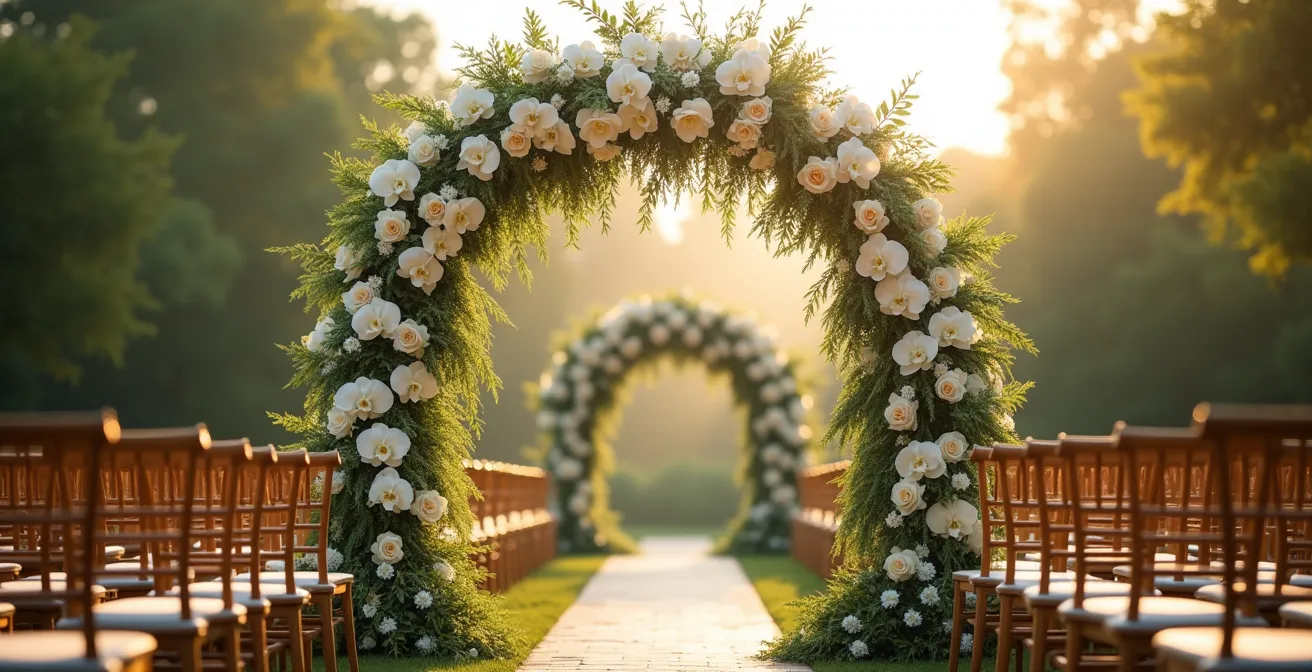
The secret to a “million-dollar look” wedding on a strict budget isn’t about spending more, but mastering ‘perceptual economics’ to manipulate focus and sensory input.
- Concentrate your budget on a few high-impact focal points that dominate guest photography and perception.
- Choose materials and finishes based on a “Proximity Test”: invest in what guests touch, and save on what they only see.
Recommendation: Prioritize your spending on the four key areas guests photograph most: the ceremony space, the bar, dinner tables, and the entrance. This strategy creates the illusion of opulence far beyond your actual spend.
The desire for a breathtaking, opulent wedding often clashes with the reality of a mid-range budget. Many couples believe the path to luxury is paved with endless floral arrangements, expensive tableware, and high-end everything. The common advice is to focus on lighting or to simply rent instead of buying, but these tips only scratch the surface. They address the what but ignore the far more powerful why. The truth is, achieving a high-end feel is less about financial brute force and more about strategic deception. It’s an exercise in directing your guests’ attention with surgical precision.
What if the key wasn’t spreading your budget thinly across every surface, but concentrating its power on a few key “wow” moments? This guide is built on the principle of perceptual economics: the art of allocating funds where the perceived value is exponentially higher than the actual cost. We will deconstruct the psychology behind what makes a wedding feel expensive and provide a strategic framework for making smart, high-impact decisions. You’ll learn why a single, magnificent floral arch can erase the memory of a hundred cheap chairs, how to leverage lighting and music to manufacture emotion, and when “faux” is a brilliant move versus a costly mistake.
This article provides a detailed roadmap to allocating your decor budget like a seasoned strategist. By exploring the core principles of visual hierarchy and sensory experience, you will gain the tools to create an atmosphere of lavishness and sophistication that your guests will talk about for years, all while staying firmly within your financial reality.
Summary: A Strategist’s Guide to Mid-Budget Wedding Opulence
- Why one massive floral arch hides a multitude of cheap chairs?
- The psychology of metallics: choosing the right finish for perceived value
- Plastic gold chargers vs. Glass: when does “faux” look too fake?
- Fewer expensive blooms vs. mass cheap greenery: which looks more luxe?
- The 30-second window: syncing lights and music to creating a “wow” entrance
- Where to spend 50% of your decor budget: linens, lights, or flowers?
- Is buying raw silk cheaper than renting polyester linens?
- How to Install Crystal Chandeliers safely in Temporary Structures?
Why one massive floral arch hides a multitude of cheap chairs?
The human eye is inherently lazy. In a visually complex environment like a wedding, it doesn’t catalogue every single item. Instead, it seeks out a dominant focal point and uses that as an anchor to form an overall impression. A single, breathtaking floral arch at the ceremony entrance or behind the main table exploits this principle of visual hierarchy. It screams “luxury,” “effort,” and “expense” so loudly that the functional, less-glamorous elements like standard-issue venue chairs fade into the background. You aren’t just decorating a space; you are directing your guests’ perception and their cameras.
This isn’t just theory; it’s a proven budget strategy. By concentrating funds on one or two spectacular installations, you create a disproportionate perception of opulence. It’s about winning the first impression and the most photographed moments. The arch will be in every ceremony photo, and a stunning sweetheart table will be the backdrop for speeches and candid couple shots. These are the images that will define the memory of your wedding’s aesthetic.
Case Study: The Sub-$800 High-Impact Reception
Ling’s Moment has demonstrated how couples can achieve an incredibly elegant reception for under $800. The strategy hinges on rejecting the idea of decorating every corner. Instead, they focus spending on ready-to-use, high-impact faux floral arrangements. For instance, a stunning sweetheart table can be created with a flower garland and backdrop for just $129.98. This single area becomes the undeniable centerpiece of the room, creating maximum visual impact where the couple will be photographed most, proving that one spectacular element creates more perceived luxury than a budget spread thin across multiple mediocre decorations.
To maximize this effect, the placement of your arch is critical. It should be used to frame the most important moments. Position it at the ceremony entrance for a dramatic guest arrival, ensure it frames you during the vows, and then—crucially—repurpose it. Moving the arch to serve as a backdrop for the sweetheart table or a dedicated photo station during the reception doubles its value and reinforces its role as the evening’s primary visual anchor.
The psychology of metallics: choosing the right finish for perceived value
When it comes to faking luxury, metallics are your most powerful ally. They reflect light, add depth, and subconsciously signal value. However, not all metallics are created equal. The finish—from brushed to polished—has a profound psychological impact on how guests perceive the quality of your decor. Polished, mirror-like surfaces can look glamorous but also risk appearing cheap or “plasticky” if the material isn’t high-quality. Brushed or matte finishes, on the other hand, diffuse light more softly, suggesting a heavier, more substantial material and a more sophisticated, modern form of luxury. With decoration budgets that typically range from $2,000 to $10,000, making the right choice here is a high-leverage decision.
The key is to match the metallic finish to the overall mood and lighting of your venue. Warm, soft metallics like brushed brass or champagne gold excel in candlelight, creating an intimate and expensive glow. Cooler, high-shine tones like polished chrome can work in a modern setting with controlled spotlighting but can easily look harsh or dated in the wrong context. Rose gold offers a romantic, trendy appeal but should be used thoughtfully to avoid overwhelming a space.
This table breaks down how different metallic finishes can influence the perceived luxury of your wedding decor.
| Metallic Finish | Visual Impact | Best Lighting | Cost vs. Perceived Value |
|---|---|---|---|
| Champagne Gold | Contemporary luxury | Candlelight | Low cost, high perceived value |
| Brushed Brass | Modern sophistication | Mixed warm lighting | Medium cost, consistent elegance |
| Rose Gold | Romantic refinement | Natural daylight | Medium cost, trendy appeal |
| Polished Chrome | Traditional glamour | Controlled spotlighting | High maintenance, variable perception |

As the image above highlights, texture is everything. The soft diffusion of light on a brushed surface feels inherently more luxurious than the sharp, often-plastic glare of a cheap polished finish. When on a budget, always opt for a matte or brushed metallic finish; it’s far more forgiving and almost always reads as more expensive than it is.
Plastic gold chargers vs. Glass: when does “faux” look too fake?
The eternal question for budget-conscious couples is when they can get away with “faux” materials. The answer lies in a simple but powerful framework: The Proximity Test. This principle divides your decor into two categories: items guests will physically touch or see within arm’s reach, and items they will only ever view from a distance. This distinction is the ultimate guide for allocating your material budget.
Items that must pass the “Touch Test”—cutlery, napkins, glassware—demand higher quality. A guest will immediately feel the flimsy, lightweight nature of a plastic fork or the cheap texture of a polyester napkin. In these instances, investing in real metal, quality fabric, and real glass is non-negotiable for maintaining the illusion of luxury. Conversely, items that only need to pass the “Photo Test”—such as high centerpieces, ceremony arch decorations, or ceiling installations—can absolutely be high-quality fakes. No one will be climbing a ladder to inspect your faux hydrangeas, but they will look lush and full in photos.
A smart strategy is to layer real over fake. Using an affordable yet trendy cheesecloth table runner over a basic table instantly elevates the tablescape. Another tactic is creating a distraction hierarchy: place one undeniably high-quality item on each table, like a heavy, beautifully designed menu card, to draw the eye and lend credibility to the less-expensive elements around it.
Case Study: The Thrift Store Success Strategy
The thrift store approach is a perfect real-world application of the Proximity Test. Couples successfully source decor by focusing on items that have authentic weight and patina. Mismatched vintage glass vases, heavy brass candle holders, and antique frames for signage are found for pennies on the dollar. This strategy works because these items, while inexpensive, pass the “Touch Test” with flying colors. The inherent quality of old glass and real metal reads as authentic and intentional, far more so than a new, mass-produced plastic item trying to imitate them.
Fewer expensive blooms vs. mass cheap greenery: which looks more luxe?
The conventional wisdom that more flowers equals more luxury is a dangerous budget trap. A sparse arrangement of a few expensive peonies can look sad and wanting, highlighting what’s missing rather than what’s there. The more strategic, and ultimately more luxurious, approach is to embrace mass and monochrome with greenery. Using abundant, inexpensive greenery like eucalyptus, smilax, or ruscus creates a sense of lushness and intentionality that a few scattered premium blooms simply cannot match. This approach is also financially brilliant, with greenery-heavy designs often leading to a 50-70% cost reduction compared to traditional floral arrangements.
The key to a high-end look is confident execution. A massive, overflowing installation of a single type of greenery looks like a deliberate, bold design choice. It’s sculptural and textural. This doesn’t mean you have to forgo flowers entirely. The secret is the “High-Low Floral Mixing Strategy,” a technique used by top designers:
- Reserve Premium Blooms: Save the most expensive flowers, like orchids or garden roses, exclusively for the one place they’ll be seen most up close and photographed: the bridal bouquet.
- Strategic Placement: Use a few standout blooms from your ceremony arch to decorate the wedding cake, creating a cohesive and romantic moment without ordering extra flowers.
- Fill with Impact: Use mass quantities of inexpensive but visually impactful filler flowers like baby’s breath. A giant cloud of baby’s breath can create a stunning, ethereal effect for a fraction of the cost of roses.
- Play with Levels: Position your few expensive flowers at eye level on tables, while using greenery for ground-level installations and overhead arrangements where detail is less important.
This approach ensures your budget is spent on volume and impact, not on a few costly stems that get lost in the space. You’re creating an immersive, verdant atmosphere that feels far more opulent than a handful of pricey, isolated blooms.
The 30-second window: syncing lights and music to creating a “wow” entrance
Your wedding entrance is not just a walk into a room; it’s a piece of theater. You have a 30-second window to establish the energy for the entire reception and create an unforgettable “wow” moment. The most cost-effective way to do this is through the precise synchronization of lighting and music. This is sensory layering at its finest—manipulating sight and sound to generate a peak emotional response. A dramatic lighting change timed perfectly to a musical crescendo can make even the simplest venue feel like a high-end production.
Lighting is one of the most transformative, budget-friendly tools at your disposal. Strategic use of uplighting can wash walls in color, hide imperfections, and add immense depth to a room. As one case study shows, even a modest budget can create a massive impact. Couples have successfully used simple hacks like wrapping fairy lights or using glass votives to create an enchanting, intimate ambience that feels incredibly glamorous. The secret is timing and control.
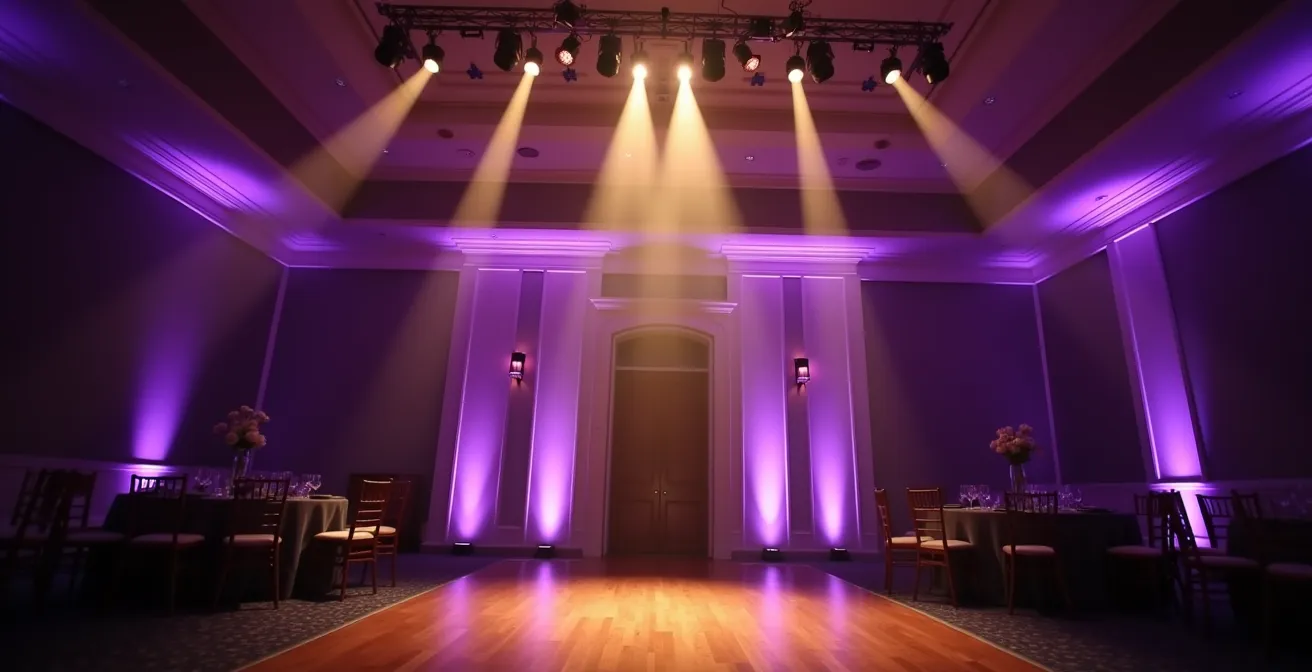
Choreographing the entrance is a science. It involves coordinating with your DJ and lighting technician (or a designated friend) to execute a specific sequence of cues. This isn’t about just flicking a switch; it’s about building and releasing tension for maximum emotional payoff. The following guide breaks down the timing for a perfect grand entrance.
| Time Marker | Light Effect | Music Element | Guest Response |
|---|---|---|---|
| T-10 seconds | Dim house lights 50% | Fade current song | Attention shifts |
| T-5 seconds | Spotlight on entrance | Build dramatic pause | Anticipation peaks |
| T-0 (Entrance) | Full uplighting burst | Beat drop/crescendo | Emotional release |
| T+10 seconds | Follow spot tracks couple | Maintain energy | Sustained excitement |
Where to spend 50% of your decor budget: linens, lights, or flowers?
Couples often agonize over this question, believing there’s a magic formula for budget allocation. The truth, as revealed by a venue-dependent budget allocation approach, is that the right answer depends entirely on your venue’s strengths and weaknesses. If your venue has gorgeous historic architecture, spending on lighting to highlight it is wise. If the venue is a blank canvas like a marquee or a simple hall, you need to create your own architecture with large-scale floral or fabric installations. There is no one-size-fits-all answer.
However, there is a guiding strategic principle that cuts through the confusion, and it is perhaps the single most important rule in this guide. The decision of where to spend isn’t about choosing between linens, lights, or flowers. It’s about choosing the locations that get photographed the most. An analysis of thousands of weddings reveals a stunning fact: a huge majority of memorable guest photos are taken in just a few key spots. Evidence shows that 4 key focal areas are responsible for 90% of guest photos. When decor is spread too thinly, its impact is diluted and lost.
Therefore, the definitive strategy is to concentrate your budget on the four “photo-op” zones:
- The Ceremony Area: Where the most emotionally significant moments happen.
- The Bar: A natural gathering point where guests will spend considerable time.
- The Dinner Tables: Specifically the head table/sweetheart table, and to a lesser extent, the guest tables.
- The Entrance/Escort Card Display: The first and one of the last impressions of your decor.
By focusing your spending on making these four areas spectacular, you create strong visual anchors that define the entire experience for your guests and, crucially, for the camera. You are spending money on what will be remembered and memorialized, which is the smartest investment you can make.
Is buying raw silk cheaper than renting polyester linens?
On the surface, renting seems like the obvious budget-friendly choice. The initial cash outlay for renting basic polyester linens is almost always lower than buying premium fabrics like raw silk. However, a “luxe for less” strategist looks beyond the initial price tag and considers the Total Cost of Ownership (TCO) and opportunity. This includes factoring in cleaning, transport, and, most importantly, the potential for resale.
When you account for the strong resale market for wedding decor, especially high-quality, neutral-colored textiles, the math changes dramatically. While the upfront cost of buying raw silk is higher, you can often recover 40-60% of the cost by reselling it immediately after the wedding. This can make the net cost of buying luxurious silk surprisingly competitive with, and sometimes even cheaper than, renting high-quality polyester.
This comparative table breaks down the true cost of each option for a hypothetical 10-table wedding.
| Cost Factor | Raw Silk Purchase | Polyester Rental | Hybrid Strategy |
|---|---|---|---|
| Initial Cost (10 tables) | $800-1200 | $300-500 | $400-600 |
| Cleaning/Prep | $150-200 | $0 (included) | $50 |
| Storage/Transport | $50-100 | $0 | $25 |
| Resale Recovery | -$300-500 | $0 | -$150 |
| Net Cost | $500-1000 | $300-500 | $325-525 |
As the table shows, a hybrid approach is often the smartest financial move. This “Buy the Best, Rent the Rest” strategy offers the perfect balance of high-impact luxury and financial prudence.
Your Action Plan: The “Buy the Best, Rent the Rest” Linen Strategy
- Identify Photo Hotspots: Purchase luxurious raw silk or velvet linens exclusively for the tables with maximum photo exposure: the head table, cake table, and gift table.
- Rent for the Masses: For all other guest tables, rent high-quality, heavy-weight polyester or cotton-blend linens from a reputable company.
- Choose for Resale: If purchasing, select silk in neutral, in-demand colors like ivory, dove grey, or champagne to maximize your potential resale value.
- Leverage Rentals for Big Items: Utilize rental companies for large, one-time-use items like ceremony arches, unique seating, and other major decor pieces to save on cost and eliminate post-wedding storage issues.
- Plan Your Exit: List your purchased linens for resale on platforms like Facebook Marketplace or specialized wedding forums immediately after the event to capitalize on high demand.
Key takeaways
- The illusion of luxury is created by controlling guest perception, not by infinite spending.
- Concentrate the majority of your decor budget on 3-4 high-impact, photogenic “focal points.”
- Use the “Proximity Test”: invest in quality for items guests touch and use “smart fakes” for items seen from a distance.
How to Install Crystal Chandeliers safely in Temporary Structures?
The dream of a magnificent crystal chandelier hanging in a beautiful wedding tent is a powerful one, but it often meets a harsh reality: safety, structural limitations, and cost. Temporary structures like tents or marquees are not typically engineered to support the immense weight of a traditional crystal chandelier. The real question for a “luxe for less” strategist is not *how* to solve this complex engineering problem, but how to achieve the chandelier effect without the weight, risk, and expense.
The secret is to pivot from the literal object to its visual essence: cascading light and elegant shape. Modern event design offers several brilliant, lightweight alternatives that deliver the same perceived luxury. These solutions provide the glamour and ambiance you desire while being safer, more affordable, and far easier to install.
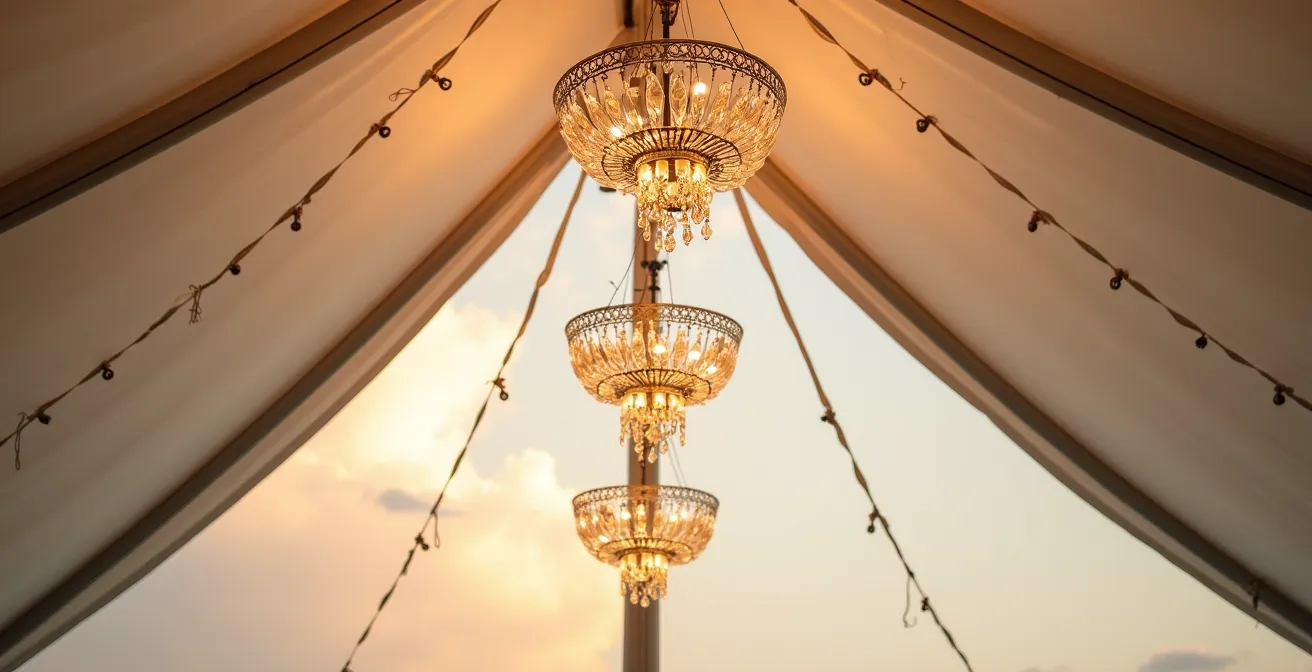
Case Study: Zero-Weight Luxury with Chandelier Alternatives
Couples are increasingly achieving a high-end look by sidestepping heavy crystal entirely. Lightweight capiz shell chandeliers, for example, offer a similar translucent elegance at a fraction of the weight and cost. Another popular solution is creating bespoke floral chandeliers, where greenery and flowers are woven around a light frame with battery-powered micro LEDs, adding organic glamour without any electrical load concerns. Perhaps the most innovative solution is the use of high-resolution gobo projectors, which can cast a hyper-realistic image of a chandelier onto the tent ceiling. In the low light of an evening reception, many guests cannot distinguish this zero-weight illusion from a real, multi-thousand-dollar fixture.
By focusing on the effect rather than the object, you can create a stunning and safe overhead spectacle. This approach embodies the core philosophy of smart luxury: it’s not about owning the expensive thing, but about masterfully recreating its feeling and impact for a fraction of the cost.
To truly bring these strategies to life, the next step is to analyze your chosen venue and identify the 3-4 key focal points where your budget will have the most dramatic and memorable impact.