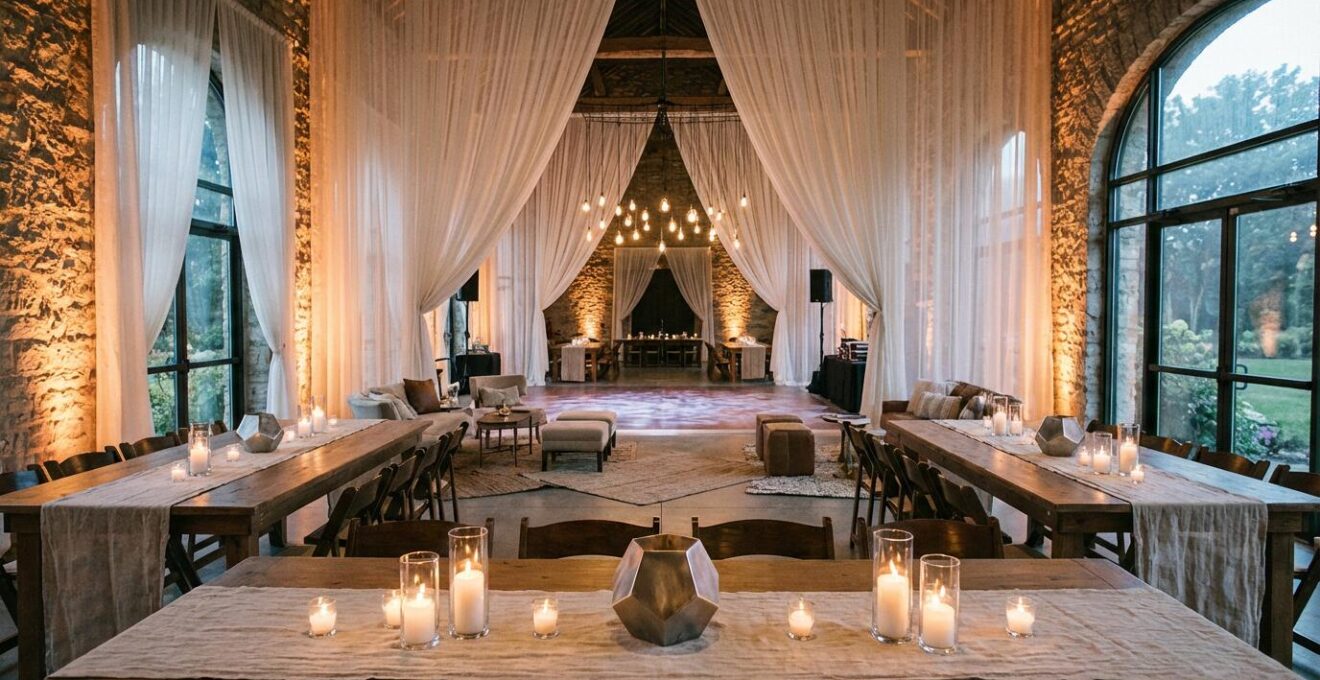
Designing an immersive wedding is not about adding more elements, but about scripting the guest’s sensory journey to control the event’s emotional arc.
- Strategic zoning of sound, light, and scent creates distinct emotional chapters throughout the event.
- The layout of food and the flow of the space are powerful tools to dictate social interaction and energy levels.
Recommendation: Shift your mindset from ‘planner’ to ‘experience director’ to transform your venue into a living, breathing narrative.
Most couples want their wedding to be memorable. They invest in beautiful flowers, curated playlists, and exquisite food. Yet, many highly-produced weddings feel strangely flat—a beautiful tableau that guests observe rather than experience. The fundamental mistake is treating the wedding as a collection of static elements instead of a dynamic, unfolding story. The focus is on aesthetics, not on the guest’s journey through the space and time of the event. It’s the difference between decorating a room and directing a film.
The standard advice to “engage the five senses” often results in a checklist approach: sight (flowers), sound (music), taste (cake), smell (perfume), and touch (linens). While well-intentioned, this is a surface-level interpretation. A truly immersive event doesn’t just present sensory elements; it scripts them. It uses environmental psychology to guide emotions, manage energy, and create a cohesive narrative from the moment a guest arrives to the final farewell. The real question isn’t *what* to add, but *how* and *when* to deploy each sensory cue to shape the experience.
This guide will deconstruct the art of sensory scripting. We will move beyond generic tips to explore the strategic “why” behind each decision. You will learn to think like an experiential director, mastering the tools of sound, taste, scent, and light to architect an event that captivates, engages, and leaves a lasting imprint on the memory of every single guest. We will cover how to zone audio for different moods, how food placement drives interaction, and how to control the night’s energy with surgical precision.
To navigate this deep dive into experiential design, the following guide breaks down the core strategies you’ll need to master. This table of contents will serve as your map for transforming your wedding from a simple gathering into a fully immersive event.
Summary: How to Script an Immersive Wedding Experience
- How to zone audio so guests can talk in the lounge while the party rages?
- Grazing tables vs. Passed apps: which encourages more guest interaction?
- The “too much” factor: preventing guest fatigue in highly produced events
- Why changing the scent from ceremony to reception resets the mood?
- Mapping the guest journey: avoiding dead ends in your venue layout
- Cold-air diffusers vs. Candles: how to scent a ballroom evenly?
- Subtle birdsong in the restrooms: details that enhance the garden illusion
- How to Manage Lighting Intensity to Control the Energy of the Night?
How to zone audio so guests can talk in the lounge while the party rages?
Sound is the most powerful and poorly managed tool in event design. A common failure is a one-size-fits-all audio approach: a single playlist blasting uniformly across the entire venue. This forces guests into a binary choice—either shout over the music or retreat in silence. The solution is strategic audio zoning, an approach that treats different areas of your venue as distinct acoustic environments, each with its own purpose and energy level.
The goal is to create a dynamic soundscape. The dance floor needs high energy and volume to feel vibrant, but the lounge area just a few feet away requires an intimate atmosphere conducive to conversation. This is often complicated by venue restrictions; industry data shows that many UK wedding venues have sound limiters set between 85-100 dB, a level that can struggle to contain the energy of a live band while protecting quieter zones. Effective zoning isn’t about just turning down the volume; it’s about architectural acoustics.
True mastery involves using specialized equipment and placement. Zone array sound systems with ceiling-mounted speakers can precisely direct sound onto the dance floor, minimizing bleed. In lounge areas, positioning smaller speakers at seated head-height (around 4-5 feet) creates “acoustic bubbles” where conversation is comfortable. You can also use the venue’s architecture to your advantage by creating natural buffer zones—like hallways or transitional foyers—with minimal ambient sound. This allows guests to move between high-energy and low-energy zones, giving them control over their sensory experience and preventing them from feeling overwhelmed.
Grazing tables vs. Passed apps: which encourages more guest interaction?
Food is not just for sustenance; it’s a primary driver of guest movement and interaction. The choice between passed hors d’oeuvres and a static grazing table has profound implications for the social dynamics of your cocktail hour. Passed appetizers create fleeting, transactional moments. A server offers a tray, a guest takes one, and the interaction is over. It keeps people dispersed but doesn’t inherently encourage them to connect with each other.
A well-designed grazing table, by contrast, becomes a social anchor. It’s a destination that pulls people together, creating a natural hub for conversation. However, a traditional, cluttered grazing board can be counterproductive, causing queues and a sense of scarcity. A more visionary approach is “clustered grazing,” a trend that organizes the table into distinct, abundant groupings. As noted in an analysis by Wedshed on new wedding food trends, this shift has practical benefits: “it becomes easier for guests to find preferred foods and for teams to replenish stocks.” This thoughtful arrangement transforms the table from a chaotic free-for-all into an exploratory journey, inviting guests to linger, discuss the offerings, and interact organically.
This “clustering” method encourages a different kind of behavior. Instead of a quick grab-and-go, guests pause, make choices, and often comment to those next to them. This creates the perfect low-stakes environment for strangers to strike up a conversation. By designing the food station as a point of discovery rather than just a point of service, you are actively engineering social interaction.
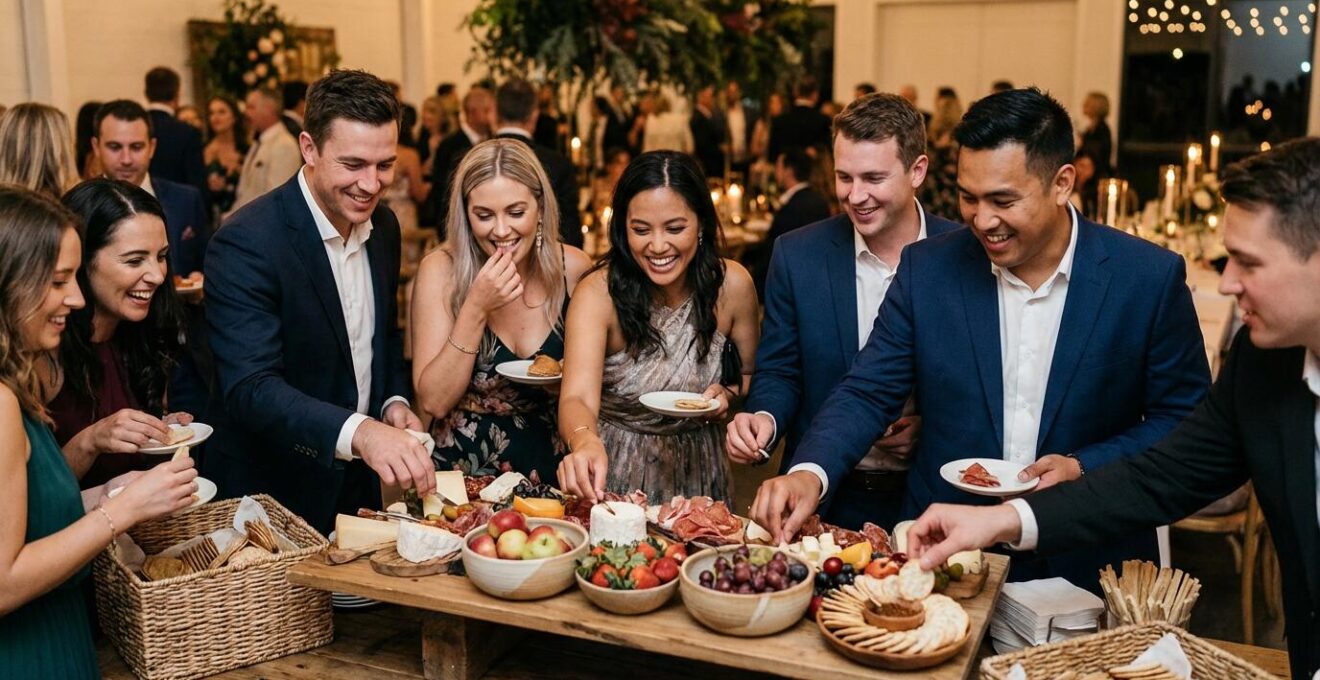
As you can see, the layout itself encourages mingling. The arrangement of food into clear, artistic clusters invites exploration and provides natural conversation starters, turning the simple act of eating into a shared experience. The goal is to make the food a catalyst for connection, not just a prelude to dinner.
The “too much” factor: preventing guest fatigue in highly produced events
In the quest to create a spectacular wedding, there’s a real danger of “sensory overload.” When too many strong elements compete for attention—loud music, dramatic lighting, strong scents, constant activity—the result isn’t a heightened experience, but guest fatigue. The human brain can only process so much stimulation before it starts to shut down. An event that is relentlessly “on” at maximum intensity for hours will exhaust guests, not exhilarate them. The art of experiential design lies in modulation and restraint.
Think of your wedding’s timeline as an emotional arc with peaks and valleys. The ceremony might be a moment of quiet, focused intensity. The cocktail hour should build social energy. Dinner is a time for connection and lower stimulation. The dance party is the peak of high-energy release. A common mistake is to keep the energy at a constant high, which is unsustainable. You must build in moments of sensory rest—quieter lounge spaces, softer lighting during dinner, or a shift in musical style.
This level of curation requires a director’s mindset. It’s about making conscious choices about what *not* to do as much as what to do. As the experts at Glamour & Grace highlight, achieving this balance is a professional skill: “To pull it off flawlessly, work with a team of seasoned professionals with a background in experiential design.” An expert can help you script the sensory journey, ensuring that each element is introduced with purpose and that the overall experience has rhythm. The most memorable events are not the loudest or brightest, but the ones that master the flow of energy, guiding guests through a range of emotions without overwhelming them.
Why changing the scent from ceremony to reception resets the mood?
Of all the senses, smell is the most powerfully and directly linked to memory and emotion. The olfactory bulb has a direct pathway to the limbic system, which governs both. This neurological shortcut means that scent can trigger feelings and recall memories almost instantaneously, bypassing conscious thought. This makes scent scripting one of the most subtle yet potent tools for defining the emotional chapters of your wedding day.
Using a single scent throughout the entire event is a missed opportunity. The far more powerful strategy is to assign different, distinct scents to different phases of the day. This is called “scent chaptering.” By introducing a specific fragrance for the ceremony—perhaps something solemn and sacred like frankincense or white florals—you are creating a unique olfactory anchor for that memory. When guests encounter that scent years later, it will transport them back to the moment you exchanged vows.
When guests then move to the reception space and are greeted by a completely different aroma—say, something warm and celebratory like amber, citrus, or vanilla—it signals a clear psychological transition. This shift does more than just make the room smell nice; it cleanses the emotional palate and cues a change in mood and energy. It tells their brains, “The formal part is over; the celebration is beginning.” As noted by the Wedding Academy Global in a piece on event design, “Scent and memory are inextricably linked, providing guests with a sensory experience” that is both profound and lasting. Creating a signature scent for your wedding isn’t just a trend; it’s a sophisticated way to hard-wire your event into the long-term memories of your guests.
Mapping the guest journey: avoiding dead ends in your venue layout
The physical layout of your venue is the canvas for your guest experience. A poorly planned space creates friction, confusion, and “dead ends” where energy dissipates. A visionary planner doesn’t just place tables; they perform guest journey mapping. This involves analyzing the layout from the perspective of different guest “personas” and engineering a flow that is intuitive, engaging, and free of obstacles.
You must anticipate the needs of various archetypes. The “Dancer” wants an easy path between the dance floor and the bar. “Older Relatives” need clear, unobstructed routes to quiet seating and restrooms. The “Social Butterfly” thrives in spaces with multiple conversation zones. By thinking in terms of these personas, you can proactively design a layout that serves everyone. This isn’t just about efficiency; it’s about shaping behavior through environmental design. You can use furniture arrangements, lighting, and even floor textures to create intuitive pathways and zones.

This kind of macro-level planning ensures that no guest ever feels lost or stuck. A well-mapped journey guides guests seamlessly from one experience to the next, maintaining the event’s momentum. The table below illustrates how to cater to different guest needs through smart layout decisions.
| Guest Persona | Primary Needs | Layout Solution |
|---|---|---|
| The Dancer | Easy bar/restroom access from dance floor | Position facilities within 30 feet of dance area |
| Older Relatives | Clear paths to quiet seating | Create unobstructed routes with visible signage |
| Social Butterflies | Multiple conversation zones | Design various lounge areas with different atmospheres |
| Photo Enthusiasts | Instagram-worthy backdrops | Create designated photo zones with good lighting |
By proactively addressing these needs, you eliminate points of friction and ensure a smooth, enjoyable experience for every attendee. The venue becomes a welcoming and intuitive environment, allowing guests to focus on celebrating rather than navigating.
Cold-air diffusers vs. Candles: how to scent a ballroom evenly?
Scenting a large space like a ballroom presents a significant technical challenge. While candles provide visual warmth, they are notoriously ineffective for uniform scent distribution. Their aroma is localized, and many venues prohibit open flames altogether for safety reasons. To achieve a consistent and sophisticated ambient scent, you must turn to professional-grade technology. The most effective tool is the cold-air diffuser.
Unlike heat-based or water-based diffusers, cold-air diffusers use nebulizing technology. They break down fragrance oils into a micro-mist of dry nanoparticles that are so light they remain suspended in the air for hours. This ensures a perfectly even, consistent scent experience throughout the entire space, without leaving residue on surfaces or fabrics. For the most seamless effect, these systems can be integrated directly into the venue’s HVAC system, making the source of the scent completely undetectable. The fragrance simply becomes part of the atmosphere.
The key is subtlety. The goal is not to perfume the room, but to give it a signature background note. As wedding design expert Khaira advises, “The key to achieving the perfect smell is to keep it light and tie it into the other sensory elements of your celebration.” This is where layering comes in. You can use a cold-air diffuser for the base scent and then add unscented or very lightly scented candles for their visual appeal. It’s also critical to position diffusers away from food service areas to avoid any interference with the culinary experience. Mastery of scent is a balance of technology and artistry.
Your Scent Distribution Audit Plan: Key Points to Verify
- Venue Regulations: Check the venue’s fire codes and policies on open flames and diffusion systems before committing to a strategy.
- System Selection: Prioritize professional cold-air diffusers for consistency. If possible, opt for HVAC integration for the most even and undetectable distribution.
- Scent Placement: Position diffusers strategically to create a uniform ambiance, but keep them far from dining tables and food stations to prevent flavor interference.
- Layering Strategy: Use the diffuser for your primary “base note” scent and layer with unscented or lightly scented candles for visual warmth without creating competing aromas.
- Intensity Calibration: Test the scent intensity in the space beforehand. The goal is a subtle background note, not an overwhelming perfume. It should be barely noticeable.
Subtle birdsong in the restrooms: details that enhance the garden illusion
The difference between a good wedding and an unforgettable one often lies in the micro-experiences—the small, unexpected details that delight guests and demonstrate an obsessive commitment to the theme. These are the elements that people talk about for years. A perfect example is extending the sensory theme into unexpected spaces, like restrooms. If you’re hosting a garden wedding, why should the illusion end when a guest steps inside?
Imagine a guest leaving a vibrant outdoor reception and entering a restroom, only to be greeted by the soft, ambient sound of subtle birdsong and rustling leaves. This tiny detail does several things. First, it maintains the narrative. The garden theme is not just a visual style; it’s a complete world. Second, it creates a moment of surprise and delight. It shows a level of thoughtfulness that goes far beyond the ordinary. As highlighted in a feature on memorable wedding experiences, you can “Enhance the natural beauty of an outdoor ceremony with bespoke soundscapes that mimic the serenity of nature” and extend them to private spaces.
This principle can be applied across all senses. A restroom could feature a specific hand soap with a fragrance that complements the main reception scent. The hand towels could have a unique, luxurious texture. The lighting could be softer and warmer than standard facility lighting. These are not high-cost additions, but they have an outsized impact because they are discovered in personal, private moments. They communicate that every single aspect of the guest’s comfort and experience has been considered. It’s this dedication to the complete sensory journey that elevates an event from a party to a true work of experiential art.
Key takeaways
- Think like a director, not a decorator. Your job is to script a journey and manage an emotional arc.
- Subtlety and modulation are more powerful than intensity. Avoid sensory overload by creating peaks and valleys in your event’s energy.
- Every sensory element—sound, scent, light, taste, touch—is a tool for storytelling and controlling the atmosphere.
How to Manage Lighting Intensity to Control the Energy of the Night?
Lighting is the single most effective tool for controlling the mood and energy of an event space. It works on a subconscious, physiological level, telling guests how to feel and behave without a single word being spoken. As noted by event professional Angie Johnson, “Rustic Edison bulbs, elegant chandeliers, dynamic uplighting — there are many ways to transform your event space with simple lighting techniques.” But a visionary approach goes beyond choosing fixtures; it involves creating a dynamic lighting script that evolves with the emotional arc of the night.
Different phases of the wedding require different lighting. During social periods like the cocktail hour and dinner, warm tones (in the 2700K-3000K range) mimic candlelight and firelight, promoting intimacy and relaxation. The lighting should be static or have very slow-moving textures to create a calm, settled atmosphere. This encourages conversation and connection. A static environment tells the brain it’s time to be still and engage with those nearby.
When it’s time to party, the lighting script must signal a dramatic shift in energy. The transition to the dance floor should be marked by a change to cooler tones like blues and magentas, which are known to increase physiological arousal and energy. Introducing dynamic, sound-activated lighting at this stage is crucial. The movement and pulsing of light sync with the music, creating a multisensory experience that draws people to the dance floor and gives them permission to let loose. By consciously scripting these lighting cues to match specific moments in your timeline—entrances, toasts, the first dance—you are actively conducting the energy of the entire evening.
By moving from the mindset of a planner to that of an experience director, you unlock the ability to create more than just a beautiful day. You architect an experience that lives on in the memories of your guests. To begin scripting your own immersive event, the next step is to analyze your venue and timeline through this new sensory lens.