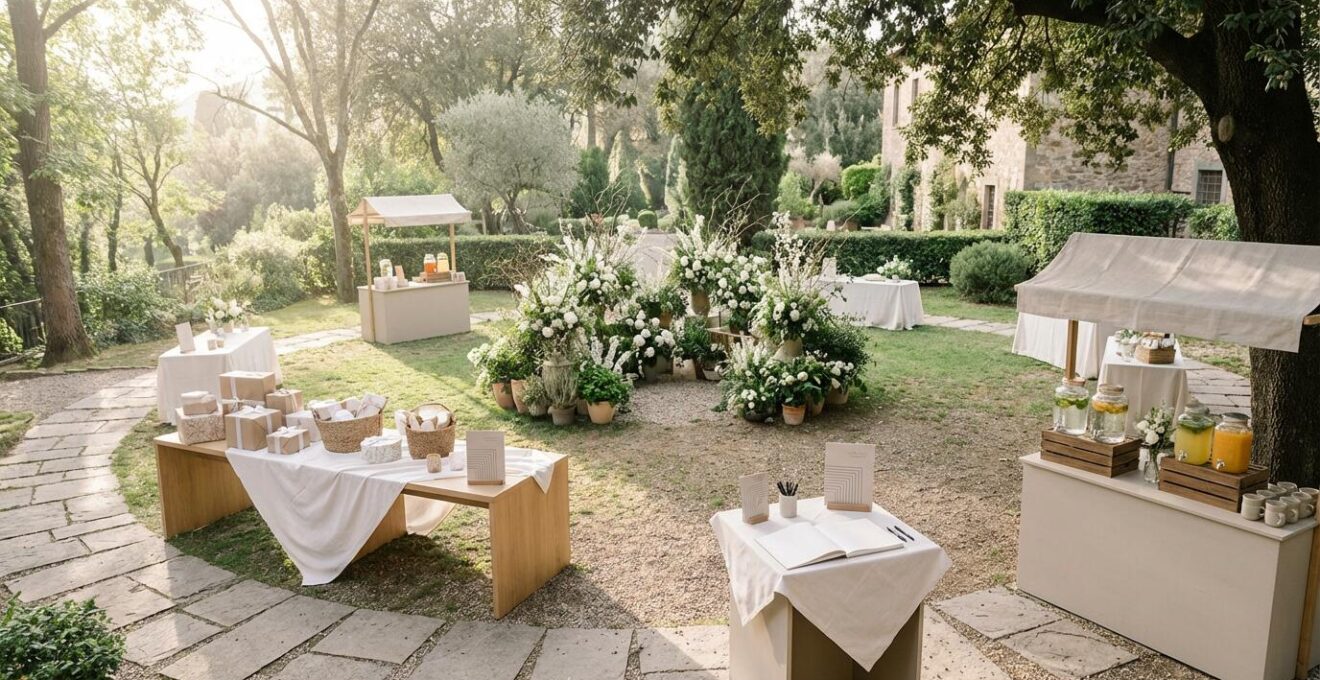
The secret to a smooth wedding arrival for 150+ guests isn’t more decoration; it’s treating your welcome area as a sophisticated guest-flow management system.
- A chaotic start ruins the guest experience, which 75% of couples prioritize above all else.
- Strategic layout, intuitive signage, and efficient service points are the keys to preventing frustrating traffic jams.
Recommendation: Map your guest’s journey from their car to their ceremony seat, identifying and eliminating every potential point of friction or confusion before the big day.
The moment your guests arrive is the opening scene of your wedding day. You’ve pictured it: smiles, warm greetings, and an air of excited anticipation. But for weddings with over a hundred attendees, the reality can quickly become a stressful crush of confusion, with guests asking “Where do I put my gift?” or “Am I in the right place?” This initial chaos can subtly chip away at the romantic and elegant atmosphere you’ve spent months building. Many couples focus on a welcome sign and a drinks table, but these are merely props, not a strategy.
The conventional approach treats the welcome area as a static, decorative space. This completely overlooks its true function: to be the primary engine of guest management. For a larger guest list, this oversight is a recipe for disaster, leading to bottlenecks at the entrance, long queues for a drink, and a general sense of disorientation that undermines the guest experience from the very beginning. According to recent data, the challenge is significant, with weddings hosting an average of 145 guests in 2024.
But what if the solution wasn’t just to make the entrance prettier, but to make it smarter? The key is to shift your mindset from a decorator to a logistical designer. This means thinking about guest flow, intuitive wayfinding, and psychological comfort. A truly successful welcome area doesn’t just look beautiful; it functions flawlessly, guiding each guest from their arrival to their seat with such ease that they never even notice the complex system at work. It’s about designing an experience that anticipates needs and solves problems before they even arise.
This guide will walk you through the essential logistical and design principles to engineer a welcome area that is both elegant and efficient. We will deconstruct each element, from signage placement to drink service speed, to give you a comprehensive blueprint for a seamless and stress-free start to your celebration.
Summary: Designing a Flawless Welcome for a Large Wedding
- Why a Chaotic Arrival Ruins the Romantic Mood Before the Ceremony Even Starts?
- How to Position Welcome Signage so Guests Never Ask “Where Do I Go”?
- Lemonade vs. Champagne: Which Welcome Drink Minimizes Line-ups in Summer?
- The Layout Mistake That Causes Traffic Jams at 80% of Wedding Entrances
- When to Start the Playlist: The 15-Minute Rule for Early Arrivals
- The Bar Placement Mistake That Traps Guests in the Corner
- How Area Rugs Subconsciously Tell Guests “Stop and Sit Here”?
- How to Use Design to Solve Guest Frustrations Before They Happen?
Why a Chaotic Arrival Ruins the Romantic Mood Before the Ceremony Even Starts?
The first 15 minutes of a guest’s arrival set the emotional tone for the entire day. A smooth, welcoming, and intuitive entry validates their effort in attending and makes them feel cared for and at ease. Conversely, a chaotic arrival—marked by confusion about parking, the entrance location, or where to go next—triggers a low-grade stress response. This initial friction forces your guests out of a celebratory mindset and into a problem-solving one. Instead of soaking in the ambiance, they are preoccupied with logistical questions, forming queues, and feeling like they are in the way.
This is more than a minor inconvenience; it’s a direct contradiction to the very purpose of the event. When a guest feels lost or overlooked, the carefully crafted romantic atmosphere is punctured by anxiety. For a large group, this effect multiplies. A single bottleneck can create a ripple effect of frustration, impacting dozens of guests at once. The feeling of being part of a disorganized crowd is the antithesis of the personal, intimate experience you want to create. It’s a critical first impression, and getting it wrong means you’ll spend the rest of the event trying to recover that lost sense of ease and elegance.
Prioritizing this initial experience is not just about logistics; it’s about hospitality. It demonstrates foresight and a genuine concern for your guests’ comfort. By engineering a seamless arrival, you are communicating that their presence is valued and their journey has been considered. This proactive care is the foundation of a truly memorable and high-quality event, allowing the romantic mood to build naturally from the very first moment.
How to Position Welcome Signage so Guests Never Ask “Where Do I Go”?
Effective wedding signage is not about a single, beautifully calligraphed “Welcome” sign at the door. It’s about creating an intuitive wayfinding system. The goal is for your guests to move from one point to the next without ever having to consciously think or ask for directions. This requires a strategic, multi-layered approach where signs are placed at every potential point of confusion or decision.
The journey begins before they even leave their car. A confirmation sign at the parking lot or drop-off point is the first crucial touchpoint, assuring them they’ve arrived at the right location. From there, directional signage must be placed at every fork in the path or change in direction. Think like a first-time visitor to your venue: where might you hesitate? Place a sign there. The key is to create a “breadcrumb trail” that leads them effortlessly toward the main welcome area.
Once at the entrance, the signage should evolve to provide more detailed information. A central, well-designed map or directory should clearly list the locations of key stations: the gift table, guest book, coat check, restrooms, and the bar. Visual hierarchy is critical here. Use larger fonts or more prominent placement for the most vital directions, such as “Ceremony This Way.” For enhanced clarity, especially with international guests, pairing text with universal icons (like a gift box or a coat hanger) can drastically speed up comprehension and keep the flow of traffic moving smoothly.
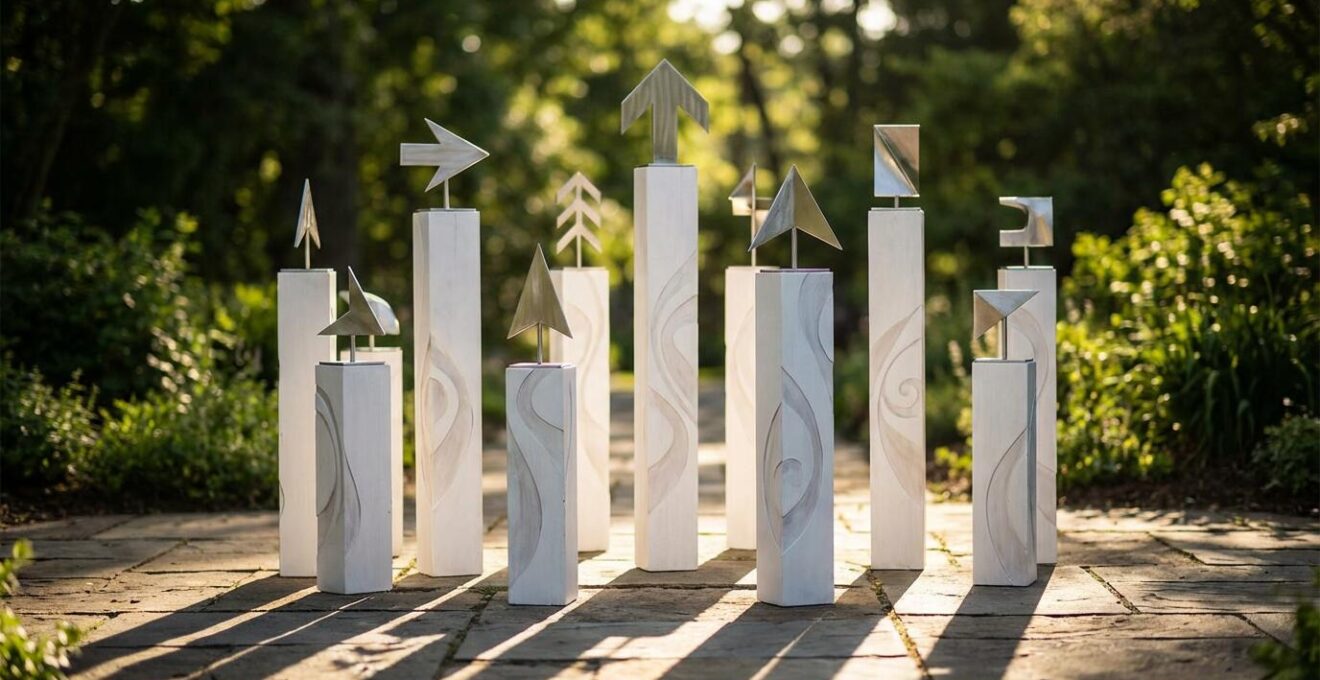
As this visual representation suggests, hierarchy isn’t just about size, but also about placement and style. A cohesive system of signs feels intentional and guides the eye naturally. By meticulously planning this visual journey, you replace guest confusion with a sense of calm and confidence, allowing them to relax and engage with the celebration immediately.
Action Plan: Your Strategic Signage Checklist
- Confirmation Point: Place the very first sign at the designated parking area or guest drop-off to confirm they have arrived at the correct venue.
- Decision Points: Walk the path from the car to the ceremony seat and place a directional sign at every single fork, turn, or moment of potential hesitation.
- Central Directory: At the main entrance, install a detailed map or sign listing all key amenities (gifts, guest book, bar, restrooms) to answer questions proactively.
- Visual Hierarchy: Ensure the most critical information (e.g., “Ceremony,” “Reception”) is in the largest, most visible text.
- Universal Icons: Add simple, recognizable icons next to text for faster comprehension and to assist international guests or children.
Lemonade vs. Champagne: Which Welcome Drink Minimizes Line-ups in Summer?
The welcome drink is a classic gesture of hospitality, but for a large wedding, its execution can either be a graceful touch or the primary cause of a major bottleneck. The choice of beverage is less important than the speed and method of service. When 150 guests arrive within a short window, a drink that takes 20 seconds to serve can quickly create a long, frustrating queue that blocks the entrance and sours the initial mood. The key is to select a service style that prioritizes efficiency without sacrificing elegance.
For a summer wedding, a refreshing glass of lemonade sounds lovely, but if it requires a bartender to pour it over ice, add a garnish, and hand it to each guest, you’ve created a significant operational delay. In contrast, pre-poured beverages are the gold standard for managing high-volume arrivals. Trays of chilled champagne, sparkling water, or a signature cocktail, ready to be picked up, reduce the service time per guest to mere seconds. This “grab-and-go” approach allows the flow of traffic to remain fluid.
Another highly effective method is a self-serve dispenser station. While this takes slightly longer per guest as they operate the spigot, setting up multiple identical stations can disperse the crowd. The crucial factor here is providing ample “landing space” around the dispensers for guests to set down bags or personal items while they pour. A dual-option strategy, with two separate stations (e.g., one alcoholic, one non-alcoholic), can also be very effective as it naturally segments the queue based on guest preference, halving the demand on any single point.
This comparative analysis shows the dramatic difference in flow based on service style. As a wedding planner, your choice should be guided by operational reality, not just taste.
| Drink Type | Service Time Per Guest | Setup Requirements | Line Management |
|---|---|---|---|
| Pre-poured Champagne | 3-5 seconds | Trays ready on tables | Minimal bottleneck risk |
| Self-serve Dispenser | 5-8 seconds | Multiple stations needed | Fast but requires landing space for bags |
| Staff-served Lemonade | 15-20 seconds | Bartender + garnish station | Significant bottleneck risk for 150+ guests |
| Dual-Option Strategy | Varies by choice | Two separate stations | Naturally segments queue by preference |
The placement of these stations is just as important as their efficiency. As Sara Wiebold, Beverage Manager at Arbor Day Farm, advises:
Stations should be near high-traffic areas like entrances or lounges, but not so close that they create bottlenecks. For larger weddings, setting up multiple stations on opposite sides of the venue keeps lines short and traffic flowing.
– Sara Wiebold, Beverage Manager at Arbor Day Farm
The Layout Mistake That Causes Traffic Jams at 80% of Wedding Entrances
The single most common layout mistake in wedding welcome areas is creating a central point of interest directly inside the entrance. This is typically a large, beautifully decorated table for the guest book, gifts, or seating chart. While aesthetically pleasing, it acts like a dam in a river. Arriving guests immediately stop, creating a blockage right at the main artery of your event. Those behind them are forced to halt, and a traffic jam quickly forms, spilling out the door.
A successful layout for a large group must be designed for continuous movement. The goal is to get guests off the “main road” and into designated zones where they can pause without obstructing the flow. Instead of a single central table, the superior approach is the “hub-and-spoke” model. In this layout, the entrance is a wide, open “hub.” From this hub, clear pathways “spoke” out to various “islands” or stations—one for gifts, one for the guest book, another for welcome drinks. This design intuitively disperses guests, allowing them to choose their destination and preventing a single point of congestion.
This concept requires generous spacing. You must ensure that the pathways between these islands are wide enough for two-way traffic and that there is ample room around each station for a small group to congregate without blocking the path for others. The key is to pull all “stopping activities” away from the main entry and exit points. By decentralizing these functions, you transform the welcome area from a potential bottleneck into an efficient and welcoming dispersal system.
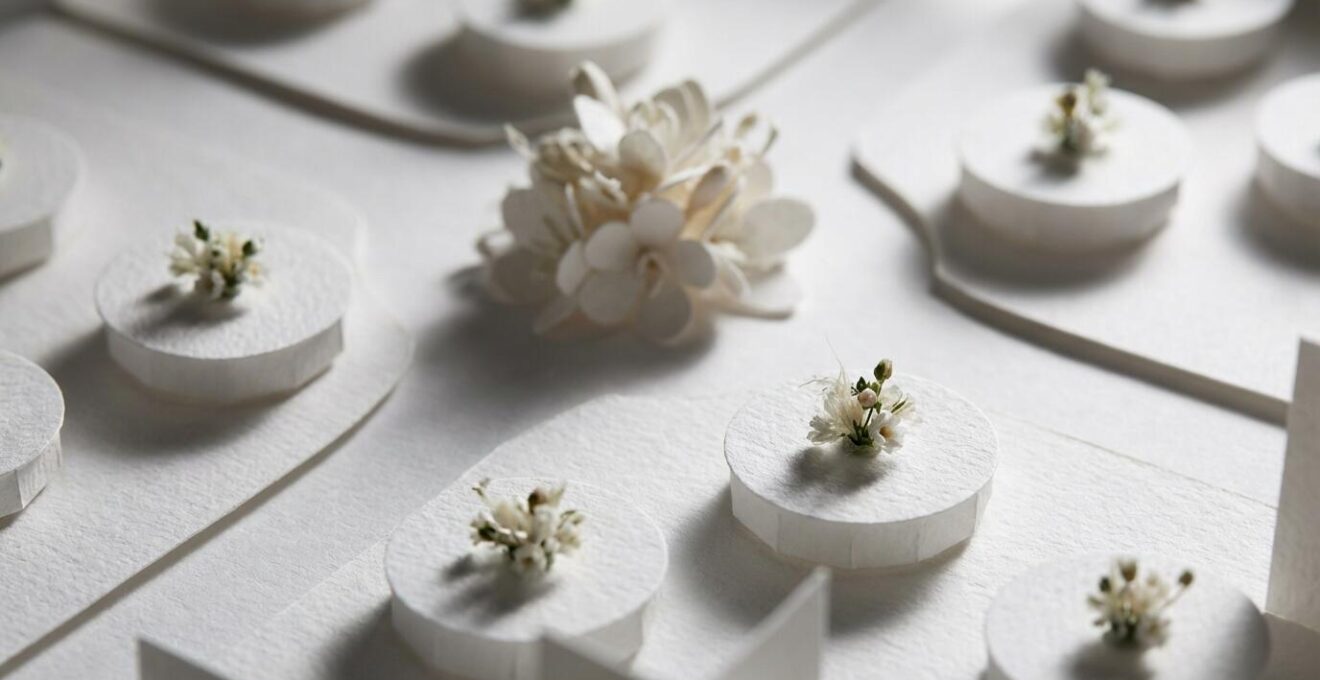
The aerial view of this model demonstrates how multiple pathways and station islands create a natural, flowing environment. This strategic placement is the architectural foundation of a stress-free arrival experience, ensuring that even with a large influx of guests, movement remains fluid and unencumbered.
Checklist: Auditing Your Welcome Area Layout for Bottlenecks
- Map the Path: Draw the guest’s path from the main door to the ceremony entrance. Identify every item that requires them to stop (guest book, gift table, coat check).
- Identify Obstructions: Is any “stopping station” located directly in the main traffic path? If so, it’s a critical bottleneck.
- Measure Clearances: Check the width of your main pathways. Is there enough space for at least two people to walk past each other comfortably, even if others are standing nearby?
- Create Zones: Redesign the layout to pull stopping stations out of the main flow, creating dedicated “islands” or “zones” off to the side.
- Test the Flow: Imagine 10 people arriving at once. Does your new layout allow them to disperse to different stations without crashing into each other? Adjust until the flow is seamless.
When to Start the Playlist: The 15-Minute Rule for Early Arrivals
Music is a powerful tool for shaping atmosphere, but its role in the welcome experience is often mistimed. Many couples start the playlist at the official invitation time, leaving the first guests—the punctilious and the eager—to arrive in unnerving silence. This creates an awkward, empty feeling, making them wonder if they are too early or in the wrong place. The solution is the 15-minute rule: your ambient playlist should begin at least 15 to 20 minutes *before* the time printed on the invitation.
This simple act of foresight transforms the experience for early arrivals. It immediately envelops them in the intended atmosphere, assuring them that they are expected and welcome. However, the music shouldn’t be static; it should follow a phased progression to build energy naturally as more guests arrive. This creates a subtle but effective auditory narrative for the pre-ceremony period.
A well-designed musical timeline can guide the energy of the room and even act as a cue for guests. The final phase, with its more majestic or climactic tone, serves as an elegant, non-verbal “last call,” signaling that it’s time to find a seat for the ceremony. This approach turns the playlist from simple background noise into an active component of your guest management strategy. To complement this, creating a designated “Soft Landing Zone” with a few lounge chairs or high-boy tables away from the main entrance path gives early arrivals a comfortable place to settle with their drink, preventing them from hovering awkwardly near the door.
Phased Music Timeline for Guest Arrivals
- Phase 1 (Early Birds): Start a low-tempo, ambient instrumental playlist 15-20 minutes before the official invitation time to create a serene and welcoming atmosphere.
- Phase 2 (Peak Arrival): As the bulk of guests arrive (from invitation time to 15 mins after), slightly increase the tempo and volume to build energy and a sense of occasion.
- Phase 3 (Last Call): In the final 5-10 minutes before the ceremony begins, shift to more majestic or climactic music. This serves as an elegant auditory cue for guests to move toward the ceremony area.
The Bar Placement Mistake That Traps Guests in the Corner
Just as the main entrance can become a bottleneck, the bar area is another critical point of potential congestion. A common mistake is placing the bar in a tight corner or at the end of a dead-end space. While this might seem like a good way to tuck it out of sight, it creates a logistical trap. Guests form a queue to be served, and once they have their drinks, they tend to congregate in the same area. This combination of a line and a lingering crowd effectively seals off that entire section of the venue, trapping people in and preventing others from getting through.
The principle of flow is paramount here. A bar should always be positioned in a location with clear entry and exit paths. Ideally, it should be in an open area or along a wall with ample space on either side, allowing guests to approach from one direction, get served, and exit in another. This creates a natural, circular flow rather than a stagnant pool of people. For larger weddings, the advice to set up multiple, smaller bar stations on opposite sides of the venue is even more critical during the reception or cocktail hour.
As one expert from a WeddingScout guide notes, this is a predictable problem with a clear solution:
You don’t want 150 guests to walk through the same entrance and immediately run into a table. Create space around the main entrance or transition area from cocktail hour. The same goes for the bar. No one wants lines at a bar, but even if there isn’t a wait, people tend to grab a drink and immediately congregate.
– Wedding Planning Expert, WeddingScout Event Layout Guide
By treating the bar as a high-traffic service point that requires its own dedicated flow management, you can prevent one of the most common sources of frustration at a large reception. The goal is to make grabbing a drink an effortless and pleasant experience, not a strategic challenge.
How Area Rugs Subconsciously Tell Guests “Stop and Sit Here”?
While clear pathways are essential for movement, you also need to give guests permission to stop. This is where the subtle psychology of interior design comes into play. Area rugs are an incredibly effective yet often overlooked tool for subconscious guest guidance. In a large, open welcome area, a well-placed rug acts as a visual anchor, creating a distinct “zone” that signals a change in function for that space.
When guests step from a hard floor onto a soft rug, their brain receives a subconscious cue to slow down. The texture and defined boundary of the rug create a psychological “room within a room.” Placing a seating arrangement, like a small sofa and chairs or a few high-boy tables, on an area rug transforms it into an inviting lounge or “landing zone.” It non-verbally tells guests, “This is a place to pause, gather, and converse.”
This technique is a brilliant way to manage flow because it actively encourages guests to move out of the main traffic arteries. Instead of lingering in walkways, they are drawn to these comfortable, defined islands of activity. By creating several of these small zones, you can effectively disperse the crowd and promote mingling in a structured, organized way. It’s a perfect example of using design to solve a logistical problem elegantly. You’re not putting up a sign that says “Please Don’t Stand Here”; you’re providing an attractive alternative that guides behavior naturally.
Key Takeaways
- Think Like a Logistical Designer: Your welcome area’s primary job is to manage guest flow, not just look pretty. Prioritize function over form.
- Decentralize Everything: Avoid a single, central table at the entrance. Use a “hub-and-spoke” layout with multiple “island” stations to disperse crowds.
- Optimize for Speed: Use pre-poured drinks or multiple self-serve stations to eliminate queues. Service time is more important than the specific drink.
How to Use Design to Solve Guest Frustrations Before They Happen?
The ultimate goal of a well-designed welcome area is predictive hospitality. This means using your layout, signage, and service design to anticipate and solve your guests’ frustrations before they even consciously register them. It’s about looking at your venue not as a static space, but as a dynamic environment through which people must move. Every element should work in concert to make that movement feel effortless, intuitive, and pleasant.
An expert-level tool for achieving this is creating a guest movement diagram. This involves sketching a floor plan of your venue and drawing lines to represent how guests will travel between key points: from the entrance to the coat check, to the bar, to the restrooms, and finally to the ceremony seating. This simple exercise, as recommended by event experts at venues accustomed to large crowds, immediately reveals potential choke points, awkward intersections, and areas of likely congestion. It allows you to see your space through your guests’ eyes and make adjustments before it’s too late.
This proactive approach is the synthesis of all the principles we’ve discussed. It’s understanding that signage provides clarity, that service speed prevents queues, that a hub-and-spoke layout prevents blockages, and that psychological cues like rugs create comfortable resting zones. When these elements are thoughtfully integrated, you create more than just a welcome area; you create a seamless and gracious guest journey. You’ve engineered an environment where no one feels lost, awkward, or in the way, allowing every single guest to feel personally welcomed and immediately embrace the joy of the occasion.