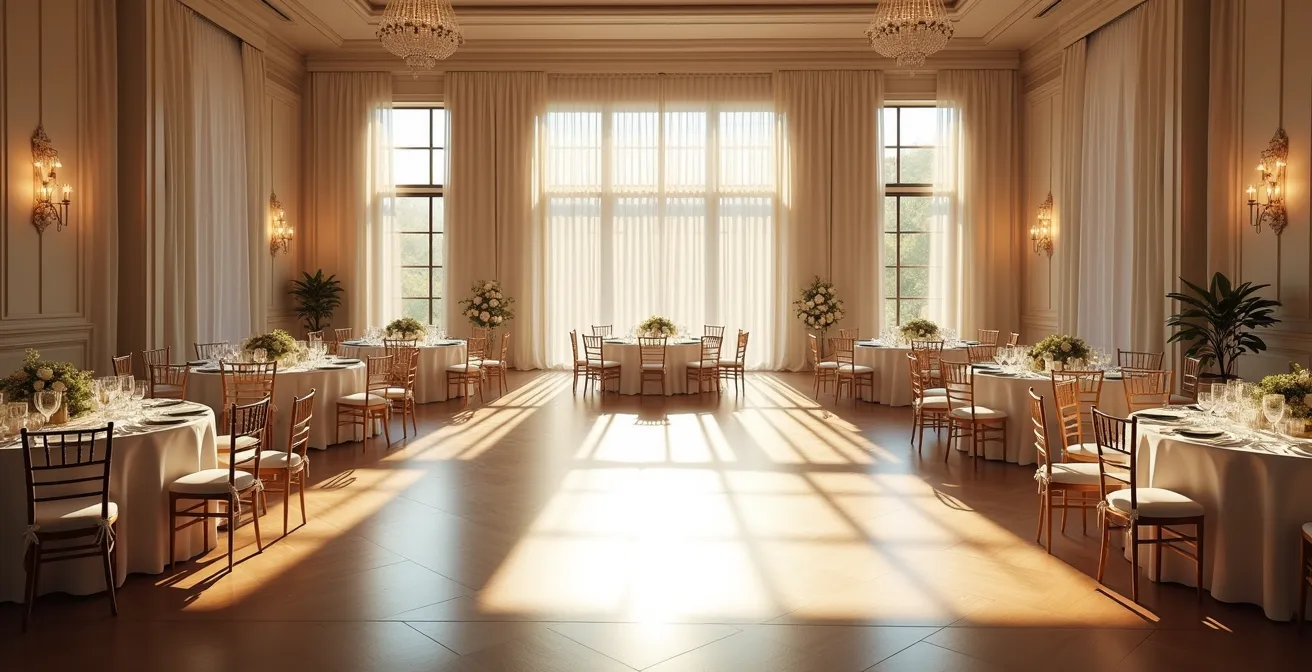
Stop designing your wedding layout for photos; start engineering it for human connection and seamless flow.
- The choice between round and rectangular tables dictates conversational dynamics, not just aesthetics.
- Proper spacing (the “60-inch rule”) is non-negotiable for efficient service and guest comfort, directly impacting the perception of luxury.
- Fewer guests per table (8 instead of 10) significantly boosts interaction and creates a more spacious, elegant atmosphere.
Recommendation: Prioritize guest-to-guest and guest-to-couple interaction by treating your floor plan as a strategic tool for social engineering, not just a decorative arrangement.
The debate between classic round tables and trendy long harvest tables often dominates wedding planning discussions. Couples spend hours agonizing over aesthetics, pinning images of rustic farm tables or elegant circular setups. But this focus on visual appeal misses the most critical function of a reception layout: it is the invisible architecture of your party’s social energy. The decisions you make about table shape and placement will either foster vibrant conversation and effortless movement or create awkward silences and logistical bottlenecks. It’s the difference between a room full of isolated groups and a single, interconnected celebration.
Most advice centers on platitudes about round tables being “better for conversation” or long tables creating a “family feel.” While true on the surface, this guidance fails to address the underlying mechanics of social dynamics and operational efficiency. The real challenge isn’t just picking a shape; it’s engineering a complete system where guests feel comfortable, service staff can move unimpeded, and every attendee feels included in the event. This requires thinking less like a decorator and more like a social dynamics engineer.
But what if the key to a lively reception wasn’t the table’s shape, but the space *between* the tables? What if the perceived luxury of your event was dictated not by the height of your centerpieces, but by the inches of “personal space” afforded to each guest? This guide moves beyond the surface-level debate. We will dissect the geometry of conversation, the physics of service flow, and the psychology of spatial comfort. By the end, you will have a new framework for designing a banquet layout that not only looks beautiful but, more importantly, *feels* incredible for everyone in the room.
This article provides a blueprint for making these critical decisions. We will explore the strategic pros and cons of your head table options, the non-negotiable rules of table spacing, and how to master the art of combining different table shapes for a layout that is both dynamic and cohesive.
Summary: Engineering a Socially Dynamic Wedding Layout
- Pros and cons: sitting with your bridal party vs. sitting alone?
- Why you need 60 inches between tables for efficient plated service?
- The layout mistake that leaves 30% of guests staring at a pillar
- How to combine round and rectangular tables without it looking messy?
- 10 chairs at a 60-inch round: is it too tight for a formal dinner?
- 24 inches per guest: why crowding the table ruins the luxury feel?
- Reducing table count: why 8 guests per table feels airier than 10?
- How to Design a Tablescape That Is Beautiful But Still Functional for Eating?
Pros and cons: sitting with your bridal party vs. sitting alone?
Your position in the room as a couple is the epicenter of the event’s social energy. Where you sit sends a powerful signal to your guests, defining your accessibility and the overall tone of the reception. While tradition often dictates a long head table with the entire wedding party, modern couples are increasingly weighing the optics against the experience. In fact, while many couples stick to tradition, it’s no longer the only option. Data shows that even with a return to classic celebrations, with 64% of couples planning traditional affairs, the seating choice for the newlyweds themselves is becoming more strategic.
The “Sweetheart Table”—a small table for just the two of you—offers a powerful advantage: it creates a clear focal point while granting you moments of privacy and the freedom to easily get up and mingle. It transforms you from static figures at a head table into dynamic hosts. Conversely, sitting at a table with your wedding party can feel inclusive and celebratory, but it can also isolate you from other guests and limit your direct interactions to only those seated with you. A third option, sitting at a regular guest table, offers maximum integration but can dilute the sense of occasion and make you harder for guests to locate.
The choice hinges on your primary goal: are you aiming for a grand, ceremonial feel or a more fluid, interactive atmosphere? There is no single right answer, only the one that best aligns with the social dynamics you wish to create. The following table breaks down these strategic choices, helping you visualize the impact of each option.
| Seating Style | Guest Interaction | Visual Impact | Best For |
|---|---|---|---|
| Sweetheart Table | High mobility for couple | Creates focal point | 30-100 guests |
| Traditional Head Table | Limited to wedding party | Strong ceremonial feel | 100-200 guests |
| Guest Table Integration | Maximum interaction | More casual atmosphere | Small weddings under 75 |
Why you need 60 inches between tables for efficient plated service?
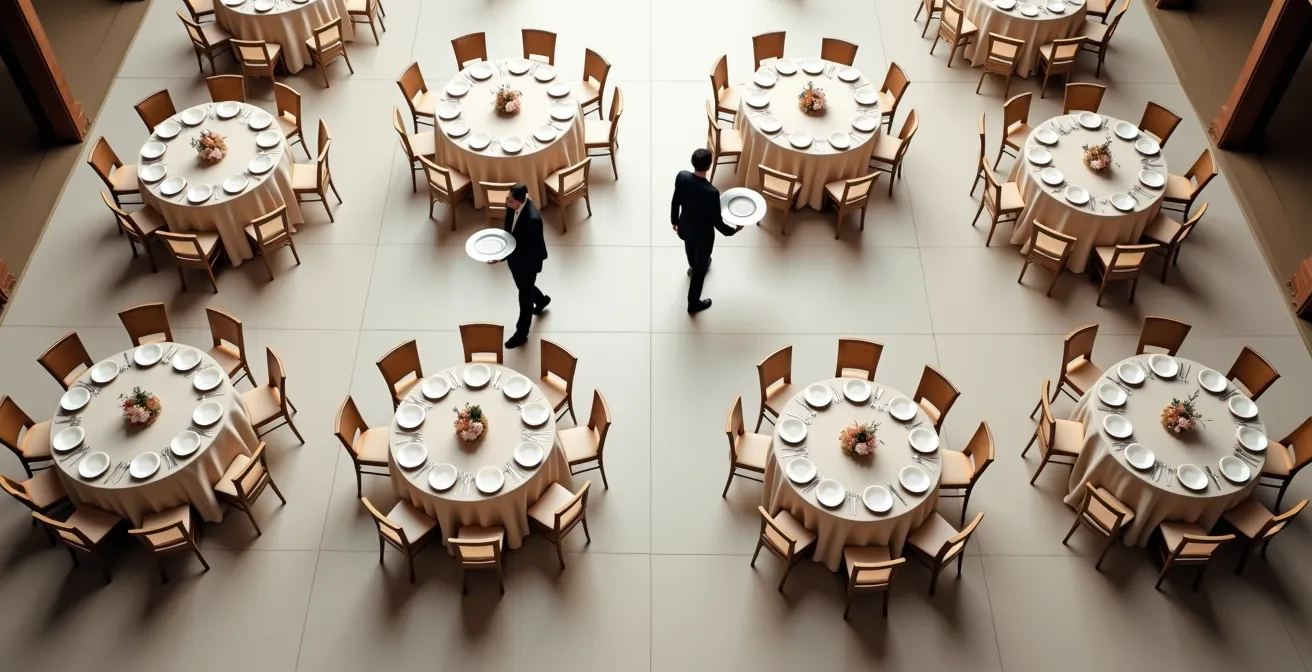
The space between your tables is the most overlooked element of luxury and operational success. Insufficient spacing doesn’t just feel cramped for guests; it cripples your catering team’s ability to provide elegant, efficient service. For a formal plated dinner, the industry standard is a minimum of 60 inches between round tables. This isn’t an arbitrary number; it’s a carefully calculated dimension required for optimal flow dynamics.
This spacing creates what venue experts call a “two-way traffic lane.” As wedding planners at The Gardens of Castle Rock explain, the 60-inch rule is the magic number that allows one server to enter an aisle with full plates while another exits with used dishes, all without awkward shuffling or delays. Anything less, and you create bottlenecks that slow down service, increase the risk of spills, and force servers to constantly interrupt guests. This seemingly small detail has a massive impact on the guest experience, ensuring that food arrives hot and tables are cleared discreetly.
This diagram visualizes the concept, showing how proper spacing creates clear, functional pathways for service staff, ensuring a smooth and uninterrupted dining experience for your guests.
For other service styles, this dimension can be adjusted. A buffet line, which creates a more predictable one-way flow of guests, might only require 48 inches. However, high-traffic areas near the bar, dance floor, or restrooms should always default to the more generous 60-inch standard to accommodate guest movement. Engineering this space correctly is a fundamental investment in a seamless event.
The layout mistake that leaves 30% of guests staring at a pillar
Almost every venue has its quirks: structural pillars, awkward corners, or unconventional shapes. The most common layout mistake is to ignore these features and hope for the best. This passive approach often results in “bad seats”—tables tucked away in corners or, worse, positioned directly behind a pillar, completely obstructing a guest’s view of the head table, dance floor, and speeches. A guest with a blocked view is a guest who feels disconnected from the celebration. Ensuring every attendee has a good sightline is a cornerstone of inclusive event design.
Instead of treating architectural obstacles as liabilities, the best approach is to transform them into assets. A pillar doesn’t have to be an obstruction; it can become an anchor for your design. By strategically integrating these elements, you can create a more dynamic and interesting space. As luxury event planning experts note, strategic arrangements are a direct driver of guest comfort and satisfaction. Ignoring a pillar means you are actively diminishing the experience for a portion of your guests.
Proactive planning is essential. Before finalizing your table count or seating chart, create a to-scale floor plan of your venue, marking every potential obstruction. Sit in every “seat” on your map and ask: “What is my view?” If the answer is “the back of a pillar,” that table position must be eliminated or re-thought. This meticulous process ensures that no guest feels like an afterthought.
Case Study: Transforming Obstacles into Features
A wedding venue successfully turned its obstructive pillars into celebrated design features. Instead of hiding them, they wrapped them in string lights and greenery, using them as anchors for satellite bars and dessert stations. By designing a layout with a central dance floor and arranging eight round tables (seating 10 each) in a wide circle around the perimeter, they guaranteed that all 80 guests had a clear, unobstructed view of the main events, fostering a more inclusive and engaging atmosphere.
How to combine round and rectangular tables without it looking messy?
Mixing round and rectangular tables can create a visually stunning and dynamic layout, breaking the monotony of a uniform setup. However, without a clear geometric strategy, it can quickly look cluttered and chaotic. The key to a successful mixed-table design is not randomness, but a deliberate and structured approach. You must establish a strong visual anchor and then build the rest of your layout around it with intention and symmetry.
The most effective method is to use the rectangular tables to create a dominant architectural feature. For instance, arranging them in a large ‘X’ pattern across the center of the room or as a long “spine” down the middle immediately establishes a strong, organized foundation. Once this anchor is in place, the round tables can be placed symmetrically within the open spaces or quadrants created by the long tables. This combination of linear and circular shapes adds interest while maintaining a sense of order and purpose.
Cohesion is the final, crucial ingredient. To unify the different table shapes, you must use consistent design elements across the entire room. This means using identical linens, chair styles, and centerpiece concepts on every table. The color palette, floral arrangements, and place settings should be the same, ensuring that while the shapes differ, the overall aesthetic remains harmonious. As the experts at The Lane advise, “Mixed layouts offer unexpected beauty and flexibility to align with your space,” but that beauty comes from disciplined execution, not haphazard placement.
Action Plan: Creating a Cohesive Mixed-Table Layout
- Establish an Anchor: Create a strong geometric pattern, like an ‘X’ or a central spine, using your rectangular tables.
- Ensure Symmetry: Place the round tables symmetrically in the open quadrants or areas surrounding your rectangular anchor.
- Unify with Decor: Use identical linens, chair styles, and centerpiece heights on all tables to create a cohesive look.
- Zone for Energy: Position rectangular tables near high-energy areas like the dance floor, as they tend to feel more communal.
- Zone for Conversation: Place round tables in quieter, more peripheral areas to encourage more intimate, small-group conversations.
10 chairs at a 60-inch round: is it too tight for a formal dinner?
Yes, for a formal, multi-course plated dinner, 10 guests at a 60-inch round table is too tight. While it is physically possible to fit 10 chairs, doing so compromises guest comfort and the perception of luxury. Wedding planning resources often state that large circular tables can fit 8 to 12 people, but this broad range fails to account for the crucial variable of service style. A casual buffet dinner has very different spatial requirements than a formal affair with multiple courses, charger plates, and extensive glassware.
The math of “spatial comfort” is revealing. A 60-inch round table has a circumference of approximately 188.5 inches. For 8 guests, this provides a comfortable 23.5 inches of personal space per person. At 9 guests, it drops to an acceptable 20.9 inches. But at 10 guests, each person is left with less than 19 inches. This is significantly less than the 22-24 inches considered standard for comfortable formal dining. This lack of “elbow room” can make guests feel cramped and prevent them from dining with ease.
The visual density of the tablescape is also a factor. A formal setting with charger plates, multiple forks, and several glasses takes up considerable surface area. Squeezing 10 place settings onto a 60-inch table leaves little to no negative space, resulting in a cluttered and visually stressful appearance that undermines the elegance of the event.
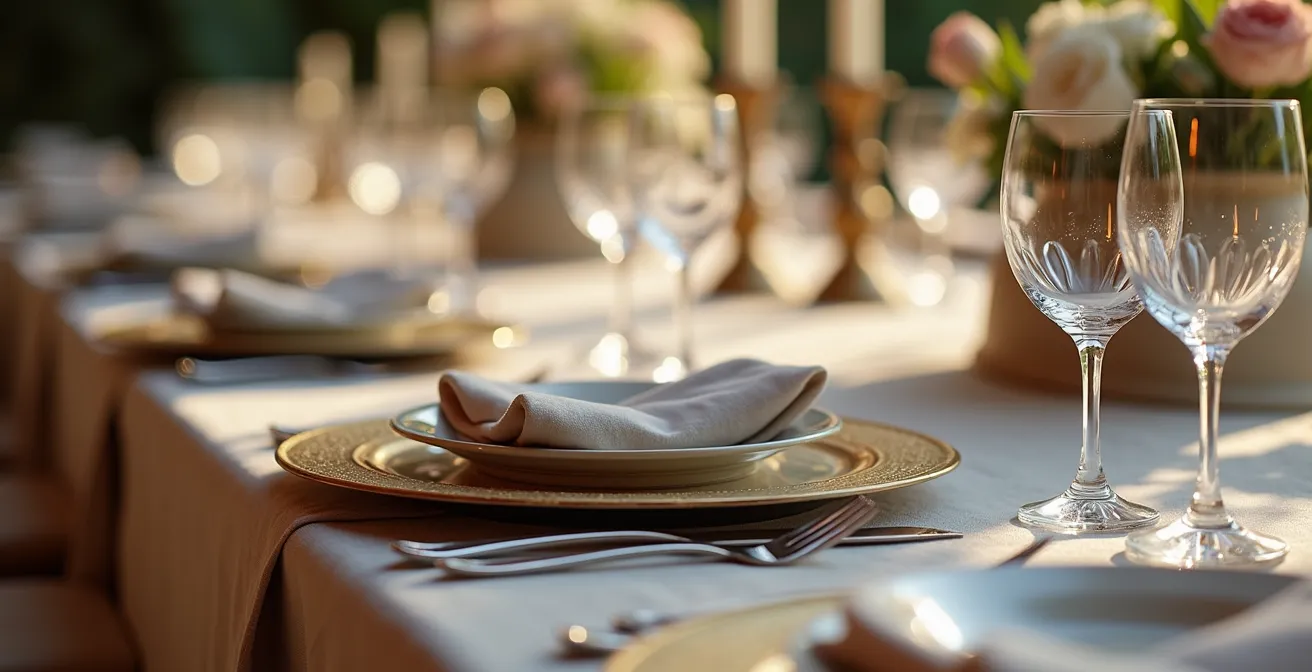
The following analysis breaks down the capacity of a standard 60-inch round table, making it clear why 8 is the optimal number for a formal dinner, while 10 should be reserved only for more casual service styles.
| Number of Guests | Space per Person | Service Style | Comfort Level |
|---|---|---|---|
| 8 guests | 23.5 inches | Formal plated | Comfortable |
| 9 guests | 20.9 inches | Formal plated | Acceptable |
| 10 guests | 18.8 inches | Buffet only | Too cramped |
24 inches per guest: why crowding the table ruins the luxury feel?
In the world of high-end experiences, from first-class air travel to fine dining, the ultimate luxury is not opulence—it is space. The 24-inch rule, which dictates the minimum personal space each guest should have at a table, is the bedrock of this principle. Violating this rule by crowding tables is the fastest way to undermine the thousands of dollars spent on creating a luxurious wedding atmosphere. You can have the most exquisite flowers and the finest cuisine, but if your guests are bumping elbows and struggling to move, the entire experience will feel cheapened.
This concept of spatial comfort is deeply psychological. Ample personal space signals care, respect, and abundance. A crowded environment, conversely, can trigger feelings of stress and confinement, making it difficult for guests to relax and enjoy themselves. As the planning team at Curated Events states with piercing clarity:
In luxury experiences, personal space is the ultimate commodity.
– Curated Events Planning Team, Crafting Flawless Wedding Seating Guide
This isn’t just about aesthetics; it’s a fundamental component of hospitality. A commitment to the 24-inch standard per guest at rectangular tables, and the equivalent generous spacing at round tables, demonstrates a host’s genuine concern for their guests’ well-being. It allows for comfortable dining, prevents people from feeling trapped in their seats, and facilitates easier conversation as guests can turn and engage with their neighbors without encroaching on their space. Given that couples invest heavily in their venue and catering, compromising on this foundational element of comfort is a critical strategic error.
Think of it as an investment. Every extra inch of space you provide per person pays dividends in guest satisfaction. It elevates the entire event from a simple gathering to a truly gracious and memorable occasion, ensuring the feeling of luxury is tangible, not just visual.
Reducing table count: why 8 guests per table feels airier than 10?
The decision to seat 8 guests at a table instead of 10 goes far beyond simple comfort; it fundamentally re-engineers the room’s atmosphere and conversational dynamics. While opting for 10-person tables might seem like an efficient way to accommodate a large guest list, it often creates a dense, loud, and visually crowded environment. Reducing the number of guests per table, even if it means adding a few more tables overall, creates a more open, airy, and elegant feel. The room breathes, and so do the conversations.
At a 10-person round table, conversation is often fractured. It’s too large for a single, inclusive discussion, so the table typically splinters into two or three separate, smaller conversations. Guests are effectively limited to talking only to the person on their immediate left or right. An 8-person table, however, hits the “sweet spot” of conversational geometry. It is small enough that a single, unified conversation can flow across the entire table, allowing all eight guests to interact and connect. This fosters a much more inclusive and engaging social dynamic.
This isn’t just theory; it’s backed by venue data. An analysis of recent trends found that while many couples aim for a guest count of 100-150, venues consistently report higher guest satisfaction ratings for events that utilize 8-person table configurations. The perceived improvement in service efficiency and, most importantly, conversational quality makes it a superior choice for hosts prioritizing the guest experience. The extra space on the table and the improved flow for servers are tangible benefits that guests notice and appreciate.
Your Action Plan: Calculating the Optimal Table Configuration
- Assess Net Space: Calculate the total usable square footage of your venue after subtracting fixed areas like the dance floor, bar, and DJ booth.
- Apply the Comfort Formula: For a comfortable layout with ample service lanes, divide your net square footage by 25. This gives you a realistic maximum guest count for a spacious feel.
- Prioritize 8-Person Tables: For any formal, multi-course dinner, default to 8-person tables as your standard to maximize conversation and service quality.
- Account for Aisle Space: When planning, remember that a layout with more 8-person tables requires slightly more aisle space overall than fewer 10-person tables. Plan for 20% more pathway room.
- Strategize VIP Seating: Always place your most important guests (immediate family, close friends) at 8-person tables near your own to ensure quality interaction.
Key Takeaways
- Your banquet layout is a tool for social engineering, not just decoration. Prioritize guest interaction and service flow.
- The 60-inch rule for spacing between tables is non-negotiable for formal plated service to allow for a “two-way traffic lane” for servers.
- For a luxury feel, aim for 24 inches of space per guest. Seating 8 people at a 60-inch round table is optimal for comfort and conversation, while 10 is too cramped for a formal dinner.
How to Design a Tablescape That Is Beautiful But Still Functional for Eating?
A breathtaking tablescape can set the entire mood for your reception, but its beauty becomes a liability if it interferes with its primary function: providing a comfortable and practical space for dining. The challenge is to strike a perfect balance between stunning aesthetics and practical functionality. A tablescape fails if guests have to move elaborate decor to see each other, or if there’s no room for bread baskets and water glasses. Functionality must be the foundation upon which beauty is built.
The first rule of functional design is to respect the “real estate” of each place setting. A guest needs adequate room for their plate, glassware, and cutlery. Any decorative element, from charger plates to menus and favors, must fit within this designated zone without creating clutter. Centerpieces are the biggest culprits in dysfunctional design. A centerpiece that is too wide eats up valuable space needed for sharing platters in a family-style meal, while a centerpiece that is too low and bushy can completely block sightlines, killing cross-table conversation. The ideal centerpiece is either very tall and slim (with the bulk of the arrangement above eye level) or very low and discreet.
Layering is key to creating a rich look without sacrificing space. Use a combination of textures and heights to add visual interest. A beautiful linen, an elegant charger plate, a folded napkin, and a simple place card can create a luxurious feel without a single flower. When adding floral elements, consider a “runner” of small, disconnected bud vases instead of a large, continuous garland. This provides the beauty of fresh flowers while leaving ample open space on the table surface. Ultimately, a successful tablescape is one that enhances the dining experience, not one that obstructs it. It should invite guests to connect and enjoy their meal in a beautiful, well-engineered setting.
By shifting your perspective from that of a decorator to a social dynamics engineer, you can design a reception layout that not only looks spectacular but functions flawlessly, fostering connection and creating an unforgettable experience for you and your guests. The next logical step is to apply these principles by creating a to-scale floor plan and running simulations for guest and server movement.
Frequently Asked Questions About Functional Wedding Tablescapes
How do you accommodate family-style service with elaborate centerpieces?
Use elevated centerpieces on tall, slender stands to lift the floral arrangements above the table surface. This keeps the decor visible and beautiful while leaving the “real estate” below completely free for large serving platters. Alternatively, create a “deconstructed” runner using a series of small, disconnected arrangements or bud vases that can be easily moved or positioned around the platters.
What functional elements must be visible on the tablescape?
Key functional items must always remain accessible and should never be buried under decorative elements. This includes menus, which guests need to consult; place cards, which are essential for seating; and any wedding favors you’ve provided. If you are using digital elements, such as a QR code for a shared photo album or online guestbook, ensure it is clearly visible and not obscured by flowers or candles.