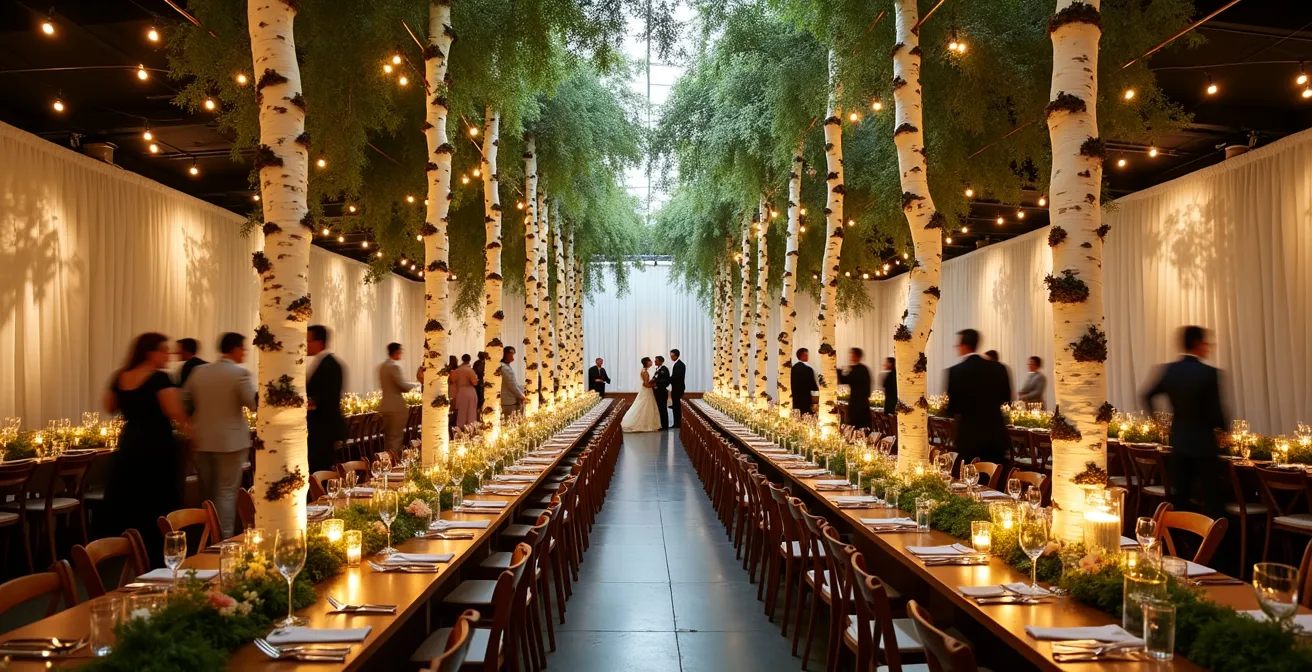
The key to a successful indoor garden wedding isn’t just adding flowers; it’s creating a complete sensory illusion that convinces guests they are truly outdoors.
- Prioritize vertical elements like tall trees and light projections to fundamentally redefine the architecture of the space.
- Engage secondary senses with subtle soundscapes and authentic, earthy scents to deepen the immersive experience.
Recommendation: Shift your budget from traditional, distributed decor (like small table centerpieces) to large-scale, transformative elements for maximum visual and atmospheric impact.
The weather forecast shifts, the season turns, or the dream outdoor venue is simply unavailable. For couples who envisioned saying “I do” under a canopy of leaves, being forced indoors can feel like a significant compromise. The typical response involves loading the space with flowers and draping fairy lights, but this often results in a room that feels decorated, not transformed. The scent of the air, the quality of the light, the very feeling of the space remains stubbornly “indoors.” This approach treats nature as an accessory, a superficial layer applied to an existing structure.
But what if the goal wasn’t to decorate, but to create a complete biophilic illusion? As a designer who specializes in blurring the lines between interior and exterior worlds, I see this challenge not as a limitation, but as an opportunity. The secret lies in systematically engaging all the senses to build a convincing psychological bubble of an outdoor environment. It’s about moving beyond static decorations and embracing architectural greenery, dynamic light, and sensory scaffolding to trick the mind into believing it’s in a garden.
This guide will deconstruct the process of creating that magic. We will explore how to use trees not as props but as architecture, how to paint with shadow to mimic dappled sunlight, and how to layer sound and scent to build an immersive world. Forget just bringing the outdoors in; we’re going to rebuild the outdoors from the inside out, creating an enchanting garden wedding that feels more intentional and magical than you ever imagined.
To guide you through this transformation, this article breaks down the essential strategies into a clear roadmap. Discover how to choose the right foundational elements, layer in sensory details, and make smart, high-impact decisions that create a cohesive and breathtaking indoor garden experience.
Summary: How to Create an Immersive Indoor Garden Wedding
- Ficus vs. Birch: which rental trees create the best forest effect indoors?
- Is renting high-end turf for an indoor reception crazy or genius?
- Subtle birdsong in the restrooms: details that enhance the garden illusion
- Gobo projection: creating “dappled leaf” shadows on the walls
- Live moss vs. Preserved: which smells better and creates less mess?
- Indoor to Outdoor: keeping the aesthetic consistent when moving guests
- Renting 10-foot trees: are they better space fillers than table flowers?
- How to Design Living Plant Sculptures That Wow Guests and Minimize Waste?
Ficus vs. Birch: Which Rental Trees Create the Best Forest Effect Indoors?
The single most transformative element in creating an indoor forest is the strategic use of real, tall trees. This is the foundation of architectural greenery—using plants not as mere objects, but as structural tools to redefine the scale and feel of a room. Forget small potted plants; we are creating a canopy. Your choice between lush Ficus and elegant Birch trees will dictate the entire atmosphere of your “forest.” Ficus trees, with their dense, dark green leaves, are perfect for creating an intimate, enclosed, secret-garden feeling. Their wide canopies help lower the perceived ceiling height and fill horizontal space, making a large ballroom feel cozier.
Birch trees, in contrast, offer a completely different aesthetic. Their striking white trunks and sparse foliage create strong vertical lines, drawing the eye upward and emphasizing high ceilings. They evoke the feeling of an open, airy woodland or a sophisticated Scandinavian forest. They are particularly effective when uplit, as the light catches their white bark and creates architectural drama. As demonstrated in a stunning indoor garden shoot by Zingerman’s Cornman Farms, the goal is total transformation, with vines stretching up walls and greenery covering surfaces to erase the boundaries of the room.
To make an informed decision, you must compare their practical and aesthetic attributes directly. This isn’t just about looks; it’s about logistics, cost, and how each tree interacts with your lighting plan.
The following comparison, based on data for professional rentals from providers like Colorado Plant Gallery, breaks down the key differences to help you choose the right arboreal architecture for your vision.
| Feature | Ficus Trees | Birch Trees |
|---|---|---|
| Average Rental Cost (6-7ft) | $110-165 per tree | $200-400 per tree |
| Visual Impact | Lush, dense canopy creates intimate garden feel | Dramatic vertical lines, minimalist elegance |
| Space Coverage | 24-36″ wide spread, fills horizontal space | Narrow profile, 12-18″ spread |
| Weight & Logistics | Heavy pots (40-60 lbs), wider doorway access needed | Lighter structure, easier vertical transport |
| Lighting Compatibility | Perfect for weaving fairy lights through dense foliage | Ideal for uplighting white trunks for architectural drama |
| Best For | Creating cozy, enclosed forest atmosphere | Open, airy spaces with high ceilings |
Before committing, it’s vital to assess your venue’s constraints. A practical approach involves careful measurement and calculation to ensure your forest vision can be realized safely and effectively. Consider the following steps:
- Measure your venue’s ceiling height and subtract 2 feet for clearance to determine your maximum tree height.
- Check all access points, including doorways and elevators, for a minimum width of 36 inches to accommodate pot transport.
- Calculate your coverage needs: plan for one tree per 100 sq ft for a dense forest effect, or one tree per 150 sq ft for more subtle accent placement.
- Verify the venue’s floor load capacity, as each potted tree can weigh 40-80 lbs, concentrating significant weight in a small area.
- Budget approximately $300-500 per tree, which should include professional delivery, setup, and removal services.
Is Renting High-End Turf for an Indoor Reception Crazy or Genius?
Once you’ve established the vertical forest canopy, the next step in building the biophilic illusion is grounding it. What is underfoot is just as important as what is overhead. A standard hotel carpet or polished wood floor instantly shatters the illusion of being outdoors. The solution? High-end artificial turf. This isn’t the cheap, scratchy plastic of a miniature golf course; modern event turf is incredibly realistic, soft, and dense, perfectly mimicking the feel of a manicured lawn. By replacing the venue’s floor, you’re not just decorating—you’re fundamentally changing the environment.
The idea may seem extravagant, but consider its impact. It provides an unbroken sea of green that visually connects all your botanical elements. It offers a delightful tactile surprise for guests, especially those who kick off their heels to dance. It can also be used to create distinct “zones” within a large room, such as a lush ceremony “meadow” and a separate cocktail area. When you consider that the average vendor budget is $2,800 for decorations, allocating a portion of this to a high-impact element like flooring can provide a far greater return on investment than dozens of smaller, scattered items.
The genius of turf lies in its ability to create a full-sensory foundation for your garden theme, making the entire experience more cohesive and believable.

As you can see, the effect is seamless and transformative. The key is quality. Premium turf has a varied blade height and color, a dense thatch layer, and proper backing that allows it to lie flat without ripples. It immediately signals luxury and attention to detail, reassuring guests that this is a deliberate design choice, not a novelty. The decision to invest in turf is a commitment to a complete illusion, proving that you’re serious about creating an authentic outdoor experience indoors. It’s a bold move, and in the world of event design, bold moves are what create unforgettable memories.
Subtle Birdsong in the Restrooms: Details That Enhance the Garden Illusion
With the primary visual and tactile elements in place—the trees and the turf—it’s time to build the next layer of your biophilic illusion: the sensory scaffolding. This is where we move beyond what guests see and begin to influence what they hear, smell, and feel on a subconscious level. These subtle details are often the most powerful because they aren’t consciously processed as “decor.” Instead, they work together to create an authentic atmosphere that simply feels right. The goal is to create a multi-sensory environment where every element reinforces the garden theme.
Sound is a powerful but often overlooked tool. While music will fill the main reception area, consider the quieter spaces. Placing a small, high-quality speaker in the restrooms or a hallway playing a continuous loop of subtle, ambient birdsong or the gentle sound of a breeze through leaves can be a stunningly effective detail. As guests step away from the music and chatter, they are enveloped in a soundscape that reinforces the outdoor illusion. Similarly, your choice of scent creates a powerful olfactory signature. Instead of generic floral air fresheners, consider using diffusers with more complex, natural scents like damp earth, cut grass, or petrichor (the smell of rain on dry soil). These authentic aromas trigger deep-seated memories and emotions connected to nature.
Case Study: The Multi-Sensory Garden at The Nest at Ruth Farms
To create a truly immersive experience, designers layered blossom branches to form a canopy over tables set with glowing candles and votives. This visual warmth was complemented by light, airy textiles that softened the raw wood tables. The sensory journey was completed with signature cocktails adorned with real flowers and bottles of wine chilled over ice infused with botanical elements. This approach shows how layering light, texture, and even taste can make a secret garden theme feel all-encompassing and real.
Even the most common decor elements can be elevated with a sensory focus. As the team at Lily & Lime Wedding Design points out, string lights are a staple for a reason, but their placement is key to enhancing the illusion.
There is something irresistible about string lights glimmering amidst greenery and works in almost all garden wedding situations
– Lily & Lime Wedding Design, DIY Garden Wedding Decor Ideas
Instead of just stringing them across the ceiling, weave them *through* the branches of your rental trees. This mimics the way natural light filters through a canopy and makes the light feel like an organic part of the environment, rather than an artificial addition. Each detail, from sound to scent to light, adds another thread to the tapestry of your indoor garden.
Gobo Projection: Creating “Dappled Leaf” Shadows on the Walls
Natural light is rarely static or uniform. The most magical quality of light in a real garden is its dynamic nature—the way it filters through leaves to create a constantly shifting pattern of light and shadow on the ground and walls. This is “dappled light,” and recreating it indoors is a masterstroke of biophilic design. The most effective way to achieve this is with gobo projection. A gobo (“goes before optics”) is essentially a stencil placed inside a spotlight to project a specific pattern. By using gobos with organic leaf and branch patterns, you can “paint” the walls and dance floor with a beautiful, moving forest canopy effect.
This technique of creating dynamic light and shadow is far more sophisticated than using simple colored uplighting. It adds depth, texture, and movement to the space, making flat, boring ballroom walls disappear behind an ethereal layer of foliage. You can use multiple projectors with slightly different patterns and even add slow-rotating motors to create a subtle, breeze-like motion in the shadows. This transforms the venue from a static room into a living, breathing environment. The effect is particularly stunning on a dance floor, where guests can feel like they are dancing in a moonlit forest clearing.
While professional lighting companies provide this service, a dedicated DIY approach can also yield impressive results for a fraction of the cost, making it an accessible touch of magic.
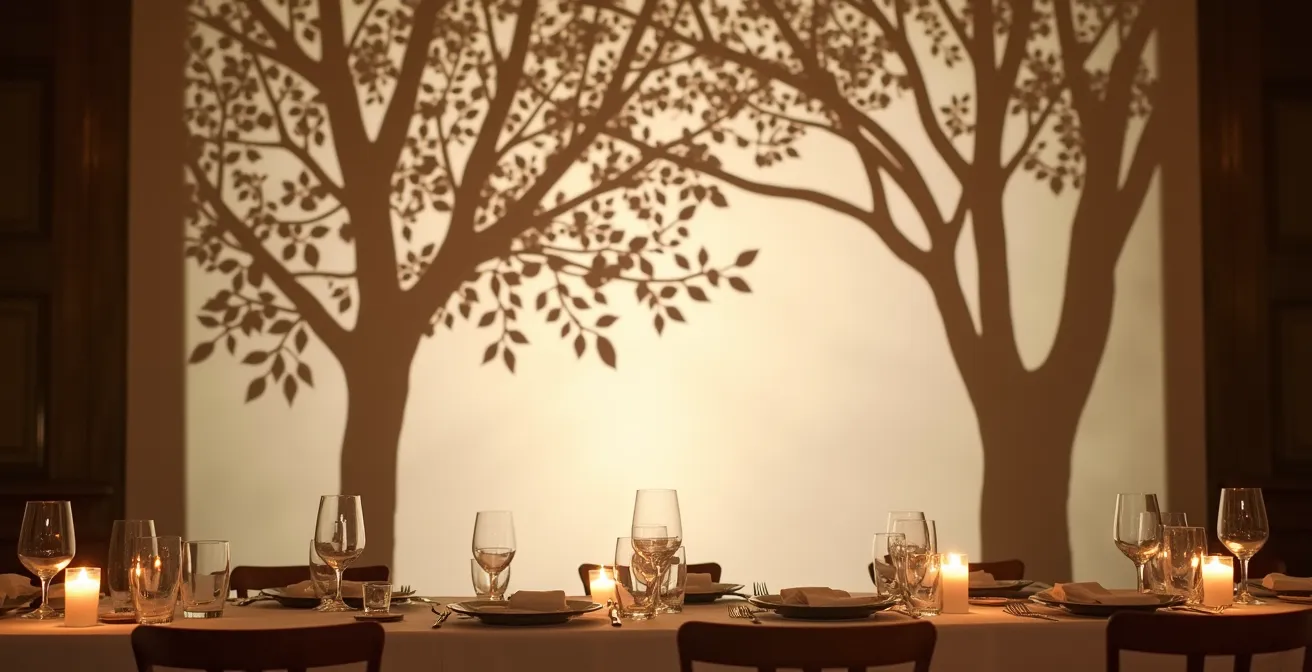
As the image demonstrates, the effect is sophisticated and immersive. The projected shadows interact with the physical space to create an illusion of depth that simply can’t be achieved with physical decorations alone. You can even set up a simple version yourself with a few key pieces of equipment:
- Purchase or rent a 500W+ halogen spotlight or a powerful LED stage light ($50-100 for a rental).
- Create your own custom gobo stencils using black cardstock or thin, heat-resistant metal sheets, cutting out organic leaf patterns.
- Position the lights 10-15 feet from the walls, aiming at a 45-degree angle to get the best shadow definition and avoid harsh glare.
- Layer two or three different leaf patterns from multiple angles to create a more natural and complex sense of depth.
- For a dynamic effect, consider adding a slow-rotating motor attachment (around $30) or simply have someone manually adjust the light’s position slightly every hour.
Live Moss vs. Preserved: Which Smells Better and Creates Less Mess?
Once the large-scale elements of trees and light are in place, the focus shifts to texture and detail. Moss is an exceptional material for bringing an authentic, earthy feel to an indoor garden. It can be used to create stunning table runners, cover the base of rental trees, or be incorporated into sculptural centerpieces. The choice between using live moss and preserved moss, however, has significant implications for scent, maintenance, and mess—all crucial factors in a controlled indoor environment.
Live moss offers an unparalleled olfactory signature. Its fresh, damp, forest-floor aroma is impossible to fake and instantly transports you outdoors. It’s also soft, springy, and cool to the touch, adding a rich tactile dimension. However, it comes with challenges. Live moss requires misting to stay vibrant, which can introduce unwanted moisture that might stain delicate table linens or wooden surfaces. When it begins to dry out, it can also become brittle and shed soil or small particles, creating a cleanup headache.
Preserved moss, on the other hand, is the pragmatic choice. It has been treated with glycerin and dyes to maintain its color and texture indefinitely without any need for water. This makes it completely mess-free and worry-free. While it lacks the fresh scent of live moss (sometimes having a slight chemical or musty smell initially that dissipates), its visual appeal is excellent and it is far more durable for a long event day. The decision ultimately comes down to a trade-off: are you willing to manage the risks of live moss for its superior sensory authenticity, or do you prefer the reliable, mess-free convenience of preserved moss?
This side-by-side comparison, drawing on general knowledge from floral suppliers and resources like guides to garden wedding ideas, clarifies the pros and cons of each option.
| Aspect | Live Moss | Preserved Moss |
|---|---|---|
| Scent Profile | Fresh, earthy, forest-floor aroma | Neutral to slightly musty initially |
| Moisture Level | Requires misting, potential for staining | Completely dry, no moisture issues |
| Lifespan | 3-5 days without proper care | 2+ years with minimal maintenance |
| Touch Experience | Soft, springy, naturally cool | Slightly stiffer but still tactile |
| Cleanup Factor | Sheds when dry, may leave residue | Minimal shedding, easy removal |
| Cost per sq ft | $8-12 | $15-25 |
| Eco-Impact | Sustainable if locally sourced | Chemical preservation process required |
Indoor to Outdoor: Keeping the Aesthetic Consistent When Moving Guests
For venues that have both an indoor space and an adjacent outdoor area (like a patio or terrace), maintaining the biophilic illusion during guest transitions is paramount. Nothing breaks the magic faster than walking from a lush indoor forest into a sterile, undecorated outdoor space. The key is to create a seamless sensory bridge that makes the two areas feel like a single, cohesive environment. This requires extending your design philosophy beyond the four walls of the reception hall.
The transition should feel natural and intentional, guiding guests without jarring them out of the carefully crafted atmosphere. This is especially important when managing the flow of what can be a large group; with the average number of guests at a wedding in the United States between 126 and 136 people, a smooth and visually continuous path is essential. The goal is to blur the line where “inside” ends and “outside” begins. This can be achieved by repeating key design elements across the threshold.
Creating this seamless flow involves a few strategic steps that address lighting, flooring, and even scent to ensure the garden aesthetic remains unbroken. Follow this practical checklist for a flawless indoor-outdoor transition:
- Lighting Continuity: Install identical string lights, preferably with large, warm-toned bulbs, both in the area leading to the exit and throughout the outdoor space. This creates a continuous ceiling of light.
- Botanical Pathway: Place matching potted plants or small trees at regular 10-foot intervals along the entire transition path, both inside and out, to create a visual “runway” of greenery.
- Flooring Bridge: Use the same flooring element, such as a continuous runner, a series of matching rugs, or even strips of artificial turf, to create an uninterrupted visual path from the indoor floor to the outdoor ground.
- Golden Hour Sync: If the transition happens around sunset, time it to coincide with the golden hour. Pre-adjust the indoor lighting to warmer, softer tones about 30 minutes before moving guests to match the natural outdoor light.
- Olfactory Continuity: Position signature scent diffusers (using a consistent scent like lavender or eucalyptus) at the exit of the indoor space and the entrance of the outdoor space. This creates an invisible “scent bridge” that guests walk through.
Renting 10-Foot Trees: Are They Better Space Fillers Than Table Flowers?
A common pitfall in wedding decor is focusing budget and attention on small, distributed elements, most notably floral centerpieces on every table. While beautiful, this approach can feel fragmented and often fails to make a significant impact on the overall atmosphere of a large room. When the goal is a complete transformation into a garden, you must think in terms of scale. This is where renting tall, 10-foot trees becomes a strategically superior choice. They are not just better space fillers; they are space definers.
A single 10-foot tree has more visual impact than a dozen small floral arrangements. Its verticality draws the eye up, adds architectural drama, and fundamentally alters the perception of the space. Instead of having 20 small points of interest, you create a handful of powerful, statement-making focal points. This approach is often more cost-effective than it appears. Ten tall trees can create a breathtaking canopy effect that no amount of table flowers can replicate, often for a comparable budget. This strategy was used to great effect at venues like The Breakers Palm Beach, where bringing in large trees or creating tree-like structures from branches became the primary decor, making a far greater statement than traditional centerpieces.
The real value of tall trees lies in their ability to solve multiple design problems at once. They fill empty vertical space in venues with high ceilings, help obscure less-desirable architectural features, and create a natural framework for lighting elements. They provide a much higher return on atmospheric investment, shifting the focus from decorating tables to building a world. Rather than dotting a room with flowers, you are enveloping your guests in a forest.
Key Takeaways
- Think like a set designer, not a decorator. The goal is a complete, immersive illusion, not just pretty accessories.
- Prioritize verticality and scale. A few large, transformative elements like tall trees and light projections have more impact than many small ones.
- Engage all senses. A successful illusion depends on layering subtle sound, authentic scent, and tactile surfaces to support what the eyes see.
How to Design Living Plant Sculptures That Wow Guests and Minimize Waste?
The final, and perhaps most artful, layer of an indoor garden wedding is the creation of living plant sculptures. These are more than just centerpieces; they are dynamic, three-dimensional installations that serve as focal points and conversation starters. The beauty of this approach lies in its duality: it allows for breathtaking creativity while also embracing sustainability. By designing sculptures that are modular and use living, potted plants, you can create a stunning visual impact that also minimizes waste, a core principle of biophilic design.
Instead of using cut flowers that will be discarded after the event, these sculptures are built from individual, hardy plants like succulents, air plants, or pothos. These plants can be arranged on frames made from natural, reusable materials like bamboo or copper pipes. This modular approach allows for incredible versatility in design—from cascading green walls to abstract botanical towers. The concept aligns perfectly with a forward-thinking, eco-conscious ethos. As seen in a charming DIY backyard wedding, the spirit of giving back can be as simple as offering guests single gladiolus bulbs as favors, a small piece of the garden to take home.
The most compelling aspect of this strategy is what happens after the wedding. Because the sculptures are made of individual potted plants, they can be easily disassembled. The plants can then be given to guests as living wedding favors, a far more meaningful and lasting memento than a non-perishable trinket. Alternatively, the entire collection of plants can be donated to a local school, hospital, or community garden, allowing the beauty and life of your wedding day to continue growing and giving back to the community. This turns your decor from a temporary expense into a lasting, positive investment.
Action Plan: Building Your Modular Living Sculptures
- Create Base Frames: Build your sculpture skeletons using renewable bamboo poles (costing $3-5 each) connected with either zip ties for stability or natural twine for a more organic look.
- Select Hardy Plants: Choose robust plants that can thrive for 8+ hours without direct water, such as succulents, air plants (Tillandsia), pothos vines, or even preserved ferns for a no-maintenance option.
- Use Individual Pots: Plan your design around standard 4-inch pots, which are easy to handle and ideal for guest favors. Budget around $3-5 per potted plant.
- Design for Disassembly: Create modular sections that can be easily taken apart. This simplifies transport and makes it straightforward to distribute the plants as favors or prepare them for donation.
- Include Care Instructions: Attach a small, beautifully designed care instruction card to each plant that is given as a favor or donated, ensuring its long-term survival.
By thoughtfully integrating these living, breathing elements into your design, you not only create an unforgettable aesthetic but also leave a positive, green legacy long after your special day concludes.
Frequently Asked Questions on How to Bring the Outdoors In for a Garden-Like Wedding Inside?
How many 10-foot trees do I need for a 5,000 sq ft ballroom?
For architectural impact, plan 8-10 trees positioned at corners, entrances, and framing key areas like the dance floor or head table.
Will tall trees block guest sightlines?
Position trees along perimeter walls and between (not in front of) guest tables. Use narrow varieties like birch for minimal obstruction.
What’s the ROI compared to traditional centerpieces?
Ten 10-foot trees at $400 each ($4,000) can replace 20 table centerpieces at $200 each (same cost) while creating more dramatic vertical impact.